Summary: Real-time API protection solutions analyze live API traffic to detect and block attacks as they happen. Radware is best for teams wanting runtime protection and posture management in one service, Akamai fits multi-source discovery and testing, Cloudflare fits edge enforcement, and Salt Security is best for behavioral detection.
What are Real-Time API Protection Solutions?
Real-time API protection solutions monitor API requests and responses as they occur. They analyze traffic for signs of attacks, abuse, authentication problems, data exposure, and behavior that differs from normal usage. Unlike periodic security scans, these tools can identify threats while an API is actively processing traffic.
These solutions typically combine API discovery, traffic analysis, policy enforcement, and threat detection. They may block malicious requests, apply rate limits, detect stolen credentials or tokens, and alert security teams to suspicious activity. Some also build behavioral baselines to identify attacks that valid-looking requests can hide, such as business logic abuse.
Protection can be deployed through API gateways, reverse proxies, service meshes, agents, or integrations with existing infrastructure. The goal is to enforce security controls close to the API without requiring developers to manually identify every possible attack pattern. This helps organizations protect public, internal, and partner APIs as their API environments change.
This is part of a series of articles about AI security.
In this article:
The table below summarizes the key differences between the solutions covered in this guide, including where each one fits best and what to watch for. Each solution is explored in more detail in the sections that follow.
| Category |
Solution |
Best For |
Key Strengths |
Things to Consider |
| End-to-End API Security Platforms |
Radware API Security Service |
Runtime protection driven by live production traffic |
Business logic defense, OWASP API Top 10, HTTPS DDoS |
Reporting and dashboard customization are limited |
| End-to-End API Security Platforms |
Akamai API Security |
Multi-source discovery, posture and runtime monitoring |
Behavioral detection, 200+ CI/CD tests, compliance mapping |
Policy tuning and report customization take effort |
| End-to-End API Security Platforms |
Salt Security Agentic Security Platform |
Behavioral detection of logic-based API and agent abuse |
Traffic baselining, identity correlation, real-time blocking |
Reporting depth and some integrations still maturing |
| End-to-End API Security Platforms |
Cequence API Security |
API posture, compliance reporting and inline enforcement |
250+ risk rules, native bot mitigation, inline or gateway mode |
Large API estates need extended tuning |
| End-to-End API Security Platforms |
Wallarm Advanced API Security |
Inline blocking across cloud-native and hybrid setups |
Broad protocol support, flexible deployment, spec enforcement |
Initial configuration and tuning take time |
| API Protection Built Into WAAP and Edge Platforms |
F5 Distributed Cloud API Security |
API security tied to an existing F5 footprint |
Multi-source discovery, L7 enforcement, data leak controls |
Console navigation and legacy integration can be complex |
| API Protection Built Into WAAP and Edge Platforms |
Imperva API Security |
BOLA and business logic detection alongside a WAF |
Real-time BOLA response, data classification, bot integration |
Higher cost, limited custom policy options |
| API Protection Built Into WAAP and Edge Platforms |
Cloudflare API Shield |
Edge-based discovery and schema enforcement |
Positive security model, response scanning, global enforcement |
Key capabilities limited to Enterprise plans |
Related content: Read our article about API security solutions.
APIs Expose Business Logic and Sensitive Data
APIs connect clients directly to functions such as authentication, payments, account management, and data retrieval. A request can be technically valid while still abusing the intended workflow. For example, an attacker might manipulate object identifiers to access another user's records or automate a transaction in an unintended sequence.
Real-time protection can evaluate the user, endpoint, request parameters, and previous activity together. This context helps identify authorization abuse, excessive data access, and other attacks that basic input validation may not detect.
API Traffic Is Difficult to Distinguish From Malicious Activity
Many API attacks use valid endpoints, supported HTTP methods, and correctly formatted requests. Attackers may also authenticate with compromised credentials or valid API keys. As a result, malicious traffic can closely resemble normal application activity.
Real-time monitoring can establish normal patterns for users, tokens, endpoints, and clients. It can then detect anomalies such as unusual request sequences, access to unexpected resources, or sudden changes in request frequency.
Automated Attacks Can Scale Rapidly
Attackers can use scripts and bots to send large numbers of API requests in a short period. Automation supports credential stuffing, account enumeration, scraping, inventory abuse, and attempts to exploit authorization weaknesses across many objects.
Real-time controls can respond as attack patterns emerge. Rate limiting, behavioral detection, token restrictions, and automated blocking can reduce the number of malicious requests that reach application services.
API Environments Change Continuously
API environments evolve as teams release new endpoints, modify schemas, deploy new versions, and connect additional services. Undocumented or deprecated APIs may remain accessible even when security teams are unaware of them. Static inventories can therefore become outdated quickly.
Continuous discovery and traffic monitoring help maintain an up-to-date view of active APIs. Protection systems can identify new or changed endpoints, observe how they are used, and apply security policies as the API surface changes.
Continuous API Discovery
API discovery identifies endpoints by observing traffic, gateway logs, application telemetry, and other runtime data. This helps security teams find documented, undocumented, deprecated, and shadow APIs without relying only on manually maintained inventories.
Continuous discovery is important because API environments change frequently. A useful solution should detect new endpoints and versions, classify them, and update the inventory as services are deployed or removed. It should also identify information such as HTTP methods, parameters, authentication mechanisms, and data types associated with each endpoint.
Discovery can also reveal APIs that bypass standard gateways or security controls. Comparing discovered APIs with approved inventories helps teams identify unmanaged services and determine where additional controls are required.
API Endpoint and Attack Surface Monitoring
Attack surface monitoring tracks which API endpoints are exposed and what data or operations they make accessible. It can highlight endpoints with sensitive data, weak controls, unexpected external exposure, or obsolete versions.
Monitoring should also detect changes in schemas, parameters, authentication requirements, and usage. This gives teams context for prioritizing endpoints that create greater security risk. For example, an externally accessible endpoint that returns personal information generally requires closer monitoring than an internal endpoint serving non-sensitive metadata.
Effective monitoring also tracks dependencies and exposure over time. This makes it easier to detect endpoints that remain reachable after migration, testing, or deprecation and may otherwise become forgotten attack paths.
OWASP API Top 10 Protection
API protection solutions should address common API security risks described by the OWASP API Security Top 10. Examples include broken object-level authorization, broken authentication, unrestricted resource consumption, server-side request forgery, and improper inventory management.
Coverage should extend beyond signature-based detection. Several OWASP API risks depend on authorization state, request sequences, and business context, which require analysis of how an API is actually being used.
Organizations should examine how a solution detects and mitigates each relevant risk rather than relying on a general claim of OWASP coverage. Some weaknesses require runtime controls, while others are better identified through testing, configuration analysis, or improvements to application code.
Behavioral and Machine Learning-Based Detection
Behavioral detection models normal activity for APIs, users, tokens, IP addresses, and other entities. It can identify deviations such as unusual endpoint access, unexpected request sequences, abnormal data retrieval, or sudden changes in traffic volume.
Machine learning can help detect patterns that fixed rules do not describe well. For example, a request rate might be normal by itself but suspicious when combined with access to many unrelated customer records.
Teams should still be able to understand why activity was flagged and tune detection thresholds to control false positives. Models also need to adapt to legitimate changes in traffic, such as new application releases or seasonal usage increases, without treating every change as an attack.
Business Logic Abuse Detection
Business logic attacks use valid API functionality in ways the application did not intend. Examples include repeatedly claiming a promotion, manipulating transaction sequences, scraping valuable data, or automating operations intended for individual users.
Detection requires context across multiple requests rather than inspection of a single payload. A protection solution should correlate sessions, identities, resources, and request sequences to identify abusive workflows.
This capability is especially important when individual requests pass authentication and input validation checks. Detecting abuse may require identifying limits that exist in the business process, such as how often an action should occur or which sequence of operations is considered valid.
Bot Management
Bot management distinguishes legitimate automation from malicious or unwanted automated traffic. APIs can be targeted by bots performing credential stuffing, account creation, scraping, enumeration, inventory hoarding, or transaction abuse.
Controls can use request patterns, client characteristics, reputation data, and behavioral signals to classify automation. Responses may include blocking, rate restrictions, additional authentication, or other controls appropriate for API clients.
API-focused bot management should account for legitimate machine-to-machine traffic. Unlike browser applications, many API clients cannot complete JavaScript or interactive challenges, so enforcement needs to avoid disrupting approved integrations and automated services.
Rate Limiting and Adaptive Throttling
Rate limiting restricts how frequently a client, identity, token, endpoint, or other entity can access an API. It can reduce brute-force attempts, scraping, resource exhaustion, and accidental overload.
Adaptive throttling changes limits based on context instead of applying one fixed threshold. For example, a system can restrict an identity more aggressively when its request rate and behavior indicate abuse while allowing expected high-volume clients to continue operating.
Granular controls are useful because different endpoints have different usage patterns and costs. Limits may need to consider account, token, IP address, operation, or resource rather than total request volume alone. Responses should also use appropriate API status codes and retry behavior where possible.
Authentication and Authorization Monitoring
Authentication monitoring detects suspicious activity involving credentials, API keys, sessions, and access tokens. Relevant signals include repeated authentication failures, unusual token usage, expired credentials, and credentials being used from unexpected clients or locations.
Authorization monitoring checks whether authenticated identities are accessing resources and operations appropriately. This is particularly important for detecting object-level and function-level authorization attacks that use otherwise valid requests.
A solution can also correlate identities with API activity over time. For example, the same token accessing an unusually large number of customer objects or suddenly calling administrative endpoints can indicate compromised credentials or attempts to bypass access controls.
API Security Testing
Runtime protection should be complemented by API security testing. Testing can identify vulnerabilities in schemas, authentication controls, authorization rules, input handling, and API behavior before attackers encounter them in production.
Useful solutions can integrate testing into development and deployment workflows. Findings from production traffic can also help focus tests on active endpoints, realistic request structures, and security issues observed at runtime.
Testing should include authenticated workflows and different user roles where possible. Many API vulnerabilities only become visible when tests compare what one identity can access with what another identity should be allowed to access. Automated testing can then be repeated as APIs change.
Real-Time Alerts and Incident Investigation
Alerts should provide enough context for security teams to determine what happened without reconstructing an incident from raw logs. Relevant details include the affected endpoint, identity, token, source, request sequence, detection reason, and response taken.
Investigation capabilities should correlate related activity across requests and APIs. A timeline can help analysts determine whether an event was isolated or part of a broader sequence involving reconnaissance, authentication attempts, data access, and other actions.
Integrations with security information and event management, security orchestration, automation and response, and ticketing systems can help teams incorporate API incidents into existing response workflows. Alert grouping and prioritization are also important for preventing high-volume API activity from creating excessive numbers of separate alerts.
How we selected these solutions: We shortlisted real-time API protection solutions based on continuous API discovery, runtime traffic analysis, OWASP API Top 10 coverage, business logic abuse detection, bot and rate-limiting controls, and inline enforcement capabilities.
1. Radware API Security Service
Best for: Runtime API protection driven by live production traffic
Strengths: Business logic defense, OWASP API Top 10, HTTPS DDoS
Things to consider: Reporting and dashboard customization options are limited
Radware API Security Service covers the API lifecycle using runtime traffic rather than static inventories. It continuously discovers APIs across environments, including third-party, outdated, shadow and deprecated endpoints, and presents the full API catalog alongside usage trends and anomalies.
Runtime posture management surfaces risks that are only visible in live production traffic, so teams prioritize issues based on observed behavior. Discovery, analytics, posture management, testing and protection are managed from one portal, and AI-based automation generates and adapts security rules from production traffic.
Key features include:
- Runtime API protection: Covers embedded attacks, business logic attacks, API-focused bot attacks and HTTP DDoS attacks against API endpoints, applying enforcement while traffic is in flight.
- Business logic attack mitigation: Automatically maps API workflows, then generates and enforces rules against those workflows to detect and block sequences that abuse intended application logic.
- Continuous API discovery: Identifies APIs across environments and builds visibility into inventories, schemas, usage and workflows, including shadow, deprecated and third-party APIs.
- Runtime posture management: Analyzes live production traffic to identify active risk, prioritize remediation and reduce the volume of theoretical findings teams need to triage.
- Contextual API testing: Adapts test cases to application business logic, covers the OWASP API Top 10 risks and integrates into CI/CD pipelines so issues are found before release.
- HTTPS DDoS protection: Generates behavior-based signatures in real time to mitigate encrypted HTTPS floods aimed at API endpoints without blocking legitimate requests.
- Single-portal management: Combines discovery, management, risk assessment and runtime protection in one console shared by Dev, Sec and DevSecOps teams, with 24/7 managed services available.
Limitations (as reported by users on PeerSpot):
- Reporting and dashboard customization: Preset dashboards dominate the main view, and teams preparing management presentations often export data to build their own visualizations.
- API configuration documentation: Reviewers note the API protection documentation could be more detailed to help first-time users complete initial configuration.
- Training language coverage: Most webinars and training materials are offered in English, which adds friction for non-English-speaking teams.
2. Akamai API Security

Best for: Multi-source API discovery, posture and runtime monitoring
Strengths: Behavioral detection, 200+ CI/CD tests, compliance mapping
Things to consider: Policy tuning and reporting customization take effort
Akamai API Security is a vendor-neutral solution that does not require other Akamai products and works across multicloud, hybrid and on-premises environments. It builds an API inventory from runtime traffic, code repositories, API specifications, gateways, cloud environments and external exposure points.
Runtime behavior analysis identifies abuse, business logic risk, sensitive data exposure and attacks, while posture management measures APIs against internal policies and compliance frameworks. Findings route into existing SIEM, ITSM, ticketing, CMDB, WAAP, gateway and developer workflows.
Key features include:
- Multi-source API discovery: Continuously discovers APIs across traffic, code, specs, gateways, cloud and external exposure points, including shadow, zombie, unmanaged, MCP and AI-linked endpoints.
- Runtime behavior analysis: Detects abnormal activity, misuse, business logic abuse, sensitive data exposure, data scraping, tampering and resource exhaustion in APIs that use valid endpoints and credentials.
- Active API testing: Runs more than 200 dynamic tests in CI/CD and preproduction workflows that simulate malicious traffic, including tests aligned to the OWASP API Security Top 10.
- Posture and compliance mapping: Maps findings to OWASP API, PCI DSS, HIPAA, ISO 27001, GDPR, HITRUST and NIST, and tracks posture gaps and remediation progress over time.
- Remediation context: Links API findings to owners, repositories, file paths and last committers where available, so issues reach the team that can fix them.
- North-south and east-west coverage: Analyzes API traffic from supported north-south and east-west sources across cloud, hybrid and internal environments, with a native connector for Akamai Cloud traffic.
- Managed service option: Extends the SOC with Akamai API security specialists for continuous monitoring, investigation and response support.
Limitations (as reported by users on PeerSpot):
- Policy tuning effort: Reviewers describe fine-tuning policies for specific API behavior as time-consuming and ask for more granular customization and guided recommendations.
- Detection transparency: Some users want clearer visibility into why particular traffic is flagged as anomalous, which would speed up troubleshooting.
- Reporting customization: Dashboard and exportable report customization is described as limited, particularly for governance and customer-facing reporting.
- Integration automation: Reviewers ask for stronger SIEM and SOAR integrations to automate incident response workflows.
- Learning curve and cost: Training staff takes time, and licensing is described as premium, with bundles capping API counts and extra charges beyond the limit.
3. Salt Security Agentic Security Platform

Best for: Behavioral detection of logic-based API and agent abuse
Strengths: Traffic baselining, identity correlation, real-time blocking
Things to consider: Reporting depth and some integrations are still maturing
Salt Security organizes its platform around discovery, live traffic analysis and enforcement across APIs and the AI agents that call them. Salt Surface maps external exposure, Salt Connect provides visibility into APIs running in cloud environments, and Salt Collect analyzes live traffic data.
Detection works from behavioral baselines rather than static signatures. The platform correlates traffic back to a unique identity and performs intent analysis to catch mass data pulls, unauthorized tool usage and logic-based abuse, with Salt Protect applying automated real-time blocking.
Key features include:
- Live traffic analysis: Salt Collect analyzes production traffic data to establish behavioral baselines, which detection then measures deviations against.
- Identity-aware intent analysis: Correlates all traffic back to a unique identity to detect mass data pulls, unauthorized tool usage and logic-based abuse that packet inspection does not surface.
- Real-time blocking: Salt Protect interrupts machine-speed attacks with automated blocking rather than alerting only, and distinguishes legitimate automation from malicious traffic.
- External exposure mapping: Salt Surface maps the externally reachable attack surface, while Salt Connect provides visibility into APIs running inside cloud environments.
- Posture management and governance: Discovers the lifecycle from code to runtime, maps relationships between models, MCP servers and the APIs they invoke, and keeps interactions auditable against frameworks including the EU AI Act, NIST and SOC 2.
- Model layer inspection: Inspects how models are used in production, flagging jailbreak attempts, unsanctioned model access and sensitive data moving into and out of LLM calls.
- Workflow integrations: Enriches alerts in SIEM tools, opens Jira tickets and pushes blocking decisions to an existing firewall.
Limitations (as reported by users on G2):
- Reporting depth: Reviewers ask for more detailed reports and richer statistical extracts, with one noting a reporting module was still on the roadmap at the time of review.
- SIEM logging gaps: Users report missing native action logging in SIEM integrations and difficulty getting APIs behind a gateway to report as distinct items.
- Root cause detail: Some reviewers want stronger root cause analysis when issues are identified.
- Interface consistency: Tagging is described as inconsistent across dashboards, and one user asked for call chains to be stitched together graphically.
- Feature maturity: Reviewers describe the product as covering the necessary capabilities while still building out secondary features.
4. Cequence API Security

Best for: API posture, compliance reporting and inline enforcement
Strengths: 250+ risk rules, native bot mitigation, inline or gateway mode
Things to consider: Onboarding large API estates requires extended tuning
Cequence API Security discovers, monitors and tests APIs while assessing risks that lead to compliance issues, data loss and business disruption. Discovery combines inside-out and outside-in methods, covering internal, external and third-party APIs as well as edge, infrastructure, gateway and hosting providers.
Deployment integrates with existing API gateways or runs inline in the traffic path. Attack protection combines ML-powered threat detection and analytics with third-party WAF and gateway integrations, plus native mitigation through Cequence Bot Management.
Key features include:
- API attack protection: Protects web, mobile and API applications using ML-powered detection and analytics, with native mitigation including blocking, logging, rate limiting, header injection and deception.
- Continuous risk visibility: Builds a runtime API catalog of documented, undocumented, third-party and shadow APIs, assessing each for access control issues, sensitive data leakage and specification compliance.
- Compliance-ready risk rules: Ships more than 250 pre-built rules mapped to 25 frameworks, including every version of the OWASP API Security Top 10, PCI DSS, GDPR, HIPAA, SOC 2, ISO 27001 and NIST CSF.
- Sensitive data exposure prevention: Identifies and masks sensitive data using ML-based rules with predefined and customizable patterns supported worldwide, without needing APIs to be declared in advance.
- Integrated API security testing: Generates test plans automatically from Postman collections or API specifications and runs them in pre-production and at runtime across CI/CD pipelines and IDEs.
- Flexible deployment: Integrates directly with existing infrastructure such as API gateways, or deploys inline in the API traffic path.
- AI assistant and MCP server: Answers questions such as which public APIs handle sensitive data with ranked, evidence-backed findings, and exposes capabilities as MCP tools with human approval required for write actions.
Limitations (as reported by users on G2):
- Onboarding timelines: Reviewers report that initial setup and tuning can take considerable time when onboarding large or complex environments with many APIs.
- Alert tuning: Alert noise sometimes requires additional tuning to reduce false positives.
- Configuration learning curve: Understanding analytics and policy configuration is described as requiring deeper platform familiarity, with requests for improved documentation and simpler workflows.
- Networking prerequisites: Initial implementation calls for a solid grasp of DNS and routing when directing traffic through a CDN.
- Dashboard customization: Getting real-time reporting dashboards configured as wanted takes extra effort, and some users asked for more video training material.
5. Wallarm Advanced API Security

Best for: Inline API blocking across cloud-native and hybrid setups
Strengths: Broad protocol support, flexible deployment, spec enforcement
Things to consider: Initial configuration and false-positive tuning take time
Wallarm Advanced API Security groups its capabilities into discover, protect, respond and test. Discovery inventories APIs automatically, tracks changes in exposed APIs and services, reconstructs API and application topology from traffic, and identifies where sensitive data is used.
Protection covers the OWASP API Security Top 10 along with account takeover, malicious bots and L7 DDoS. Uploaded API specifications are enforced to detect and block non-compliant requests, and the same protection model applies in private clouds and data centers as in public clouds.
Key features include:
- Real-time attack blocking: Stops API attacks as traffic is processed, covering the OWASP API Security Top 10 plus API-specific threats, account takeover, malicious bots and L7 DDoS.
- Specification enforcement: Accepts uploaded API specifications and enforces them to detect and block non-compliant requests, while generating OpenAPI specs from observed traffic for visibility.
- Broad protocol coverage: Protects REST, SOAP, gRPC, GraphQL and WebSocket-based APIs across applications, microservices and serverless workloads.
- Flexible deployment options: Runs via Security Edge with a DNS record change, cloud marketplace images, Kubernetes ingress controller or Envoy sidecar for north-south and east-west traffic, NGINX or Envoy load balancers, Kong API gateways, private data centers, or out-of-band using eBPF.
- Incident response tooling: Provides drill-down into malicious requests, tracks the sequence of attacker actions and uses Active Threat Verification to surface the most urgent issues.
- Automated security testing: Runs API and web asset testing in CI/CD using existing QA tests, discovers misconfiguration issues and performs continuous assessments from the cloud.
- Sensitive data monitoring: Tracks sensitive data usage across the API portfolio to support compliance and reduce exposure risk.
Limitations (as reported by users on G2):
- Configuration complexity: Reviewers describe configuration and tuning as complex and time-consuming, particularly for users new to the platform or without a security background.
- False positive management: Several users report needing to build rules to reduce false positives, and one noted this delayed switching on full blocking mode.
- Pricing transparency: Pricing is not disclosed during the trial, and reviewers note that request-volume-based costs rise for environments with high attack traffic.
- Deployment and module upkeep: Installing modules across different operating systems and web server versions is described as painful, with recompilation needed after some upgrades.
- Documentation and integrations: Users ask for more best practices and configuration examples, and note that native SIEM integration covers a limited set of tools, with webhooks required otherwise.
6. F5 Distributed Cloud API Security

Best for: API security tied to an existing F5 delivery footprint
Strengths: Multi-source discovery, L7 enforcement, data leak controls
Things to consider: Console navigation and legacy integration can be complex
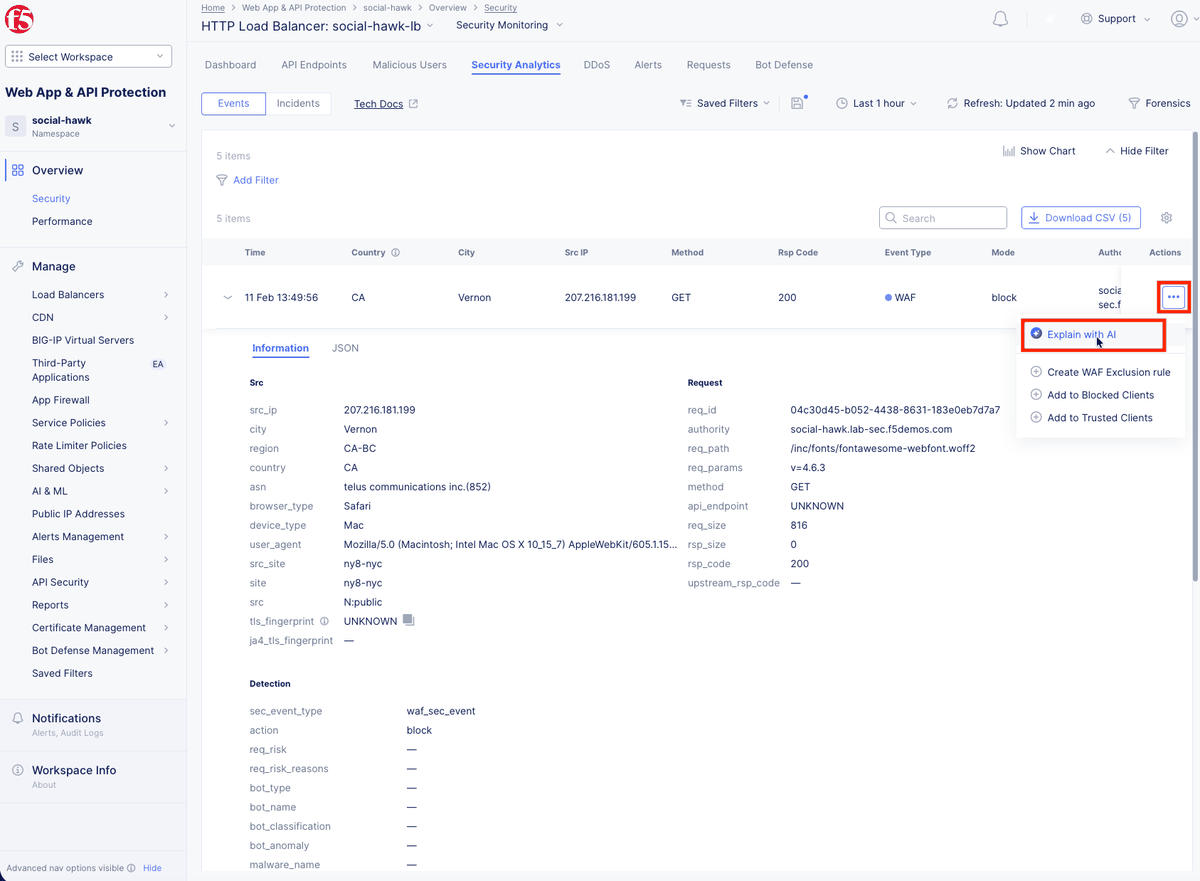
F5 Distributed Cloud API Security combines data analytics with AI and machine learning to discover, detect and protect APIs. It is delivered through a SaaS-based portal that holds the API inventory and supports threat analytics, forensics and troubleshooting of API communications.
Workloads can be protected across public clouds such as AWS, Azure and GCP, in on-premises data centers and edge sites, or from points of presence on the F5 global network. Discovery integrates with code repositories so APIs are monitored before release.
Key features include:
- Automatic API discovery: Detects and maps APIs through code repository analysis, runtime traffic inspection performed inline or out-of-band via a local SaaS connector for BIG-IP TMOS, and external web crawling, with automatic OpenAPI Specification file generation.
- API protection and enforcement: Limits, controls and blocks endpoints and suspicious activity using inline application and API security capabilities with WAF, including a granular L7 policy engine.
- ML-based traffic monitoring: Maintains behavioral baselines through continuous machine learning, flagging and blocking suspicious activity over time, with an AI assistant that answers natural language queries about API security events.
- Authentication discovery and risk scoring: Identifies and baselines the authentication state of all APIs in an environment and assigns a risk score based on authentication status and details.
- Sensitive data detection: Identifies and reports on exposed PII and data types tied to PCI DSS, HIPAA and GDPR, with options to limit, mask or block responses.
- Schema import and positive security: Creates and enforces a positive security model from learned or existing OpenAPI specifications, controlling valid endpoints, parameters, methods, authentication and payloads.
- Pre-production API testing: Runs targeted tests on discovered endpoints in pre-production to uncover vulnerabilities across OWASP API Top 10 threats.
Limitations (as reported by users on TrustRadius):
- Documentation and training: Reviewers point to a need for better documentation and training materials to shorten the learning curve.
- Dashboard complexity: The dashboard is described as complex, with console navigation and deep configuration menus adding friction.
- Legacy system integration: Integration with on-premises and legacy systems presents a challenge for some users, including alignment with F5 on-premises WAF deployments.
- Log retention: Native long-term log retention in the console is described as limited, pushing teams toward external storage for historical analysis.
Source: F5
7. Imperva API Security

Best for: BOLA and business logic detection alongside an existing WAF
Strengths: Real-time BOLA response, data classification, bot integration
Things to consider: Higher cost and limited custom policy options
Imperva API Security manages discovery, risk assessment, detection and mitigation from one console across cloud, on-premises and hybrid environments. It continuously discovers public, private and shadow APIs, tracks changes, and classifies endpoints by the sensitivity of the data they handle.
Detection is built on hybrid behavioral and rule-based engines that score anomalies and flag risky endpoints. Mitigation is enforced inline through Imperva Cloud WAF and WAF Gateway, extending protection from APIs to the wider application architecture.
Key features include:
- Real-time BOLA detection and response: Profiles traffic to establish behavioral baselines, then uses ML-driven analysis to spot deviations and block Broken Object Level Authorization exploits as they occur.
- Business logic threat protection: Combines behavioral and rule-based engines to score anomalies and surface BOLA risks before exploitation, covering OWASP API Security Top 10 threats.
- Inline automated response: Enforces mitigation through Cloud WAF and WAF Gateway, integrating with security automation rather than alerting alone.
- Continuous discovery and classification: Finds public, private and shadow APIs, tracks changes, detects design flaws and classifies endpoints by data type, including government ID, credit card details, address information and other PII.
- Bot protection integration: Works with Imperva Advanced Bot Protection to give visibility into sensitive APIs, detect bot attacks and apply tailored mitigation policies against automated abuse.
- Flexible deployment: Offers cloud-managed or self-managed options with agent-based or agentless setups, supporting cloud WAF, microservices, encrypted applications and network-layer monitoring across east-west and north-south traffic.
- Gateway and proxy integrations: Connects with Kong, MuleSoft, Azure APIM, Apigee and F5 so API traffic is inspected through existing gateways, proxies and load balancers.
Limitations (as reported by users on G2):
- Pricing: Multiple reviewers describe the solution as expensive relative to alternatives.
- Custom policy options: One reviewer noted a need for more options when building custom policies.
- Report delivery: Security event reports can be emailed but not downloaded directly, according to one reviewer.
- Support and documentation: A reviewer reported slow response and resolution times from support, along with limited accompanying documentation.
8. Cloudflare API Shield

Best for: Edge-based API discovery and schema enforcement
Strengths: Positive security model, response scanning, global enforcement
Things to consider: Key capabilities are limited to Enterprise plans
Cloudflare API Shield catalogs and manages API endpoints, blocks attacks and vulnerability exploits, and works to prevent data leakage. Because it operates on Cloudflare's global network, endpoints are discovered and secured as traffic passes through the edge rather than through separately deployed sensors.
The product consolidates application and API inventory, policy management, analytics and reporting on a single platform, alongside Cloudflare's other application services. Cloudflare positions API Shield as running on the same infrastructure it uses to build its own services.
Key features include:
- Automated endpoint discovery: Uses machine learning models and heuristics to analyze traffic and identify all API endpoints in use, including undocumented ones, building a complete inventory.
- Positive security model enforcement: Validates incoming requests against schemas so API traffic conforms to expected structure, blocking common API attacks including OWASP Top 10 API Security risks.
- Attack and exploit blocking: Stops common API attacks such as zero-day exploits, authentication abuse, data loss, DDoS and other business logic attacks at the edge.
- Response payload scanning: Continuously scans response payloads to identify sensitive information, preventing data exfiltration and leakage through APIs.
- Endpoint cataloging and management: Consolidates application and API inventory, policy management, analytics and reporting on one platform alongside Cloudflare's web application services.
- Global network enforcement: Runs across Cloudflare's global network of hundreds of locations, applying discovery, validation and protection close to where API traffic enters.
Limitations (as reported by users on Gartner Peer Insights):
- Plan gating: Reviewers note that the capability is available on Enterprise plans, and that some analytics, such as detecting a skipped step in a sequence, are not available on all plans.
- Advanced configuration: Basic features are described as easy to enable, while more complex use cases involve multiple components and settings and require deeper familiarity with the Cloudflare platform.
- Customization limits: Some reviewers report difficulty customizing timeouts and request transformations, and note the product is a security and routing service rather than a full lifecycle management tool.
- Documentation and pricing clarity: Reviewers mention that documentation and pricing are not always clear, and one referenced recent service outages.
Real-time protection is essential for securing modern APIs against rapidly evolving threats and business logic abuse. By continuously monitoring live traffic, analyzing behavior, and enforcing adaptive policies, security teams can stop attacks as they happen. Implementing comprehensive visibility and automated defense ensures business continuity while safeguarding sensitive data across complex digital environments.