Summary: Behavioral analytics for API traffic monitoring baselines normal API usage and flags deviations that static rules miss. Radware is best for real-time business logic learning and blocking, Salt Security for low-and-slow attack detection, Akamai for lifecycle posture and testing, and Wallarm for inline session-level blocking.
What is Behavioral Analytics for API Traffic Monitoring?
Behavioral analytics for API traffic monitoring refers to the practice of analyzing patterns of interactions between clients (such as users, applications, or devices) and APIs. This approach focuses on understanding the normal flow and usage of API calls to establish a baseline of expected behavior. Leading vendors offering behavioral analytics for API traffic monitoring and security focus on anomaly detection, threat identification, and usage analytics.
Key capabilities of API behavioral analytics tools:
- Continuous API discovery and inventory: Automatically identifies active, shadow, deprecated, and newly deployed APIs and keeps the inventory current.
- User, entity, and API behavior profiling: Builds behavioral baselines for users, machines, tokens, and APIs to identify unusual activity.
- Machine learning and AI-based anomaly detection: Detects deviations from normal traffic patterns that may indicate abuse, compromise, or automated attacks.
- API business logic sequence and transaction analysis: Evaluates multi-step API workflows to detect skipped steps, abnormal sequences, and misuse of legitimate functions.
- Sensitive data flow monitoring: Tracks how confidential data moves through APIs and flags unusual access, transfer, or exposure patterns.
- Automated posture management: Continuously identifies API misconfigurations, weak controls, excessive permissions, and other security posture issues.
- Risk assessment and prioritization: Ranks anomalies and API weaknesses using exposure, data sensitivity, exploitability, and behavioral context.
- Real-time blocking and response: Automatically blocks, rate-limits, challenges, or terminates suspicious API activity when risk thresholds are exceeded.
This is part of a series of articles about API security.
In this article:
The table below summarizes the main differences between the solutions covered in this guide. Each one is explored in more detail in the sections that follow.
| Category |
Solution |
Best For |
Key Strengths |
Things to Consider |
| WAAP and edge platforms |
Radware API Protection |
Real-time business logic learning and blocking |
Continuous logic learning with automated policy generation |
Fixed report templates and an initial learning period |
| WAAP and edge platforms |
Imperva API Security |
Hybrid estates needing behavioral BOLA detection |
Hybrid behavioral and rule-based anomaly scoring |
Higher pricing and limited custom policy options |
| WAAP and edge platforms |
F5 Distributed Cloud API Security |
Multicloud teams needing ML baselining with enforcement |
Continuous ML monitoring that maintains baselines |
Complex setup, unclear docs, and higher cost |
| WAAP and edge platforms |
Cloudflare API Shield |
Teams already routing API traffic through Cloudflare |
Automated discovery and response payload scanning |
Advanced features gated to higher tiers |
| Dedicated API security |
Radware API Security |
Teams standardizing on Radware for both edge and dedicated API defense |
Same continuous logic-learning engine, packaged for API-first deployments |
Same fixed reporting and learning-period trade-offs as the WAAP deployment |
| Dedicated API security |
Akamai API Security |
Governing APIs across multi-CDN and hybrid estates |
Runtime behavior analysis plus posture and testing |
UI slows on large datasets; learning curve |
| Dedicated API security |
Salt Security |
Detecting low-and-slow API attacks |
Behavioral analysis linked to posture and discovery |
Reporting and analytics depth is limited |
| Dedicated API security |
Cequence Platform |
High-volume estates needing behavioral intent scoring |
Behavioral intent engine judging actions in context |
Setup and tuning take time; dashboards can lag |
| Dedicated API security |
Wallarm API Security |
Inline blocking across REST, GraphQL, and gRPC |
Behavior-based abuse detection with session blocking |
Configuration effort and false positive review |
| Dedicated API security |
Traceable (Harness) |
Deep identity-aware behavioral analytics via distributed tracing |
Trace-based discovery linking every request to user, data, and code context |
Feature breadth outpaces polish; reporting needs work at scale |
Related content: Read our guide to API security solutions.
Establishes Baselines of Normal API Activity
Behavioral analytics starts by observing API traffic over time to understand what constitutes normal activity. This baseline includes typical request rates, common endpoints accessed, usual request payloads, and regular user or machine interaction patterns. By establishing these baselines, the system gains a contextual understanding of how APIs are used in the specific environment, accounting for business hours, user roles, and seasonal trends that might affect traffic.
Once these baselines are set, any deviation from the norm (such as a sudden spike in requests, unusual endpoints being accessed, or atypical sequences of API calls) can be flagged for further analysis. This process enables security teams to quickly identify potential threats, such as data exfiltration attempts or unauthorized access, which might otherwise go unnoticed in the noise of regular traffic. The ability to continuously update baselines as usage evolves also ensures ongoing relevance and accuracy in threat detection.
Detects Anomalous User and Machine Behavior
With a solid baseline in place, behavioral analytics tools can spot anomalies that suggest malicious or compromised activity. For example, if a user account suddenly starts making API requests at an unusual frequency, from an atypical location, or during odd hours, these deviations trigger alerts. Similarly, if a machine or automated process begins interacting with APIs in unexpected ways, such as accessing resources it never used before, the system can flag this as suspicious.
These anomaly detection capabilities are especially valuable in environments where attackers may leverage valid credentials or mimic legitimate users to avoid detection. Behavioral analytics focuses on the context and intent behind API calls, not just the surface-level details. By correlating multiple signals (such as timing, frequency, and payload characteristics) the system increases the likelihood of catching sophisticated attacks that evade traditional security controls.
Identifies Business Logic Abuse
Business logic abuse occurs when attackers exploit the intended functionality of APIs to achieve malicious outcomes, such as bypassing purchase limits, scraping data, or performing unauthorized transactions. Behavioral analytics is uniquely positioned to detect these subtle abuses by monitoring for patterns that deviate from typical user journeys or transaction flows. For example, if an account repeatedly attempts to apply discount codes in rapid succession or manipulates request parameters to gain unauthorized access, these behaviors stand out against established norms.
Unlike signature-based detection, which often misses novel attack techniques, behavioral analytics can adapt to new forms of business logic abuse as they emerge. By continuously learning from legitimate usage patterns, the system refines its detection capabilities and minimizes the risk of false positives. This proactive approach is essential for protecting APIs that handle sensitive operations, financial transactions, or critical business data.
Detects Account Takeover and Credential Misuse
Account takeover attacks often involve attackers using stolen or guessed credentials to access APIs as legitimate users. Behavioral analytics helps detect these incidents by monitoring for sudden changes in user behavior, such as logins from unusual locations, unexpected device fingerprints, or atypical access patterns. For example, if an account that typically accesses a specific set of APIs suddenly starts interacting with high-privilege endpoints, this behavior can indicate credential misuse.
In addition to monitoring user actions, behavioral analytics can also track the use of API keys and tokens to identify suspicious activity. If a single credential is used from multiple geographic locations within a short time frame or exhibits a sharp change in request volume, these anomalies are strong indicators of compromise. Early detection allows organizations to respond quickly, limiting the potential damage from account takeovers or credential stuffing attacks.
Monitors Bots, Automated Tools, and AI Agents
APIs are frequent targets for automated bots, scraping tools, and AI-driven agents that can overload systems, steal data, or abuse business logic. Behavioral analytics excels at distinguishing between human-driven and automated traffic by analyzing interaction patterns, request timing, and sequence regularity. Bots often exhibit consistent, high-frequency access or make requests in unnatural sequences, which can be readily identified against the backdrop of normal usage.
Beyond detection, behavioral analytics can categorize different types of automated activity, allowing organizations to differentiate between beneficial bots (such as search engine crawlers) and malicious automation. By providing granular visibility into automated interactions, security teams can implement targeted mitigation strategies, such as rate limiting, CAPTCHA challenges, or blocking, without disrupting legitimate business operations.
Reduces False Positives Through Contextual Analysis
One of the major challenges in API security is balancing detection sensitivity with operational efficiency, as excessive false positives can overwhelm security teams and disrupt user experience. Behavioral analytics addresses this by incorporating contextual analysis into its detection process. Instead of relying solely on static thresholds, it considers factors such as user roles, historical activity, time of day, and business context when evaluating potential threats.
This contextual understanding enables more accurate threat identification and prioritization. For example, a high volume of API requests might be suspicious for a regular user but perfectly normal for an automated system or during peak business periods. By adapting to the environment and refining detection criteria, behavioral analytics reduces unnecessary alerts, helping security teams focus on genuine threats and respond more effectively.
Related content: Read our guide to API abuse.
1. Continuous API Discovery and Inventory
Effective behavioral analytics solutions start with comprehensive API discovery and inventory. This capability ensures that all APIs are identified and cataloged. Continuous discovery uses traffic analysis, network scanning, and integration with development pipelines to maintain an up-to-date inventory, even as new APIs are added or existing ones are modified. This visibility is crucial for understanding the full attack surface and ensuring that monitoring extends to every exposed API endpoint. It should cover:
- Internal APIs
- External APIs
- Public APIs
- Shadow APIs
An accurate API inventory forms the foundation for effective behavioral analysis. Without knowing what APIs exist and how they are being used, organizations risk blind spots that attackers can exploit. By automating the discovery process, vendors help organizations maintain ongoing visibility, reduce manual effort, and quickly respond to new security risks as APIs evolve.
2. User, Entity, and API Behavior Profiling
Profiling involves building detailed models of how users, machines, and APIs interact over time. This includes tracking the following information for different entities:
- Access patterns
- Request types
- Response behaviors
- Usage frequencies
By developing these profiles, behavioral analytics solutions can distinguish between typical and atypical activities, enabling early detection of threats such as insider misuse, compromised accounts, or unauthorized automation.
Behavior profiling also supports more granular policy enforcement and risk management. Security teams can tailor controls based on the behavior of specific users, roles, or applications, allowing for adaptive responses to emerging threats. As organizations scale their API environments, robust profiling capabilities become essential for managing complexity and maintaining effective security oversight.
Related content: Read our guide to API analytics.
3. Machine Learning and AI-Based Anomaly Detection
Machine learning and AI-based anomaly detection identify API activity that differs from established behavioral patterns. Models can analyze variables such as:
- Request frequency
- Endpoint access
- Authentication behavior
- Payload characteristics
- Data volumes
This allows tools to detect subtle deviations that static rules may miss, including low-and-slow attacks and unusual automated activity. Behavioral models can adapt as legitimate API usage changes, reducing dependence on manually maintained thresholds and signatures.
Vendors may combine unsupervised learning, supervised models, and rule-based detection to improve accuracy. Effective solutions also provide context for anomalies, helping security teams understand why activity was flagged and determine whether it represents a real threat.
4. API Business Logic Sequence and Transaction Analysis
API business logic analysis examines how requests are combined into workflows and transactions rather than evaluating each request in isolation. Behavioral analytics tools learn expected sequences, such as authentication followed by account access and a transaction. They can then identify sequences that may indicate abuse, such as:
- Skipped steps
- Unexpected ordering
- Repeated operations
This capability helps detect attacks that use valid API calls but manipulate application logic. Examples include bypassing approval steps, abusing checkout workflows, repeatedly applying promotions, or automating high-value transactions. Sequence analysis provides context across multiple API calls, making it easier to identify abuse that endpoint-level controls may consider legitimate.
5. Sensitive Data Flow Monitoring
Sensitive data flow monitoring tracks the movement of confidential information across API endpoints, such as:
- Personal data
- Payment details
- Intellectual property
Behavioral analytics tools map where sensitive data is accessed, transmitted, or modified, and establish typical patterns for these operations. Any deviation, such as unusual data exports or access from unauthorized sources, is flagged for investigation.
This capability is essential for compliance with data protection regulations and for preventing data breaches. By maintaining visibility into how sensitive data flows through APIs, organizations can quickly identify and respond to potential leaks or exfiltration attempts. Continuous monitoring also supports audits and helps demonstrate regulatory compliance.
6. Automated Posture Management
Automated posture management continuously evaluates API configurations and security controls to identify weaknesses that increase exposure. It can detect issues such as:
- Missing authentication
- Excessive permissions
- Insecure endpoints
- Outdated API versions
- Deviations from security policies
Findings can be correlated with API inventories, traffic patterns, and behavioral data to show which weaknesses are actively exposed. Continuous assessment helps security teams identify posture changes as APIs are deployed or modified. Integrations with development and deployment workflows can surface issues earlier and support remediation before they become exploitable.
7. Risk Assessment and Prioritization
Risk assessment combines behavioral anomalies with context such as:
- API exposure
- Data sensitivity
- Authentication requirements
- Known vulnerabilities
- Observed usage
Instead of treating every alert equally, behavioral analytics vendors can assign risk scores that indicate which APIs, events, or entities require immediate investigation. Prioritization helps security teams focus on findings with the greatest potential impact.
For example, unusual activity involving an internet-facing API that exposes sensitive customer data should generally receive more attention than a similar anomaly on an isolated test endpoint. Risk scores should be explainable and updated as behavior, exposure, and other security conditions change.
8. Real-Time Blocking and Response
Modern API behavioral analytics solutions can trigger immediate responses when predefined risk thresholds are exceeded. Depending on the severity of the event, the platform can:
- Block malicious API requests
- Enforce rate limits
- Revoke API tokens
- Terminate active sessions
- Require additional authentication before allowing further access
These actions help contain attacks before they reach backend systems or sensitive data. Real-time response capabilities are typically integrated with API gateways, web application and API protection (WAAP) platforms, identity providers, and security orchestration tools. This allows organizations to apply adaptive security controls based on behavioral context rather than static policies.
Related content: Read our guide to API attacks.
How we selected these tools: We shortlisted API security vendors based on their ability to baseline normal API traffic, detect behavioral anomalies and business logic abuse, discover and inventory API endpoints, and take enforcement action at runtime.
1. Radware API Security
Best for: Real-time API business logic learning and blocking
Strengths: Continuous logic learning with automated policy generation
Things to consider: Fixed report templates and an initial learning period
Radware API Security is delivered as part of Radware's Cloud Application Protection Services. It continuously discovers APIs and learns application business logic in real time, then applies AI-based analysis to turn what it observes into security policies for each endpoint.
Coverage extends across business logic attacks, data leakage, denial of service, bots, account takeover, and Layer 7 DDoS. Protection is applied consistently across architectures and environments, and the service addresses the PCI DSS 4 requirement to detect and protect against attacks that exploit business logic vulnerabilities.
Key features include:
- Automated API discovery: Finds API endpoints and undocumented changes across applications, then generates tailored security policies for what it discovers.
- Business logic attack prevention: Continuously learns from real-time transactions and stops business logic attacks as they occur, without waiting for a manual policy update.
- Positive security model: Validates requests against the defined API schema and scans for embedded attacks hidden inside otherwise valid calls.
- Bot and account takeover protection: Blocks bad bot and ATO activity aimed at APIs, including credential stuffing and scraping.
- Data leakage prevention: Inspects API responses and masks sensitive values such as credit card numbers and other PII.
- API quotas: Limits the number of API calls per timeframe, per endpoint, and per source to prevent abuse.
- API DDoS protection: Generates accurate attack signatures in real time to mitigate DDoS attacks aimed at API endpoints.
Limitations (as reported by users on G2 for Radware Cloud WAF, which includes API Protection):
- Reporting depth: Out-of-the-box reports use predefined templates, and teams building executive summaries often export the data instead.
- Initial learning period: The behavioral engine requires time to establish baselines before policies reach full accuracy.
- Feature discoverability: The console covers a broad feature set, and locating specific advanced settings can take new users some time.
2. Imperva API Security

Best for: Hybrid estates needing behavioral BOLA detection
Strengths: Hybrid behavioral and rule-based engines with anomaly scoring
Things to consider: Higher pricing and limited custom policy options
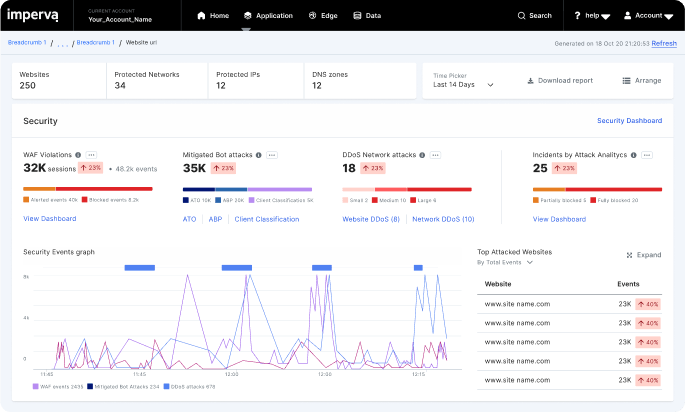
Imperva's Unified API Security Platform brings API discovery, risk assessment, detection, and mitigation into a single console covering cloud, on-premises, and hybrid environments. It profiles traffic to establish behavioral baselines, then applies ML-driven analysis to spot deviations.
Detection focuses on deprecated, unauthenticated, and BOLA-prone APIs, with mitigation enforced inline through Cloud WAF and WAF Gateway. Deployment options include an add-on for Imperva Cloud WAF, a cloud-managed console, or a self-managed local console, with agent-based or agentless setups.
Key features include:
- Behavioral baselining for BOLA detection: Profiles API traffic to build behavioral baselines, then uses ML-driven analysis to detect deviations and block Broken Object Level Authorization exploits.
- Business-logic threat protection: Combines behavioral and rule-based engines to score anomalies and flag risky endpoints in real time.
- Continuous discovery and classification: Continuously discovers public, private, and shadow APIs, tracks changes, and identifies design flaws.
- Sensitive data classification: Classifies APIs by data sensitivity, including government ID, credit card details, address information, and other PII.
- Ongoing risk assessment: Runs continuous assessments against the OWASP API Security Top 10 to surface design flaws before exploitation.
- Bot protection integration: Works with Imperva Advanced Bot Protection to detect automated abuse of sensitive APIs and apply tailored mitigation policies.
- Shift-left testing: Scans an uploaded API specification file to identify posture gaps, risky endpoints, and configuration weaknesses, classified by severity.
Limitations (as reported by users on G2):
- Pricing: Reviewers describe the solution as expensive.
- Policy customization: Users asked for more options to build custom policies.
- Report handling: Security event reports can be emailed but not downloaded directly.
- Support responsiveness: Response and resolution times were reported as slow, with limited supporting documentation.
Source: Imperva
3. F5 Distributed Cloud API Security

Best for: Multicloud teams needing ML baselining with enforcement
Strengths: Continuous ML monitoring that maintains behavioral baselines
Things to consider: Complex setup, unclear documentation, and higher cost
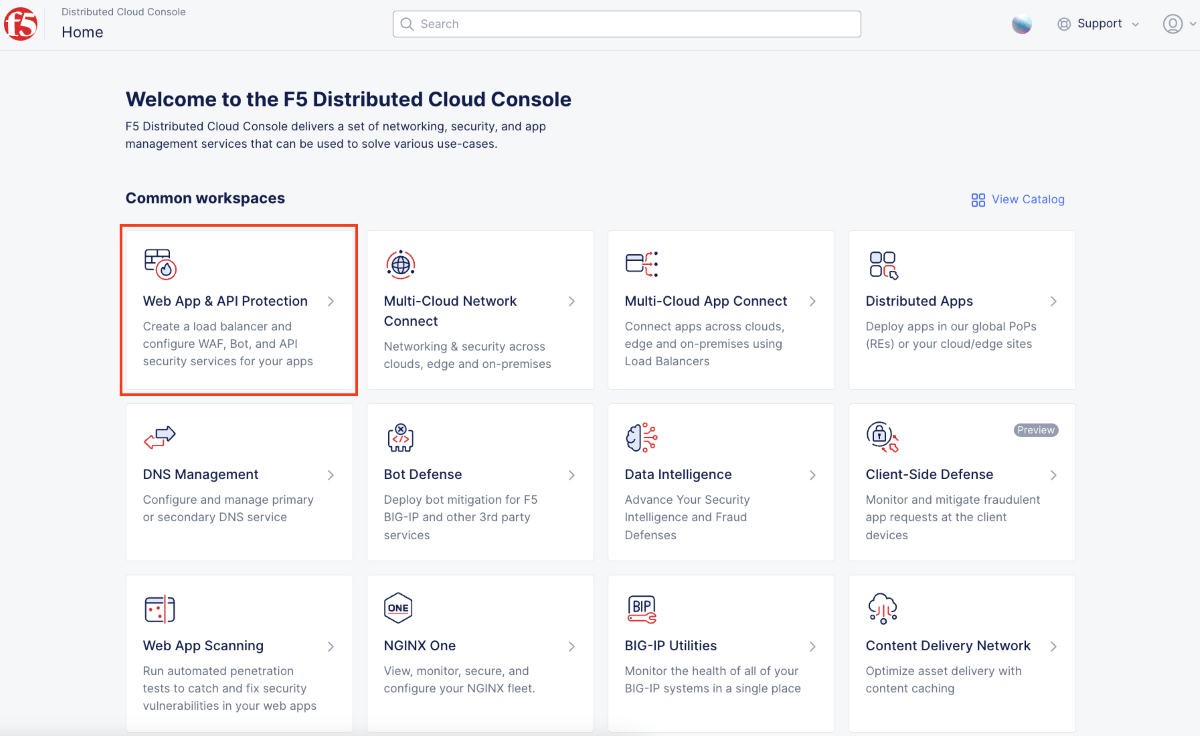
F5 Distributed Cloud API Security is part of the F5 Distributed Cloud WAAP solution and combines data analytics with AI and machine learning to discover, detect, and protect APIs. A SaaS-based portal holds the API inventory and supports threat analytics, forensics, and troubleshooting of API communications.
Protection can be delivered from public cloud environments such as AWS, Azure, and GCP, from on-premises data centers and edge sites, or from any of the points of presence on the F5 global network.
Key features include:
- ML-based traffic monitoring: Continuous machine learning maintains behavioral baselines across API traffic, flagging and blocking suspicious activity over time.
- AI assistant for analysis: Natural language queries surface API security events with context and actionable recommendations.
- Automatic API discovery: Maps APIs through code repository analysis, runtime traffic inspection performed inline or out-of-band via a local SaaS connector for BIG-IP TMOS, and external web crawling, with automatic OpenAPI file generation.
- Authentication discovery and risk scoring: Identifies and baselines the authentication state of all APIs in an environment, with views into authentication status, details, and risk score.
- Sensitive data detection: Identifies and reports on exposed PII and data types tied to PCI DSS, HIPAA, and GDPR, with options to limit, mask, or block.
- API protection and enforcement: Limits, controls, and blocks suspicious endpoints and activity through inline app and API controls, including a granular L7 policy engine.
- Schema import: Enforces a positive security model from learned or existing OpenAPI specifications, controlling valid endpoints, parameters, methods, authentication, and payload details.
Limitations (as reported by users on G2):
- Documentation clarity: Reviewers report documentation that is difficult to follow, which makes the underlying concepts harder to grasp.
- Implementation effort: Setup and configuration are described as tedious and time-consuming for teams new to F5 products.
- Platform reliability: Some users have encountered glitches and variable speed in the SaaS infrastructure.
- Cost: Pricing is described as high, and integration work adds to the total effort.
Source: F5
4. Cloudflare API Shield

Best for: Teams already routing API traffic through Cloudflare
Strengths: Automated endpoint discovery and response payload scanning
Things to consider: Advanced features gated to higher tiers
Cloudflare API Shield catalogs and manages API endpoints, blocks attacks and vulnerability exploits, and works to prevent data leakage. It operates on Cloudflare's global network, so discovery and protection apply to API traffic already passing through that network.
The service pairs endpoint inventory work with inline enforcement. Rather than acting as a separate analysis layer, it applies both monitoring and blocking at the same point in the traffic path.
Key features include:
- Automated endpoint discovery: Uses machine learning and heuristics to analyze traffic and identify all API endpoints in use, including undocumented ones.
- API cataloging and inventory: Maintains a complete and accurate catalog of discovered endpoints so teams know what is exposed.
- Response payload scanning: Continuously scans response payloads to identify sensitive information, preventing data exfiltration and leakage through APIs.
- Positive security model enforcement: Blocks common API attacks, including the OWASP Top 10 API security risks, by checking that API traffic conforms to defined schemas.
- Vulnerability exploit blocking: Blocks exploit attempts directed at API endpoints alongside common attack traffic.
- Global network delivery: Discovery and protection are applied from Cloudflare's global network rather than from infrastructure the customer runs and maintains.
Limitations (as reported by users on G2 for Cloudflare Application Security and Performance, the suite that includes API Shield):
- Tier gating: Advanced security capabilities and longer log retention are tied to higher-priced plans.
- Rule tuning: Fine-tuning WAF and bot settings on dynamic applications takes time, and reviewers describe writing complex exceptions to avoid blocking legitimate API traffic.
- Detection transparency: It is not always clear which rule triggered a block, which slows troubleshooting.
- Log export: Pushing granular real-time logs to a SIEM is restrictive and costly outside enterprise tiers.
- Support access: Direct support channels are limited on lower plans.
5. Radware API Security
Best for: Teams standardizing on Radware for both edge and dedicated API defense
Strengths: Same continuous logic-learning engine, packaged for API-first deployments
Things to consider: Same fixed reporting and learning-period trade-offs as the WAAP deployment
Radware API Security is the same underlying API protection capability described earlier in this guide, delivered as part of Radware's Cloud Application Protection Services rather than as a separate product line. It appears in both categories here because Radware doesn't sell API protection as an isolated point tool; it's one module in a shared portal alongside WAF, bot management, client-side protection, and Layer 7 DDoS defense, all built on the same continuous business-logic-learning engine.
For organizations comparing dedicated API security vendors against broader WAAP suites, this matters because Radware's solution isn't a standalone API discovery-and-protection product competing feature-for-feature with Traceable or Salt Security, but rather API-specific behavioral defense that shares policy data and a single management plane with the rest of an organization's edge and application security stack.
Key features include:
- Automated API discovery: Finds API endpoints and undocumented changes across applications, generating tailored security policies for what it discovers.
- Business logic attack prevention: Continuously learns from real-time transactions and stops business logic attacks as they occur, without waiting for a manual policy update.
- Positive security model: Validates requests against the defined API schema and scans for embedded attacks hidden inside otherwise valid calls.
- Bot and account takeover protection: Blocks bad bot and ATO activity aimed at APIs, including credential stuffing and scraping.
- Data leakage prevention: Inspects API responses and masks sensitive values such as credit card numbers and other PII.
- API quotas and DDoS defense: Limits API calls per timeframe, per endpoint, and per source, and generates accurate attack signatures in real time against API-targeted DDoS.
- Shared policy plane: Because API Security runs inside the same Cloud Application Protection Services portal as WAF, bot management, and client-side protection, policy and attack data flow between modules rather than sitting in separate consoles.
Limitations (as reported by users on G2 for Radware Cloud WAF, the service that includes API Security):
- Reporting depth: Out-of-the-box reports use predefined templates, and teams building executive summaries often export the data instead.
- Initial learning period: The behavioral engine requires time to establish baselines before policies reach full accuracy.
- Feature discoverability: The console covers a broad feature set spanning multiple modules, and locating specific advanced API settings can take new users some time.
6. Akamai API Security

Best for: Governing APIs across multi-CDN and hybrid estates
Strengths: Runtime behavior analysis paired with posture and testing
Things to consider: UI slows on large datasets and has a learning curve
Akamai API Security covers discovery, testing, runtime detection, and response across the full API lifecycle. It is vendor-neutral and does not require other Akamai products, working across multicloud, hybrid, and on-premises environments, including estates with multiple CDNs, WAFs, and gateways.
The platform can analyze API traffic from supported north-south and east-west sources depending on how traffic is connected, which extends behavioral monitoring to internal APIs as well as internet-facing ones.
Key features include:
- Runtime behavior analysis: Analyzes runtime behavior to detect abnormal activity, business logic abuse, sensitive data exposure, data scraping, tampering, and potential attacks.
- Multi-source discovery: Builds a continuously updated inventory from traffic, code, specs, gateways, cloud environments, and external exposure points, covering shadow, zombie, unmanaged, MCP, and AI-linked APIs.
- Behavior and flow visualization: Displays API behavior, infrastructure context, traffic flows, authentication patterns, and sensitive data exposure.
- Posture and compliance mapping: Maps findings to OWASP API, PCI DSS, HIPAA, ISO 27001, GDPR, HITRUST, and NIST, and tracks posture gaps and remediation progress over time.
- Active testing: Integrates with CI/CD workflows and runs over 200 dynamic tests that simulate malicious traffic before release.
- Response routing: Sends findings into SIEM, ITSM, ticketing, CMDB, WAAP, gateway, and developer workflows.
- Ownership mapping: Maps API findings to owners, repositories, file paths, and last committers where that data is available.
Limitations (as reported by users on G2):
- Interface performance: Users report the UI slowing when working with large datasets.
- Learning curve: Reviewers describe the workflow as taking time to learn and asked for a more streamlined experience.
- Cost: Pricing is described as high for mid-sized organizations.
- Stability: One reviewer reported instability that required repeated server reinstalls.
7. Salt Security Agentic Security Platform

Best for: Detecting low-and-slow API attacks
Strengths: Behavioral analysis linked to posture and discovery
Things to consider: Reporting and analytics depth is limited
Salt Security's Agentic Security Platform organizes discovery, posture management, and threat detection around what it calls the Agentic Security Graph, the interconnected mesh of APIs that supports an organization's operations, applications, and digital experiences.
The platform is built for APIs specifically rather than as an extension of a web application security product. Its modules include Salt Surface for external exposure mapping, Salt Connect for cloud API visibility, Salt Code for policy enforcement inside AI coding agents, Salt Collect for live traffic analysis, and Salt Protect for blocking logic-based threats.
Key features include:
- Behavioral threat detection: Patented behavioral analysis identifies API-specific threats, fraud patterns, and low-and-slow attacks, surfacing attacker intent ahead of traditional alerting.
- Real-time API discovery: Provides visibility into every API running in production across environments, including shadow APIs, third-party connections, and deprecated endpoints, without manual tagging or agents.
- Live traffic analysis: Salt Collect analyzes live traffic data, which feeds both the inventory and the detection engine.
- Posture and compliance analysis: Continuously analyzes API posture and maps it to PCI DSS, GDPR, NIST, and SOC 2, with governance enforced at scale through Policy Hub.
- External exposure mapping: Salt Surface maps the externally exposed API attack surface so teams can see what is reachable from outside.
- Workflow integrations: Enriches alerts in SIEM tooling, closes gaps through Jira tickets, and blocks attacks at the firewall.
Limitations (as reported by users on G2):
- Reporting depth: Reviewers note gaps in detailed reporting and in extracting statistical data.
- SIEM logging detail: SIEM logging integrations were described as missing native action logging.
- Gateway attribution: Some users had difficulty getting APIs behind a gateway to report correctly as unique items.
- Call chain visibility: Reviewers asked for API compositions and call chains to be stitched together graphically.
- Root cause detail: Users wanted better root cause findings when issues are identified.
8. Cequence Platform

Best for: High-volume estates needing behavioral intent scoring
Strengths: Behavioral intent engine judging actions in context
Things to consider: Setup and tuning take time; dashboards can lag
The Cequence Platform protects applications, APIs, and AI agents using a behavioral intent engine that judges actions in context. The company began with network-based bot management, expanded into API security and governance, then added WAAP for DDoS and OWASP Web Top 10 coverage.
Every capability is built on the same behavioral intelligence foundation, and product modules cover AI Gateway, Bot Management, WAAP, and API Security. The platform analyzes and protects more than 10 billion application interactions daily. Deployment is modular and works across SaaS, on-premises, and hybrid environments, so organizations can start with one module and add others as requirements change.
Key features include:
- Behavioral intelligence and identity: Analyzes and governs user and entity behavior to distinguish humans from bots and legitimate automation from threats, without interrupting users with a CAPTCHA.
- Runtime detection and response: Continuously evaluates live traffic to identify threats as they emerge and trigger immediate countermeasures, rather than relying on static rules or after-the-fact analysis.
- API discovery and inventory: Finds every API in the environment, including known, unknown, and shadow endpoints.
- API security posture management: Continuously assesses API configurations and risk exposure against security best practices and compliance requirements.
- Business logic abuse detection: Detects bots exploiting application workflows in ways that rule-based controls never anticipate.
- Sensitive data controls: Identifies and redacts PII, credentials, and regulated data moving through API traffic in real time.
- Account takeover and scraping defense: Stops credential stuffing and brute force attacks, content scraping, and gift card and loyalty program enumeration.
Limitations (as reported by users on G2):
- Setup complexity: Initial setup and tuning are described as time-consuming, particularly when onboarding large environments with many APIs.
- Dashboard performance: Dashboards can lag during large queries, slowing investigation and response.
- Alert tuning: Reviewers report alert noise and false positives that require ongoing adjustment.
- Report customization: Predefined reports do not always show the views teams want, and executive summaries take extra effort to build.
- Documentation: Users asked for clearer documentation, simplified workflows, and more training material.
9. Wallarm API Security

Best for: Inline blocking across REST, GraphQL, and gRPC
Strengths: Behavior-based abuse detection with session-level blocking
Things to consider: Configuration effort and false positive review
Wallarm API Security is a real-time API protection platform that discovers every API in an estate and blocks attacks inline. It covers REST, GraphQL, gRPC, SOAP, and WebSocket from a single engine and does not require an OpenAPI spec, building one from live traffic instead.
The platform deploys at the load balancer or ingress and forms the API protection layer of an AI Control Loop, supplying the discovery and protection data that the observability and governance layers depend on.
Key features include:
- Behavior-based abuse detection: Detects credential stuffing, account takeover, malicious bots, and L7 DDoS by behavior rather than signatures.
- Session-level blocking: Correlates request sequences across sessions using volume, distribution, header anomalies, and response timing, then blocks the abuse pattern at the session rather than the IP, so legitimate logins from the same network keep working.
- Traffic-based discovery: Surfaces shadow, zombie, and rogue APIs from live traffic and auto-builds OpenAPI specs from what is actually running.
- Inline attack blocking: Stops OWASP API Top 10 issues, injection attacks, BOLA, broken function-level authorization, broken authentication, SSRF, and zero-days without signatures.
- Sensitive data tracking: Surfaces every API moving PII, payment data, credentials, or health records and maps it to compliance scope, with alerts on changes.
- API leak management: Continuously scans public sources for leaked API keys, tokens, and credentials tied to the organization's domains.
- Investigation and integration: Allows drill-down into every malicious request and pushes events to Splunk, Sumo Logic, QRadar, Jira, PagerDuty, OpsGenie, and Slack.
Limitations (as reported by users on G2):
- Configuration effort: Initial configuration and tuning are described as complex and time-consuming for new users.
- False positive management: Reviewers report needing ongoing rule work to reduce false positives before enabling full blocking mode.
- Pricing transparency: Pricing is not disclosed during the free trial, and costs scale with total request volume.
- Documentation examples: Users asked for more best practices and configuration examples in the documentation.
- Integration coverage: Native SIEM integrations are limited, with webhooks or custom code needed for other systems.
10. Traceable (Harness)

Best for: Deep identity-aware behavioral analytics via distributed tracing
Strengths: Trace-based discovery linking every request to user, data, and code context
Things to consider: Feature breadth outpaces polish; reporting needs work at scale
Traceable is an API security platform built around distributed tracing rather than network traffic inspection alone, an architecture pioneered by founder Jyoti Bansal (also a co-founder of AppDynamics). Its OmniTraceEngine captures full transaction traces, not just malicious requests, correlating API calls with the actors making them, the infrastructure they run on, and dependencies on other internal and third-party APIs. This trace-based approach catches shadow APIs and internal service-to-service calls that perimeter-focused, traffic-only tools can miss.
Traceable was acquired by Harness in March 2025 and is being integrated into the Harness DevSecOps platform; its API security capabilities continue to be sold and supported under the Harness brand (referenced in the market as Harness WAAP by Traceable). The platform combines security posture management with runtime threat protection, and has extended into discovery and protection for generative AI and MCP-connected APIs.
Key features include:
- Trace-based discovery and inventory: Builds a real-time, risk-ranked catalog of every API by analyzing distributed traces, identifying shadow and orphaned APIs and internal services that traffic-only discovery methods miss.
- Identity-aware behavioral analytics: Observes user-level transactions and applies machine learning to understand who is making each request, what data they're accessing, and how that access pattern compares to normal behavior, rather than treating requests as isolated events.
- Runtime threat protection: Detects and blocks known and unknown attacks, business logic abuse, bot activity, and sensitive data exfiltration in production based on full session-lifecycle analysis.
- Sensitive data flow mapping: Tracks where PII, payment data, and other sensitive values enter, move through, and exit the API ecosystem, supporting GDPR and CCPA compliance reporting.
- Context-driven API security testing: Runs OWASP API Top 10 coverage, business logic testing, and fuzzing informed by real production traffic patterns rather than synthetic test cases alone.
- Generative AI and MCP API security: Discovers and monitors APIs connecting to first-party and third-party LLMs, tracking sensitive data flows to and from generative AI systems and flagging prompt-injection attempts.
- Broad protocol and deployment support: Covers HTTP, REST, GraphQL, SOAP, XML-RPC, and gRPC, deployable out-of-band or inline without requiring agents or application code changes.
Limitations (as reported by users on G2):
- Feature completeness lags breadth: Reviewers note that while the platform offers an impressive range of configuration options, many features are still limited or not fully complete.
- Reporting at scale: Users say reporting needs improvement for larger environments, and the interface lacks persistent column customization in data views, requiring repeated manual adjustment.
- Documentation gaps: Some reviewers ask for more complete documentation to support advanced configuration and troubleshooting.
Selecting a behavioral analytics platform requires evaluating both the quality of its detection capabilities and how well it integrates into existing security and API management processes. The following criteria can help compare vendors based on their ability to provide accurate detection, actionable insights, and operational scalability.
- Behavioral detection accuracy: Evaluate how effectively the platform distinguishes malicious behavior from legitimate API usage while maintaining a low false positive rate. Look for evidence of real-world detection capabilities against business logic abuse, credential misuse, and automated attacks.
- Quality of baselines and learning: Assess how the solution builds behavioral baselines, how quickly it adapts to changing API usage patterns, and whether security teams can tune or customize learning models for different applications and environments.
- Visibility across the API environment: Ensure the platform monitors all API types, including public, private, partner, internal, and shadow APIs. Broad visibility reduces blind spots and improves the accuracy of behavioral analysis.
- Real-time detection and response: Verify whether the platform detects threats in real time and supports automated actions such as blocking requests, revoking tokens, enforcing rate limits, or integrating with API gateways and WAAP solutions.
- Integration with existing security tools: Look for native integrations with SIEM, SOAR, XDR, identity providers, API gateways, and ticketing systems. Strong integrations simplify investigation and accelerate incident response.
- Behavior profiling granularity: Determine whether the solution profiles users, service accounts, applications, devices, API keys, and machine identities independently. More granular profiling typically results in more accurate anomaly detection.
- Explainability of alerts: Evaluate whether alerts include the behavioral signals, risk factors, and baseline deviations that triggered detection. Clear explanations help analysts validate incidents and reduce investigation time.
- Scalability and performance: Confirm that the platform can analyze high API transaction volumes with minimal latency while maintaining consistent detection accuracy in large, distributed environments.
- Reporting and compliance support: Review the available dashboards, audit trails, and reporting features for security operations and regulatory requirements. The platform should make it easy to demonstrate API activity, security events, and access to sensitive data.
- Deployment flexibility: Consider whether the solution supports cloud-native, hybrid, and on-premises environments, along with multiple deployment models such as agentless monitoring, gateway integrations, or traffic mirroring to fit existing infrastructure.
Conclusion
Behavioral analytics strengthens API security by adding context to traffic monitoring, allowing organizations to detect anomalies, business logic abuse, credential misuse, and other threats that static rules can miss. When evaluating a solution, organizations should prioritize accurate behavioral baselines, broad API visibility, explainable detection, and timely response capabilities. The right approach should also integrate with existing security workflows and continuously adapt as APIs, users, and normal traffic patterns change.