Summary: Application vulnerability protection services combine runtime defense for live apps and APIs with testing that finds flaws before release. Radware is best for integrated protection across hybrid environments, Akamai for edge-delivered defense, Veracode for full-lifecycle testing, and Snyk for developer-first scanning.
What are Application Vulnerability Protection Services?
Trusted application vulnerability protection services secure live software, APIs, and cloud workloads from exploits, zero-day attacks, and unauthorized execution. These services combine capabilities such as vulnerability scanning, application security testing, runtime monitoring, and threat detection to find flaws before attackers can exploit them.
Application vulnerability protection services defend web applications, APIs, mobile applications, and their supporting components throughout the software lifecycle. Depending on the service, protection may include static and dynamic testing, software composition analysis, penetration testing, web application firewalls, and runtime controls.
Core capabilities of application vulnerability protection services:
- Automated vulnerability scanning: Identifies known weaknesses across applications, APIs, dependencies, servers, and configurations.
- Manual security testing: Uses security specialists to find complex flaws in authentication, authorization, workflows, and business logic.
- Source code and application security reviews: Examines code, architecture, libraries, and configurations for insecure patterns and root-cause issue.
- Web application and API testing: Tests user-facing interfaces and APIs for access control, injection, authentication, and data exposure risks.
- Risk-based vulnerability prioritization: Ranks findings by exploitability, exposure, business impact, data sensitivity, and available controls.
- Remediation guidance: Provides clear technical steps to fix vulnerabilities through code, configuration, dependency, or access-control changes.
- Vulnerability validation and retesting: Confirms whether findings are exploitable and verifies that fixes fully resolve the issue.
- Reporting and security documentation: Records findings, evidence, risk ratings, remediation steps, and progress for tracking and compliance.
This is part of a series of articles about application security.
In this article:
The table below summarizes the key differences between the solutions covered in this guide. Each solution is explored in more detail below.
| Category |
Solution |
Best For |
Key Strengths |
Ratings |
| Runtime Application and API Protection Services |
Radware Cloud Application Protection Services |
Integrated protection across on-prem, cloud, and Kubernetes |
WAF, bot, API, client-side and L7 DDoS in one managed service |
4.6/5 (141 G2 reviews) |
| Runtime Application and API Protection Services |
Akamai App & API Protector |
Edge-delivered app and API protection for high-traffic sites |
Auto-updating rules, L7 DDoS, API discovery, bot controls |
4.0/5 (310 G2 reviews) |
| Runtime Application and API Protection Services |
Cloudflare WAF |
Fast-deploying edge WAF with virtual patching for new CVEs |
Managed rulesets, content scanning, API-driven management |
4.5/5 (595 G2 reviews) |
| Runtime Application and API Protection Services |
Imperva Application Security Platform |
Enterprise app and API security across hybrid estates |
WAF, bot, API, DDoS and client-side protection in one platform |
4.7/5 (41 G2 reviews) |
| Runtime Application and API Protection Services |
F5 Web Application and API Protection |
Consistent policy across data center, cloud, and edge |
Virtual patching, API lifecycle security, web app scanning |
4.4/5 (10 G2 reviews) |
| Application Vulnerability Testing and Management Platforms |
Veracode Application Risk Management Platform |
Full-lifecycle application testing and risk management |
SAST, DAST, SCA, container scanning, ASPM, AI remediation |
3.8/5 (25 G2 reviews) |
| Application Vulnerability Testing and Management Platforms |
Snyk AI Security Platform |
Developer-first scanning of code, dependencies, and AI output |
SCA, SAST, container, IaC and DAST with reachability analysis |
4.5/5 (132 G2 reviews) |
| Application Vulnerability Testing and Management Platforms |
Invicti Platform |
DAST-first testing with proof-based validation |
Proof-based DAST, API testing, ASPM correlation, CI/CD orchestration |
4.5/5 (500+ G2 reviews) |
Trusted application vulnerability protection services help organizations identify security weaknesses, reduce exposure to attacks, and maintain consistent protection as applications change. Key benefits include:
- Earlier vulnerability detection: Find security flaws in code, dependencies, configurations, and running applications before attackers can exploit them.
- Continuous protection: Monitor applications and infrastructure for new vulnerabilities, suspicious activity, and changes in security posture.
- Reduced attack surface: Prioritize and remediate exploitable weaknesses to limit potential entry points for attackers.
- Faster incident response: Provide alerts and threat context that help security teams investigate and contain attacks more efficiently.
- Improved compliance: Support security requirements through regular assessments, vulnerability tracking, monitoring, and reporting.
- Protection across the application lifecycle: Integrate security into development, testing, deployment, and runtime environments instead of relying on periodic checks alone.
Automated Vulnerability Scanning
Automated vulnerability scanning uses security tools to identify known weaknesses across applications, APIs, dependencies, servers, and configurations. Scanners can detect outdated software, exposed services, insecure settings, missing patches, and vulnerabilities linked to known CVEs. Scanning can be scheduled regularly or triggered as part of development and deployment workflows.
The main advantage is coverage and consistency. Automated tools can assess large environments quickly and repeatedly, helping teams detect new issues as applications change. However, scanner results still need review because some findings may be false positives or may not reflect the actual exploitability of a vulnerability.
Manual Security Testing
Manual security testing involves security specialists examining applications for vulnerabilities that automated tools may overlook. Testers assess authentication, authorization, session handling, business logic, input validation, and application workflows. They can also combine multiple low-severity issues to determine whether they create a more serious attack path.
This type of testing is especially useful for complex applications where security depends on context and user behavior. A manual tester can evaluate whether controls work as intended and whether an attacker could bypass them in realistic conditions. The findings can provide deeper insight into application-specific risks.
Source Code and Application Security Reviews
Source code and application security reviews examine how security is implemented within an application's code and architecture. Reviewers look for insecure coding patterns, improper input validation, weak access controls, exposed secrets, unsafe data handling, and misuse of security functions. They may also examine third-party libraries and framework configurations.
These reviews can identify weaknesses before they become exploitable in production. They also help teams understand the root cause of recurring vulnerabilities and improve development practices. When integrated into the software development lifecycle, code reviews can reduce the cost and effort required to fix security defects later.
Web Application and API Testing
Web application and API testing focuses on vulnerabilities in interfaces that users, services, and external systems interact with. Testing commonly covers injection attacks, broken access control, authentication weaknesses, insecure data exposure, server-side request forgery, and improper input validation. API assessments also examine endpoints, methods, parameters, and authorization rules.
Testing can reveal whether attackers can access data or functions beyond their intended permissions. It also helps verify controls such as rate limiting, token validation, object-level authorization, and request filtering. These assessments are important because APIs often expose direct access to application data and business functions.
Risk-Based Vulnerability Prioritization
Risk-based vulnerability prioritization ranks security findings according to the level of practical risk they create. Instead of relying only on severity scores, it considers factors such as exploitability, asset exposure, business importance, available exploits, data sensitivity, and existing security controls. This creates a more accurate view of which vulnerabilities require immediate attention.
Prioritization helps security and development teams use limited remediation resources more effectively. A critical vulnerability on an isolated test system may require less urgent action than a high-severity vulnerability on an internet-facing production service. Risk-based decisions help teams focus first on weaknesses most likely to cause meaningful damage.
Remediation Guidance
Remediation guidance provides technical instructions for correcting identified vulnerabilities. Recommendations may include changing application code, updating dependencies, modifying configurations, improving access controls, rotating credentials, or adding security checks. Effective guidance explains both the cause of the vulnerability and the steps required to address it.
Detailed remediation advice can reduce the time developers spend interpreting security findings. It can also help prevent incomplete fixes that address only the visible symptom rather than the underlying issue. Where several fixes are possible, guidance may also explain the security tradeoffs between different approaches.
Vulnerability Validation and Retesting
Vulnerability validation confirms whether reported findings represent genuine security weaknesses. Security specialists may reproduce the issue, examine affected components, and determine whether exploitation is possible under realistic conditions. This process helps eliminate false positives and provides better evidence for remediation decisions.
Retesting takes place after a vulnerability has been addressed. The tester verifies that the original weakness can no longer be exploited and checks whether the fix introduced related problems. Retesting provides stronger assurance that remediation was successful instead of relying only on a ticket being marked as resolved.
Reporting and Security Documentation
Reporting and security documentation record the results of vulnerability assessments in a structured format. Reports typically include affected assets, vulnerability descriptions, severity or risk ratings, supporting evidence, exploitation details, and remediation recommendations. Technical findings may be accompanied by summaries for security leaders or other stakeholders.
Clear documentation also supports remediation tracking, audits, compliance activities, and future assessments. Teams can use historical reports to identify recurring vulnerabilities, compare security posture over time, and verify whether previous findings were resolved. Consistent records make it easier to manage vulnerabilities across multiple applications and environments.
How we selected these tools: We shortlisted application vulnerability protection services based on runtime protection for live applications and APIs, vulnerability discovery and validation, risk-based prioritization, remediation guidance, and coverage across the application lifecycle.
Runtime Application and API Protection Services
1. Radware Cloud Application Protection Services
Best for: Integrated protection across on-prem, cloud, and Kubernetes
Strengths: WAF, bot, API, client-side and L7 DDoS in one managed service
Things to consider: Reporting is less customizable and policy tuning takes time
Rating: Rated 4.6 out of 5 across 141 reviews (G2)
Radware Cloud Application Protection Services combines a web application firewall, bot management, API protection, client-side protection, and application-layer DDoS protection in a single portal. The protection modules share attack data between them, and security policies are generated and updated automatically using behavioral algorithms rather than static rule sets alone.
Coverage spans the OWASP lists for web application security, API security, client-side security, automated threats, and LLM security. The service runs across on-premises, Kubernetes, hybrid, private cloud, and public cloud environments, and is delivered as a managed service backed by a 24x7 Emergency Response Team.
Key features include:
- Automated positive security model: Builds a profile of expected application behavior to reduce exposure to zero-day attacks, and updates policy automatically as applications change.
- API auto-discovery and business logic analysis: Discovers API endpoints, then applies continuous AI-driven mapping and analysis of business logic to detect API abuse in real time.
- Bot detection and management: Distinguishes human traffic, good bots, and bad bots across websites, mobile apps, and APIs, with policies that can be tuned per application.
- Web DDoS protection: Uses behavioral algorithms to detect and mitigate HTTP and HTTPS application-layer floods without requiring traffic rerouting or exposure of private encryption keys.
- Client-side protection: Tracks third-party JavaScript services in the application supply chain and flags activity that could expose end user data.
- Account takeover detection: Identifies large-scale distributed login abuse against websites, mobile apps, and APIs using behavioral analysis.
- LLM Firewall: Applies prompt-level inspection to generative AI usage, checking traffic before it reaches the model.
Limitations (as reported by users on G2):
- Reporting flexibility: Out-of-the-box reports use predefined templates, and teams that want executive-level dashboards or custom time ranges often export data instead.
- Initial tuning effort: The behavioral engine needs a learning period, and fine-tuning custom rules and bot policies takes time for teams without prior WAF experience.
- Licensing model: Licensing is applied per application and some capabilities are sold as separate modules, which can complicate planning for growing estates.
2. Akamai App & API Protector

Best for: Edge-delivered app and API protection for high-traffic sites
Strengths: Auto-updating adaptive rules, L7 DDoS, API discovery, bot controls
Things to consider: Premium pricing and custom rule management can be complex
Rating: Rated 4.0 out of 5 across 310 reviews on G2
Akamai App & API Protector is a web application firewall delivered from Akamai's edge platform, bundled with API discovery, bot controls, and DDoS defenses in a single product. Its Adaptive Security Engine learns attack patterns and pushes updated protections without administrators having to write and maintain rules manually.
Every request is inspected in real time against web application, API, and bot threats. A hybrid deployment option extends the same WAF protections beyond the Akamai edge into on-premises, hybrid cloud, and multi-CDN environments, so policy stays consistent across distributed architectures.
Key features include:
- Adaptive protections for zero-days and CVEs: Akamai-managed updates and machine learning self-tuning push new defenses, including protections for newly published CVEs and OWASP Top 10 risks.
- API discovery and protection: Identifies API endpoints and applies protections aligned to the OWASP API Top 10, alongside sensitive data protection controls.
- Behavioral DDoS Engine: Provides automated Layer 7 defenses against volumetric and application-layer denial-of-service traffic at the edge.
- Hybrid WAF deployment: App & API Protector Hybrid applies WAF protections off the Akamai platform, covering north-south and east-west traffic in on-premises and multi-CDN setups.
- Malware protection module: Scans uploaded files at the edge so malicious content is stopped before it reaches origin infrastructure.
- DevOps and CI/CD integration: Configuration changes can be automated through an open API, a CLI, or a Terraform provider, with a public Postman collection available for API testing.
- SIEM integration: Connectors for Splunk and other providers feed security events into external tooling for detection and forensic analysis.
Limitations (as reported by users on PeerSpot):
- Pricing: Reviewers describe the product as more expensive than several competing CDN and WAF providers, particularly for smaller organizations.
- Custom rule management: Building and troubleshooting custom rules is described as difficult, and documentation on how conflicting rules take precedence is seen as incomplete.
- Analytics and reporting: Several reviewers ask for better analytics and reporting visibility in the management console.
- Bot challenge options: Users comparing it with other vendors note the absence of a configurable CAPTCHA challenge built into bot management.
- Support response times: Feedback on support is mixed, with some reviewers reporting delays and inconsistent availability during incidents.
3. Cloudflare WAF

Best for: Fast-deploying edge WAF with virtual patching for new CVEs
Strengths: Managed rulesets, content scanning, API-driven CI/CD management
Things to consider: Advanced controls sit in higher tiers; tuning needed
Rating: Rated 4.5 out of 5 across 595 reviews (G2)
Cloudflare WAF inspects HTTP and HTTPS requests at the network edge and applies managed and custom rules to identify and block malicious payloads before they reach the application. Because the WAF runs across Cloudflare's global network, inspection happens close to the user rather than at a centralized scrubbing point.
Cloudflare's managed rulesets are evaluated against traffic from across its network, which the vendor uses to tune them. When a new vulnerability is disclosed, Cloudflare writes and deploys a rule across the network so applications are covered while teams work on patching their own code.
Key features include:
- OWASP Top 10 coverage: Blocks injection attacks such as SQL injection and cross-site scripting against both web applications and APIs.
- Virtual patching for CVEs: When a CVE is published for a library or framework in use, the WAF blocks exploit attempts targeting that specific CVE.
- Managed rulesets with automated updates: Rules update automatically as new threats appear, without administrators needing to deploy changes themselves.
- WAF Content Scanning: File-upload endpoints can be routed through content scanning, with the returned scan fields used to quarantine or rewrite dangerous files inline.
- Custom rule engine: Teams can layer their own rules on top of the managed rulesets to match application-specific logic.
- API-driven management: The WAF is fully manageable through the API, allowing configuration to be handled inside CI/CD workflows rather than through the dashboard alone.
Limitations (as reported by users on G2):
- Tiered feature access: Advanced bot management, raw log streaming, and higher rate-limiting allowances are tied to upper-tier plans, which reviewers describe as a steep jump in cost.
- False positives on managed rules: Aggressive managed rulesets can block legitimate traffic, and reviewers report that identifying which rule fired requires digging through security event logs.
- Overlapping rule layers: Multiple rule products can achieve similar outcomes, and reviewers describe confusion over which layer takes effect when rules interact.
- Dashboard complexity: The volume of settings and frequent navigation changes are cited as making advanced configuration harder to learn.
- Support responsiveness: Reviewers on lower-tier plans report slower support responses when troubleshooting complex configurations.
4. Imperva Application Security Platform

Best for: Enterprise app and API security across hybrid and cloud estates
Strengths: WAF, bot, API, DDoS and client-side protection in one platform
Things to consider: Cost, support response times, and limited automated reporting
Rating: Rated 4.7 out of 5 across 41 reviews (G2)
Imperva's Application Security Platform groups a web application firewall, bot protection, API security, DDoS mitigation, client-side protection, DNS protection, and a CDN under one console. It is aimed at organizations running a mix of legacy systems and cloud-based applications that need consistent policy across both.
Imperva reports that more than 90% of its customers run the platform in blocking mode rather than monitoring only. The platform also includes runtime protection built on technology from its Prevoty acquisition, which is designed to work against zero-day attacks and OWASP Top 10 categories without per-application tuning.
Key features include:
- Web application firewall: Inspects and analyzes inbound requests to applications in any environment, with configuration and maintenance handled from a central console.
- API security: Applies deep discovery and classification of sensitive data across APIs, then provides continuous protection for the discovered inventory.
- Advanced Bot Protection: Defends websites, mobile apps, and APIs against automated attacks while allowing legitimate user traffic through.
- Runtime protection: Provides protection against zero-day attacks and OWASP Top 10 categories with out-of-the-box accuracy that does not require tuning.
- Client-Side Protection: Guards against formjacking, digital skimming, and Magecart-style attacks and supports PCI DSS 4.0 client-side requirements.
- DDoS Protection: Automatically mitigates DDoS attacks against applications and networks to limit downtime.
- AI Application Security: Extends the platform's controls to internally built generative AI applications.
- Cloud-native deployments: Dedicated offerings extend the platform's protections to applications running on AWS and Google Cloud.
Limitations (as reported by users on PeerSpot):
- Cost: Pricing is the most frequently raised concern, with reviewers describing both hardware and gateway licensing as expensive relative to alternatives.
- Support responsiveness: Reviewers report waits of up to eight to ten hours to reach the support team, and some cite gaps in support knowledge.
- Analytics depth: Risk assessment and attack protection intelligence are described as areas needing enhancement to deliver better insight.
- On-premises API security: API security capabilities are oriented toward cloud deployments, which reviewers running on-premises setups say limits performance.
- Automated reporting and log management: Reporting and log management options are described as limited compared with what larger teams need.
- Console availability: Some reviewers report occasional periods where the console did not load and they had to wait for service to be restored.
5. F5 Web Application and API Protection

Best for: Consistent policy across data center, cloud, and edge
Strengths: Virtual patching, API lifecycle security, web app scanning
Things to consider: Costly for smaller teams; on-prem product integration
Rating: Rated 4.4 out of 5 across 10 reviews (G2)
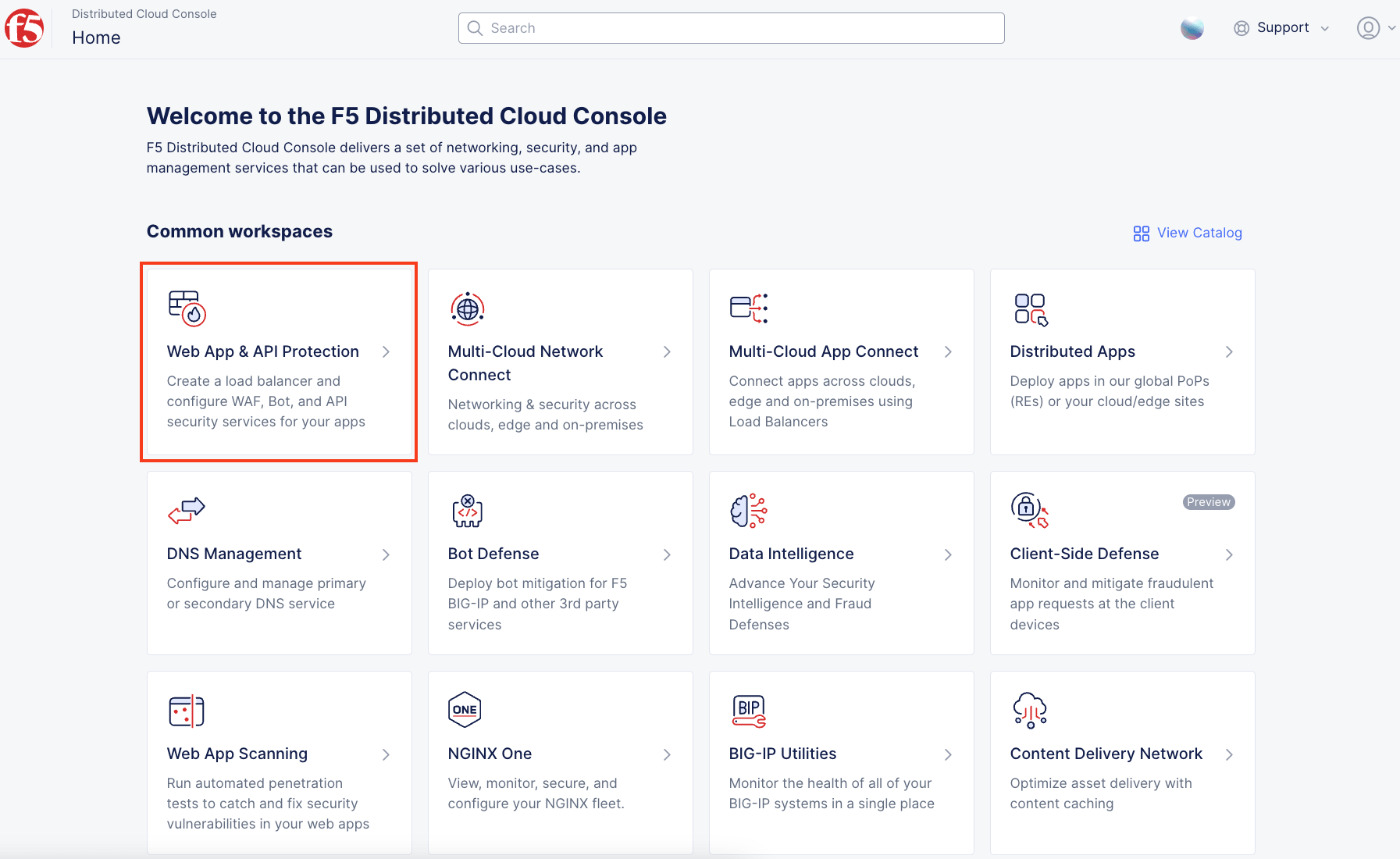
F5's Web Application and API Protection solution converges WAF, API security, bot management, and DDoS mitigation into the F5 Application Delivery and Security Platform. Rather than a single product, it is a set of enforcement points that can be deployed as SaaS, on BIG-IP hardware or virtual editions, or alongside NGINX in containerized environments.
The common thread is consistent policy management across those form factors, so the same protections apply whether an application sits in a data center, a public cloud, or at the edge. F5 also pairs inline enforcement with continuous assessment of the external attack surface, feeding scanning results into remediation prioritization.
Key features include:
- Virtual patching: WAF protections mitigate OWASP Top 10 categories and zero-day risk while permanent fixes are developed, applied consistently across hybrid multicloud deployments.
- Full lifecycle API security: Discovers and catalogs API endpoints, baselines normal behavior, and protects APIs from development through runtime with centralized enforcement.
- Web Application Scanning: Continuously assesses the external attack surface using automated testing to identify exposed applications and APIs and the vulnerabilities in them.
- Multi-signal bot defense: Uses client, device, browser, identity, and behavior signals to separate automated traffic from human users, applying step-up challenges only where needed.
- Client-Side Defense: Monitors third-party and injected browser scripts to identify data skimming and other client-side risks.
- DDoS mitigation across deployment models: Combines SaaS mitigation with on-premises controls through BIG-IP AFM and lightweight Layer 7 DoS protection for NGINX.
- Managed WAF service: A SaaS-delivered managed service option covers application protection on a 24/7 basis for teams without in-house WAF specialists.
Limitations (as reported by users on PeerSpot):
- Cost for smaller organizations: Reviewers state the service is not a fit for smaller players and that pricing is high in some regional markets.
- Integration with on-premises F5 products: The main issue raised is integration between the distributed cloud services and F5's on-premises WAF products.
- Implementation complexity: Reviewers describe challenges during implementation, particularly when combining distributed cloud and existing on-premises deployments.
- Console availability: One reviewer reports a 30-minute outage of the distributed cloud console in the preceding year.
- Non-public applications: Protecting applications that are not internet-facing requires deploying an additional customer edge layer, which adds setup work.
Source: F5
Application Vulnerability Testing and Management Platforms
6. Veracode Application Risk Management Platform

Best for: Full-lifecycle application testing and risk management
Strengths: SAST, DAST, SCA, container scanning, ASPM and AI remediation
Things to consider: Scan times and false-positive mitigation workflows
Rating: Rated 3.8 out of 5 across 25 reviews (G2)
Veracode packages application security testing and risk management into one platform covering the software development lifecycle. It combines static, dynamic, and composition analysis with container and infrastructure-as-code scanning, then layers posture management on top to consolidate findings across those engines.
The platform is used to identify vulnerabilities, determine which ones matter, and route them to the right owner for remediation. Veracode also sells human-led services alongside the tooling, including penetration testing as a service and application security consulting for teams that need help interpreting or fixing findings.
Key features include:
- Static analysis: Scans code as it is written, integrates with more than 40 development tools, and returns feedback in the IDE with a low false-positive rate.
- Dynamic analysis: Identifies runtime vulnerabilities in web applications and APIs through simulated attacks against running systems.
- Software composition analysis: Automates open-source scanning, surfaces newly disclosed vulnerabilities in dependencies, and tracks license risk.
- Risk Manager (ASPM): Prioritizes vulnerabilities, pinpoints the owner and root cause of each issue, and suggests a next best action for remediation.
- Package Firewall: Blocks vulnerable packages, malware, and policy violations from entering development pipelines before they reach the codebase.
- Container and IaC scanning: Scans container images and infrastructure-as-code for vulnerabilities, misconfigurations, and embedded secrets.
- Fix (AI code remediation): Generates remediation using reference patches designed by Veracode's own experts rather than unconstrained model output.
- Penetration Testing as a Service: Provides manual testing by experienced penetration testers alongside the automated scanning engines.
Limitations (as reported by users on G2):
- Scan duration: Source code analysis can take considerable time, which some reviewers say discourages developers from running scans as often as intended.
- False positive handling: Mitigating false positives is described as not straightforward, with dependency on the Veracode administration team interrupting the workflow.
- Third-party library coverage: One reviewer reports the platform did not handle third-party libraries well, producing findings that needed to be explained away.
- Setup complexity: Ease of setup scores low on G2 relative to other capabilities, indicating that initial configuration takes effort.
- Upload feedback: When an upload of a binary or package fails, reviewers note that users are not notified immediately.
7. Snyk AI Security Platform
Best for: Developer-first scanning of code, dependencies, and AI output
Strengths: SCA, SAST, container, IaC and DAST with reachability analysis
Things to consider: SAST false positives; DAST sits in a separate interface
Rating: Rated 4.5 out of 5 across 132 reviews (G2)
Snyk provides scanning products that developers run inside their existing workflows, covering first-party code, open-source dependencies, container images, infrastructure as code, secrets, and running web applications and APIs. Findings surface in the IDE and pull request rather than only in a separate security console.
The platform has been extended with Evo, a layer aimed at securing agentic development. This governs which external tools AI coding agents may use, monitors agent behavior during execution, and applies checks to code at the moment it is generated. Snyk also runs AI-based penetration testing and red teaming to find chained business-logic flaws.
Key features include:
- Software composition analysis: Snyk Open Source identifies vulnerabilities in dependencies and reports the versions in which each issue is fixed.
- Static analysis: Snyk Code scans first-party source for vulnerabilities, using DeepCode AI paired with deterministic engines rather than model output alone.
- Dynamic testing: Snyk API & Web provides DAST coverage for running web applications and APIs.
- Container and IaC scanning: Snyk Container and Snyk IaC extend coverage to container images and infrastructure definitions, with Snyk Secrets detecting exposed credentials.
- Reachability analysis and risk scoring: Prioritizes findings by whether vulnerable code is actually reachable, combined with application intelligence and risk scores.
- Agent Fix: Generates one-click remediation in the IDE and pull request, layering Snyk's security intelligence on top of frontier model output.
- Agentic Development Security: Validates external tools before agents use them, governs agent behavior at execution, and applies guardrails across AI assistants, IDEs, and pipelines.
- Continuous Offensive Security: Runs AI-driven penetration testing and red teaming to surface architectural flaws and chained business logic vulnerabilities.
- Governance and measurement: Automated policy enforcement and analytics track risk reduction, developer adoption, and remediation rates.
Limitations (as reported by users on G2):
- False positives: Reviewers report false positives across the platform, with the SAST results described as less mature and noisier than the composition analysis side.
- Fix recommendations: Suggested upgrade versions can introduce breaking changes, so teams still perform manual compatibility research before applying them.
- Scan duration in pipelines: Scans of medium-sized repositories can take several minutes, which reviewers say slows down CI/CD pipelines.
- Separate DAST interface: The DAST product runs in its own interface rather than being folded into the main Snyk console, which reviewers attribute to its acquisition history.
- License risk handling: One reviewer notes that license-related issues are handled less effectively than security vulnerabilities.
8. Invicti Platform

Best for: DAST-first testing with proof-based vulnerability validation
Strengths: Proof-based DAST, API testing, ASPM correlation, CI/CD orchestration
Things to consider: Large scans are slow; API scanning can need manual setup
Rating: Rated 4.5 out of 5 across 500+ reviews (G2)
Invicti takes a dynamic-testing-first approach, concentrating on exploitable vulnerabilities in live applications rather than issues identified only in source. Its proof-based scanning automatically attempts to verify whether a finding is genuinely exploitable, producing proof of exploit for common vulnerability classes.
Around that core, Invicti adds static analysis, software composition analysis, container and IaC coverage, and a posture management layer that ingests findings from other scanners. That layer correlates and deduplicates results into a single prioritized view, with suppression rules to remove noise that would otherwise reach developers.
Key features include:
- Proof-based DAST: Tests running applications and automatically validates which findings are exploitable, reducing the manual triage that follows a scan.
- API security testing: Discovers APIs across the attack surface and tests them alongside web applications, with a network traffic analyzer that integrates with Kubernetes.
- Agentic pentesting: Automates real-world attack techniques against applications as an extension of the dynamic testing engine.
- Vulnerability management (ASPM): Ingests findings from other security tools, correlates duplicates across scanners, and applies custom suppression rules to a single prioritized view.
- Static and supply chain scanning: Covers SAST, open-source dependencies, SBOM generation and license tracking, exposed secrets, container images, and ingested IaC findings.
- CI/CD orchestration: A CLI orchestrates scanners across pipelines and triggers scans, imports, and escalations without manual intervention.
- Two-way issue tracker sync: Keeps issues current in Jira, GitHub, and Azure Boards until they are resolved, rather than pushing findings one way.
- Remediation metrics and reporting: Tracks time-to-triage and time-to-fix by project and team, and generates dashboards and compliance reports for different audiences.
- Threat intelligence scoring: Adjusts vulnerability risk scores automatically based on reachability, exploitability, and threat intelligence data.
Limitations (as reported by users on G2):
- API scanning fit: One reviewer reports being unable to use the platform for API scanning because their API structure did not match how Invicti approaches API discovery.
- Scan duration on large applications: Deep scans of large or complex applications are described as time-consuming and resource-intensive.
- Finding volume: Reviewers note that the amount of output can be substantial, and filtering remaining false positives takes manual effort and experience.
- Pricing and licensing: Costs are described as high for smaller organizations, with reviewers citing annual price increases and changing target definitions.
- Authentication recording: Some reviewers found login chain capture easier to set up in competing scanners.
- Retest behavior: One reviewer reports that retest results do not always clear a finding once the underlying issue has been fixed.
Security Features and Protection Coverage
Evaluate candidate services based on the breadth and depth of their security features. A solution should include capabilities for WAF, DDoS mitigation, runtime protection, bot management, and API security. Pay attention to functions like behavioral analysis, threat intelligence integration, and automated vulnerability discovery.
Assess the provider's ability to deliver consistent protection across all relevant environments—public cloud, on-premises, multi-cloud, and hybrid architectures. Review independent security testing, customer references, and compliance certifications.
Integration, Compatibility, and DevOps Fit
Any application protection service you choose should fit within your technology stack and workflows. Assess APIs, SDKs, and prebuilt integrations for compatibility with your CI/CD pipelines, orchestration tools, and deployment environments. Look for solutions that automate threat detection and enforcement, reducing manual security overhead and supporting agile development cycles.
Test how well the service handles unique configurations, legacy systems, and polyglot application architectures. Ensure the solution deploys flexibly whether on cloud, on-premises, or hybrid, without introducing latency or bottlenecks.
Visibility, Monitoring, and Maintenance
Continuous visibility is essential for detecting attacks and ensuring the ongoing effectiveness of protection measures. Choose services with robust dashboards, real-time alerting, and granular reporting that provide actionable insights into application health, security events, and compliance status. Solutions should support centralized management and strong audit capabilities for incident response and regulatory requirements.
Consider maintenance needs as application landscapes evolve. The best services offer automated updates to threat signatures, policy templates, and behavioral models. Periodic reviews, attack simulation, and performance health checks ensure your defenses keep pace with changes in application logic or attacker tactics.
Support and SLAs
Reliable support and clear service-level agreements (SLAs) are vital to maximize the value of any application protection service. Review the provider's support model — 24x7 coverage, escalation processes, and access to security experts. Responsive, knowledgeable support reduces downtime during incidents and helps with complex integrations or tuning scenarios.
Carefully examine SLAs for guaranteed uptime, response times, and resolution metrics. Top providers back their services with financial penalties for missed targets. Ongoing training, documentation, and community resources can also make a significant difference in maximizing deployment speed and operational efficiency.
Modern application protection requires more than just isolated security controls; it demands integrated, adaptive defenses that operate consistently across diverse environments. As threats grow in sophistication and scale, effective solutions must offer deep visibility, real-time detection, and automated response while minimizing operational complexity. A strong application protection strategy supports agility, aligns with DevOps workflows, and enables secure innovation without compromising performance or user experience.