Summary: Securing multi-agent AI systems means controlling agent discovery, identity, runtime behavior, and tool access. Radware Agentic AI Protection is best for runtime behavioral defense of agent ecosystems, Palo Alto Prisma AIRS is best for full AI lifecycle coverage, Okta is best for AI Agents agent identity, and Zenity governance is best for SaaS-built agents.
What are Commercial Tools for Securing Multi-Agent AI Systems?
Commercial tools for securing multi-agent AI systems are security platforms used to govern autonomous AI agents that interact with other agents, applications, APIs, models, data sources, and external tools. They provide visibility into which agents exist, what identities and permissions they use, how they communicate, and which resources they can access. This helps security teams detect unmanaged agents, excessive privileges, unsafe tool connections, and risky dependencies across complex agent ecosystems.
These tools also apply runtime controls to agent behavior after deployment. Capabilities can include prompt injection detection, agent-to-agent monitoring, MCP and API security, behavioral anomaly detection, policy enforcement, short-lived credentials, and human approval for sensitive actions. By combining identity, posture, and runtime controls, commercial platforms help contain compromised agents and reduce the risk that one unsafe action propagates across a multi-agent workflow.
This is part of a series of articles about API security.
In this article:
The table below summarizes the key differences between the tools covered in this section. Each one is explored in more detail below, including features, integrations, and reported limitations.
| Category |
Solution |
Best For |
Key Strengths |
Things to Consider |
| Agentic AI runtime protection and posture management |
Radware Agentic AI Protection |
Runtime defense of enterprise AI agent ecosystems |
Intent-aware behavioral detection with agent risk graph mapping |
Recent release with limited independent review coverage |
| Agentic AI runtime protection and posture management |
Palo Alto Networks Prisma AIRS |
Securing the full AI lifecycle from build to runtime |
Agent identity checks, red teaming, and posture in one platform |
Value depends on adopting the wider Palo Alto ecosystem |
| Agentic AI runtime protection and posture management |
Noma Security AI Agent Security |
Mapping cascading risk across connected AI agents |
Blast-radius mapping with MCP and tool-level context |
Little independent review coverage and no public pricing |
| Agentic AI runtime protection and posture management |
Zenity |
Governing agents built in SaaS and low-code platforms |
Exploitability testing tied to runtime policy enforcement |
No published pricing or independent user review coverage |
| Agentic AI runtime protection and posture management |
Cloudflare AI Security Suite |
Controlling agent access to MCP servers and AI APIs |
MCP server portals, AI firewall, and DLP on one network |
Capabilities span several products across the platform |
| Agent identity and access governance |
Okta for AI Agents |
Treating AI agents as governed enterprise identities |
Agent registry, short-lived credentials, and a kill switch |
Regulated-environment plan excludes several capabilities |
| Agent identity and access governance |
Microsoft Entra Agent ID |
Governing agents inside a Microsoft identity estate |
Conditional Access and lifecycle governance for agents |
Full capability set depends on Microsoft licensing tiers |
| Agent identity and access governance |
SailPoint Agent Identity Security |
Governing agents alongside human and machine identities |
Agent ownership, certification, and service-account governance |
Implementation and licensing effort typical of enterprise IGA |
Agents May Operate with Different Identities and Permissions
In multi-agent AI systems, each agent may be assigned unique identities and specific permissions tailored to its role. This diversity allows for granular control over what each agent can access and do, but it also expands the attack surface. If identity management is inconsistent or poorly enforced, attackers can exploit gaps to impersonate agents, escalate privileges, or gain unauthorized access to sensitive resources.
The management of identities and permissions becomes more challenging as the number of agents grows. Manual processes for tracking and updating credentials are error-prone and difficult to scale. Automated solutions must be robust enough to handle dynamic changes, such as agents being added, removed, or reassigned, while ensuring that permissions remain tightly aligned with each agent’s intended purpose and security policies.
Compromised Agents Can Influence Other Agents
A compromised agent within a multi-agent system poses a significant risk because it can interact with and potentially manipulate other agents. Attackers can leverage the trust relationships between agents to propagate malicious instructions or data, leading to cascading failures or coordinated attacks across the system. This interconnectedness means that a single point of compromise can quickly become a system-wide threat.
Defending against this requires continuous monitoring of agent behavior and communications. Security teams must be able to detect when an agent deviates from its expected actions or attempts to influence others in unauthorized ways. Without these controls, a compromised agent can bypass traditional security boundaries, making it much harder to contain breaches and protect critical business processes.
Related content: Read our detailed guide to agentic AI security.
Autonomous Workflows Can Trigger High-Impact Actions
Multi-agent AI systems are often entrusted with executing autonomous workflows that can trigger significant actions, such as financial transactions, system reconfigurations, or data transfers. If an agent is compromised or manipulated, it could initiate unintended or malicious workflows with far-reaching consequences. The autonomous nature of these workflows amplifies the potential impact of errors or attacks, as actions may be executed at machine speed without human oversight.
This risk is compounded by the complexity of workflows that span multiple agents, each responsible for a different part of the process. Attackers may exploit these dependencies to craft sophisticated attacks that evade detection by targeting less obvious points of failure. Effective security requires comprehensive monitoring of workflow execution, strong validation of agent actions, and the ability to intervene quickly when anomalies are detected.
Agent-to-Agent Communication Is Difficult to Monitor
Agent-to-agent communication is a cornerstone of multi-agent AI systems, enabling coordination and collaboration. However, this communication is often dynamic, high-volume, and may use proprietary protocols or encrypted channels, making it difficult to monitor and analyze for security threats. Traditional network monitoring tools may not capture the full context or intent behind agent interactions, limiting their effectiveness in detecting malicious activity.
Additionally, agents may exchange sensitive information or commands that, if intercepted or manipulated, could compromise the entire system. Security teams need specialized tools that can parse and understand agent communications in real time, flagging unusual patterns or unauthorized data flows. Without this visibility, malicious actions can go undetected, increasing the risk of data breaches and operational disruptions.
1. Agent Discovery and Inventory
Agent discovery and inventory features automatically identify all agents operating within the environment, cataloging their roles, identities, and interconnections. Maintaining an up-to-date inventory helps security teams understand the system’s attack surface, spot unauthorized agents, and ensure that all components are accounted for during security assessments.
A reliable discovery process also supports compliance and incident response by providing a clear map of the system’s architecture. It enables organizations to quickly isolate or remediate compromised agents and evaluate the impact of security incidents. Without accurate inventory and discovery, blind spots can emerge, allowing malicious or rogue agents to operate undetected within the ecosystem.
Related content: Read our detailed guide to AI security posture management.
2. Agent Identity and Access Management
Agent identity and access management (IAM) controls are essential for enforcing who or what each agent can access and do within the system. These controls include mechanisms for assigning, verifying, and updating agent identities, as well as defining granular permissions based on least privilege principles. Effective IAM reduces the risk of unauthorized actions and limits the potential damage from compromised agents.
Automated IAM solutions can dynamically adjust permissions as agents are added, removed, or change roles, ensuring that security policies remain up to date. They also support auditing and compliance by maintaining detailed logs of identity and access changes. In complex multi-agent environments, strong IAM is a critical safeguard against privilege escalation, impersonation, and lateral movement by attackers.
3. Prompt Injection and LLM Threat Protection
Prompt injection and threats targeting large language models (LLMs) represent emerging risks in multi-agent AI systems. Attackers can craft malicious prompts or data inputs to manipulate agent behavior, extract sensitive information, or bypass intended safeguards. Security tools must detect and neutralize these attacks by validating inputs, sanitizing prompts, and applying contextual analysis to agent interactions.
Advanced threat protection solutions use machine learning and behavioral analysis to identify suspicious patterns that indicate prompt injection or LLM exploitation attempts. They provide real-time alerts and automated defenses to prevent malicious commands from being executed. As LLMs become more deeply integrated into multi-agent systems, these protections are vital for maintaining the integrity and reliability of automated workflows.
4. MCP Server and Tool Security
MCP (Multi-Agent Control Plane) server and tool security involves protecting the central infrastructure that manages agent orchestration, coordination, and policy enforcement. Security tools must ensure that MCP servers are hardened, access is tightly controlled, and administrative actions are logged and monitored. Compromising the MCP can give attackers broad control over the entire agent ecosystem, making it a high-value target.
Effective security also includes regular vulnerability assessments, patch management, and network segmentation to minimize the impact of potential breaches. In addition, tools should provide mechanisms for rapid containment and recovery in the event of an MCP compromise. Ensuring the integrity and availability of MCP servers is critical for maintaining trust and operational continuity in multi-agent AI deployments.
5. Malicious AI-Oriented Bot and Automated Abuse Protection
As AI agents become more common, organizations must also defend against malicious AI-powered bots that interact with their systems. These bots can probe APIs, scrape sensitive data, automate account abuse, or attempt prompt injection attacks at a scale that is difficult to match with manual defenses. Multi-agent security platforms help distinguish legitimate enterprise agents from unauthorized automated clients by evaluating identity, behavior, request patterns, and the context of each interaction.
Protection typically combines bot detection, API security, rate limiting, behavioral analysis, and anomaly detection. Rather than relying only on IP addresses or request signatures, modern tools analyze how an agent behaves over time and whether its actions match its expected role. This allows security teams to block abusive automated traffic while allowing trusted AI agents to continue operating, reducing the risk of service disruption, data theft, and automated attacks.
How we selected these tools: We shortlisted commercial multi-agent AI security tools based on agent discovery and inventory, agent identity and access management, prompt injection and LLM threat protection, runtime API and MCP visibility, behavioral abuse detection, and governance and compliance reporting.
Agentic AI Runtime Protection and Posture Management
1. Radware Agentic AI Protection
Best for: Runtime defense of enterprise AI agent ecosystems
Strengths: Intent-aware behavioral detection with agent risk graph mapping
Things to consider: Recent release with limited independent review coverage
Radware Agentic AI Protection is a security solution for autonomous AI agents operating across enterprise environments. It combines continuous discovery of agents, runtime behavioral threat detection, and AI security posture management in a single product, and addresses risks such as rogue agents, prompt injection, data exfiltration, and agent misuse.
The solution analyzes agent behavior from outside the agent environment rather than relying only on software guardrails inside it. It records agent-to-agent and agent-to-tool interactions, applies long-term behavioral analysis, and maintains a risk graph that scores exposure across the agent ecosystem. It supports both inline and out-of-band enforcement.
Key features include:
- Agent discovery and inventory: Continuously identifies AI agents across the environment, including homegrown and SaaS-based agents, and maps the tools, applications, and systems each one can reach.
- Agent-to-agent and agent-to-tool visibility: Monitors interactions between agents and between agents and their tools, covering multi-step and cross-agent behavior rather than single requests in isolation.
- Intent-aware behavioral detection: Applies runtime behavioral algorithms to identify prompt injection, agent behavior hijacking, tool misuse, memory poisoning, supply chain attacks, and rogue or compromised agents.
- AI security posture management: Maintains a dynamic risk graph that maps agent activity, dependencies, and vulnerabilities, and highlights multi-agent risk paths and potential data exposure.
- Inline and out-of-band enforcement: Supports both deployment models, so controls can sit in the request path or run alongside it.
- Platform integrations: Connects to Microsoft 365 Copilot, Microsoft 365 Copilot Studio, AWS Bedrock, and custom-built agents.
- Developer-hosted agent coverage: Extends monitoring and tool-usage governance to agents running on developer endpoints, including Anthropic Claude Code.
- Compliance reporting: Produces audit-ready reports intended to support alignment with ISO 42001, the EU AI Act, and the NIST AI Risk Management Framework.
Limitations (based on publicly available sources):
- Recent product release: The solution launched in 2026, so verified user reviews are not yet published on the major software review platforms.
- Usage-linked cost components: Marketplace pricing is charged per protected seat, with a separate add-on for additional token volume, so costs move with agent usage.
- Named platform coverage: Published integrations center on Microsoft Copilot, Copilot Studio, AWS Bedrock, and custom agents, so support for other agent platforms is worth confirming during evaluation.
2. Palo Alto Networks Prisma AIRS

Best for: Securing the full AI lifecycle from build to runtime
Strengths: Agent identity checks, red teaming, and posture in one platform
Things to consider: Value depends on adopting the wider Palo Alto ecosystem
Prisma AIRS is a platform for discovering, assessing, and protecting an organization's AI ecosystem, covering AI agents, applications, models, and data. It provides visibility into every agent, app, and model in the environment and shows how they connect, which is the starting point for governing multi-agent deployments.
The platform groups its functions into discovery, assessment, and protection. Assessment covers continuous testing of AI apps and agents, permission control, and posture monitoring. Protection covers runtime enforcement of AI-specific controls, agent identity verification, and blocking of unauthorized actions as agents move from pilot to production.
Key features include:
- Shadow AI discovery: Identifies AI agents, applications, and models across the environment and maps the connections between them.
- Agent security: Verifies the identity of every agent and applies real-time controls intended to stop unauthorized actions as agent deployments scale.
- AI runtime security: Monitors AI behavior during live interactions and enforces safeguards against manipulation, data exposure, and unsafe actions.
- AI red teaming for multi-agent systems: Simulates real-world attacks against AI agents and applications, with support for multi-turn attacks and profiling of agentic endpoints before assessment.
- AI model security: Scans third-party models for issues such as model tampering, malicious scripts, and deserialization attacks before they are adopted.
- AI posture management: Provides visibility and control over AI data used for training or inference, the integrity of agents and applications, and access to deployed models.
- AI Gateway: Acts as a control plane for enterprise AI activity, giving a single place to discover, govern, and secure AI usage.
- API violation reporting: Surfaces AI API security violations and threat detail within the platform's reporting views.
Limitations (as reported by users on Gartner Peer Insights):
- Cost and ecosystem dependency: Reviewers describe the platform as expensive and note that full value effectively requires committing to the wider Palo Alto Networks ecosystem.
- Licensing complexity: Licensing structure is cited as a barrier for smaller organizations evaluating the platform.
- Configuration effort: Setting up granular policies is described as cumbersome and carrying a significant learning curve for administrators.
- Early-stage capabilities: Some features are reported as still feeling early-stage or limited, which adds time to getting value from the platform.
- Alert and report tuning: Certain alerts and reports are said to require extra adjustment to fit a specific environment, creating manual work.
- Pace on niche threats: Reviewers note the vendor can be slower than specialized providers to ship protections for newly emerging AI attack techniques.
3. Noma Security AI Agent Security

Best for: Mapping cascading risk across connected AI agents
Strengths: Blast-radius mapping with MCP and tool-level context
Things to consider: Little independent review coverage and no public pricing
Noma Security AI Agent Security is a solution for managing autonomous AI agents across an enterprise, built around discovery, posture management, and runtime protection. It automatically discovers agents in the environment and builds a contextual profile of each one, covering its toolsets, functionality, data access permissions, and MCP server connections.
The product is oriented around the idea of an agent blast radius. It analyzes each agent's connections, tools, identities, and knowledge sources to surface cascading risk scenarios, so combinations that would be dangerous in production can be identified before deployment. The Noma Agentic Risk Map brings these views together.
Key features include:
- Deep agent discovery: Finds every agent in the environment and records its complete profile, including tools, functionality, data access permissions, MCP server connections, and operations.
- Blast radius visualization: Maps each agent's connections, tools, identities, and knowledge sources to reveal how a single compromise could cascade through connected systems.
- Pre-deployment risk interception: Flags dangerous capability and permission combinations before an agent goes live rather than after it is running.
- Over-permission detection: Monitors for over-permissive and potentially destructive agent capabilities and enforces enterprise policies against unauthorized actions and data exposure.
- Runtime guardrails: Enforces real-time controls on models and agents in production, detecting and blocking malicious prompts, rogue outputs, and unauthorized agent actions.
- Agentic access control: Provides policy-based approval, runtime enforcement, and continuous monitoring of what agents are permitted to do.
- MCP server security: Covers the MCP servers agents connect to as part of the platform's threat detection scope.
- Red teaming: Runs offensive testing against AI systems to identify weaknesses before attackers do.
Limitations (based on publicly available sources):
- No verified user reviews: Product profiles on G2, Gartner Peer Insights, and PeerSpot currently carry no published customer reviews, so independent validation is limited.
- No published pricing: Pricing is not listed publicly and requires direct contact with the vendor, which lengthens budgeting and comparison work.
- Coverage-dependent value: Discovery, blast radius mapping, and posture scoring rely on the platform being connected across every environment where agents run.
- Complementary to identity tooling: The platform focuses on agent discovery, posture, and runtime behavior rather than acting as an identity provider, so it is typically paired with an existing IAM or governance stack.
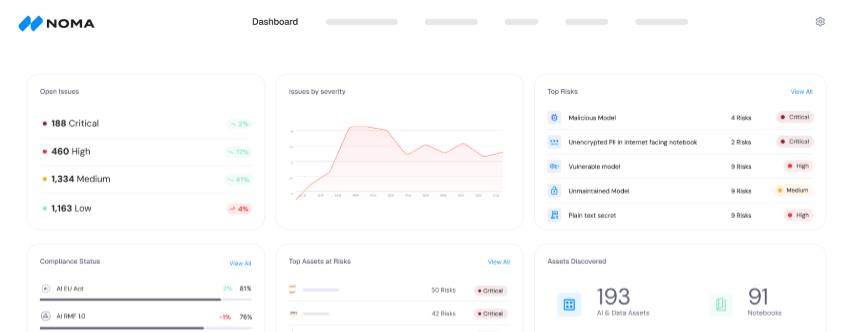
Source: Noma Security
4. Zenity

Best for: Governing agents built in SaaS and low-code platforms
Strengths: Exploitability testing tied to runtime policy enforcement
Things to consider: No published pricing or independent user review coverage
Zenity is an AI agent security and governance platform organized into three layers: surface, enforce, and protect. It builds a live inventory of agents across SaaS, custom, and endpoint deployments, evaluates how each is configured, and tests which of its attack paths are actually exploitable.
The platform is aimed at environments where agents are created inside business tools rather than only by engineering teams. It covers agentic SaaS such as Salesforce Agentforce and Copilot Studio, cloud and homegrown agents on platforms such as AWS Bedrock and Google Vertex AI, and personal and coding agents running locally.
Key features include:
- AI observability: Builds a live inventory of agents across SaaS, custom, and endpoint deployments and tracks the data each agent touches.
- AI security posture management: Evaluates agent configuration and permissions against policy before an agent is allowed to go live.
- AI exposure management: Validates which of an agent's attack paths are exploitable, scores each one, and produces a fix that can be applied through runtime boundaries.
- Runtime boundaries: Applies enforcement policies to agent behavior in production, taking the output of exposure testing as input.
- Agentic identity: Covers the identity an agent acts under as a distinct control point within the platform.
- MCP security: Addresses the MCP layer agents use to reach tools and external systems.
- AI detection and response (AIDR): Provides threat detection and response for agent activity across connected environments.
- Multi-platform agent coverage: Supports agents in ChatGPT Enterprise, Claude Enterprise, Microsoft 365 Copilot, Microsoft Foundry, Power Platform, Salesforce, ServiceNow, AWS Bedrock, and Google Vertex AI.
Limitations (based on publicly available sources):
- No verified user reviews: The vendor's G2 profile lists no published reviews, and no product review profile is available on Gartner Peer Insights, so buyer validation relies largely on vendor material.
- No published pricing: Pricing is available only through a sales conversation, with no public tiers or entry point.
- Deployment breadth required: Coverage depends on connecting the platform across SaaS, cloud, homegrown, and endpoint environments, which takes coordination across several teams.
- Agent-centric scope: The platform focuses on agent behavior and configuration rather than the underlying network, endpoint, or cloud infrastructure controls, which remain the job of existing tooling.
5. Cloudflare AI Security Suite

Best for: Controlling agent access to MCP servers and AI APIs
Strengths: MCP server portals, AI firewall, and DLP on one network
Things to consider: Capabilities span several products across the platform
Cloudflare's AI Security Suite brings model traffic, MCP servers, AI applications, and data controls onto a single network platform. For multi-agent deployments, the central capability is MCP server portals, which centralize access to third-party and internal MCP servers behind a single URL and apply zero trust policies to every agent connection.
The suite also covers public-facing AI applications. It discovers models and APIs across an organization's web properties and applies an AI firewall that blocks prompt injection, model poisoning, abusive usage, and sensitive data exposure. Data loss prevention and spend controls operate across the same policy layer.
Key features include:
- MCP server portals: Centralize agent connections to internal and third-party MCP servers, curate which tools and prompts are exposed, and connect through a single URL instead of configuring each server.
- Least-privilege agent access: Authenticate every user and agent connection through zero trust network access, with permissions scoped by identity.
- MCP request logging: Aggregate all MCP request logs in one place for auditing and analysis of what agents actually did.
- AI security for apps: Discover models and APIs across web properties and block prompt injection, model poisoning, abusive usage, and sensitive data exposure with a purpose-built AI firewall.
- AI Gateway: Route requests to AI models through a single control plane with visibility, rate limits, caching, guardrails, and cost controls across providers.
- Data loss prevention: Detect sensitive information in AI-bound traffic and apply policies to model requests, browser sessions, and SaaS destinations.
- Shadow AI discovery: Combine SaaS analytics with traffic policy controls to find and manage unsanctioned AI usage, with AI-SPM delivered through CASB integrations.
- Spend limits: Set real-time spend caps on AI usage across multiple models and providers.
Limitations (based on publicly available sources):
- Capabilities span multiple products: Agent controls are delivered across ZTNA, secure web gateway, CASB, DLP, AI Gateway, Workers, and the WAF, so getting full coverage means adopting several parts of the platform.
- Traffic must route through Cloudflare: MCP governance, logging, and firewall inspection depend on agent and application traffic passing through Cloudflare's network.
- AI-SPM tied to supported integrations: Posture findings for AI tools are surfaced through CASB integrations for specific services, so coverage depends on the connectors available.
- Not an agent identity system: The suite governs access and traffic rather than acting as an agent identity provider, so it is usually paired with an IAM platform for agent registration and lifecycle.
Agent Identity and Access Governance
6. Okta for AI Agents

Best for: Treating AI agents as governed enterprise identities
Strengths: Agent registry, short-lived credentials, and a kill switch
Things to consider: Regulated-environment plan excludes several capabilities
Okta for AI Agents brings AI agents into Okta as first-class identities within Universal Directory, so they can be discovered, onboarded, protected, and governed from a single control plane. It is structured around three questions: where the agents are, what they can connect to, and what they can do.
Discovery covers both known agents on platforms such as Salesforce and Microsoft Copilot Studio and unknown agents surfaced through OAuth consent grants. Once registered, agents and MCP servers sit in a central directory with an assigned human owner, and access to resources runs through policy rather than static credentials.
Key features include:
- Agent discovery: Continuously identifies known and shadow agents across the environment and shows what each can access and where it introduces risk.
- Agent registration and ownership: Registers agents and MCP servers in a centralized directory regardless of where they were built, and assigns a clear human owner for accountability and audit.
- Short-lived credentials: Issues temporary credentials to agents as they connect to resources, reducing reliance on long-lived tokens that can be reused if leaked.
- Connection control: Governs the connections agents depend on, covering MCP servers, APIs, and other agents, with centrally enforced access policies and vaulted credentials.
- Agent Gateway: Puts identity in the path of agent tool calls, verifying the agent, controlling what it can reach, holding credentials, and logging each call without code changes to agents or tools.
- Lifecycle governance: Runs automated governance workflows across the agent lifecycle with a full audit trail of retained access.
- Rogue agent kill switch: Revokes access and blocks new token requests when an agent behaves unexpectedly.
- Regulated environment support: A separate Core SKU unlocks capabilities for FedRAMP High, FedRAMP Moderate, and HIPAA environments.
Limitations (as reported by users on G2, covering the wider Okta platform the agent product runs on):
- Authentication friction: Users report authentication and login issues, including repeated prompts on the same device, that interrupt access to connected applications.
- Pricing and licensing transparency: Cost is described as high and difficult to predict, with advanced capabilities packaged as separate add-ons rather than included in core plans.
- Setup and policy complexity: Initial configuration of policies, integrations, and permissions is reported as complex and time-consuming for teams new to identity management.
- Administration learning curve: The admin console is described as dense, with new administrators needing time before they can make changes confidently.
- Troubleshooting visibility: Diagnosing authentication or integration problems often means working through multiple logs and settings, and error messages are reported as vague.
- Reporting flexibility: Built-in reporting is described as limited for detailed audits, with users exporting data or relying on other tools for granular views.
- Regulated-environment feature gaps: The Core plan for regulated environments does not currently include identity security posture management, privileged access, or secure agent connections to service accounts and secrets.
7. Microsoft Entra Agent ID

Best for: Governing agents inside a Microsoft identity estate
Strengths: Conditional Access and lifecycle governance for agents
Things to consider: Full capability set depends on Microsoft licensing tiers
Microsoft Entra Agent ID applies the identity, lifecycle, and access controls used for employees to AI agents. Every agent receives a built-in agent identity that enables authentication, policy enforcement, and integration with existing organizational policies, and agents are inventoried and provisioned with least-privilege access to apps, resources, and other agents.
The product extends familiar Entra capabilities to agents rather than introducing a separate control set. Conditional Access, identity governance, identity protection, and network controls all apply to agent identities, and the capabilities are delivered as part of Microsoft Agent 365, the control plane for agents.
Key features include:
- Agent identity assignment at scale: Provisions identities to agents so each one can authenticate and be subject to policy, with blueprints, tasks, and logs managed centrally.
- Conditional Access for agents: Evaluates every access attempt and can block agents showing anomalous activity or acting on behalf of risky users, with granular policies based on security attributes.
- Identity governance: Assigns and maintains agent sponsors, automates governance from deployment through expiration, and makes access assignments auditable and time bound.
- Identity protection: Detects and flags unusual or unauthorized agent activity, traces agents with compromised tokens, and supports remediation of compromised agents.
- Network controls: Logs agent network activity for audit and threat detection, applies web categorization to APIs and MCP servers, restricts file uploads and downloads, and blocks malicious destinations.
- Agent registry and inventory: Provides a unified registry covering agents from Microsoft AI platforms, partner agents onboarded through the SDK, and self-registered agents from unmanaged platforms.
- Activity mapping: Surfaces usage insights and visual mapping of agent activity and connections across the environment.
- Cross-platform onboarding: The Agent 365 CLI and SDK provision identities for agents built on other frameworks and connect them to the control plane.
Limitations (based on publicly available sources):
- Licensing dependencies: Entra Agent ID capabilities are delivered through Microsoft Agent 365 or Microsoft 365 E7, and extending Entra security features to agents requires those licenses rather than a standalone purchase.
- Downstream license requirements: Conditional Access and Identity Protection for on-behalf-of agents are evaluated against the sponsoring user's token, so that user must hold the appropriate Microsoft 365 licensing for the controls to apply.
- Per-user cost model: Agent 365 is sold per user per month on an annual subscription, so costs scale with workforce size rather than with the number of agents deployed.
- Ecosystem alignment: Controls are built around Microsoft Entra and Microsoft 365 services, so agents running outside that estate must be brought in through the Agent 365 CLI or SDK.
- Preview functionality: Parts of the agent identity administration experience have been documented as preview features that may change before general release.
8. SailPoint Agent Identity Security
Best for: Governing agents alongside human and machine identities
Strengths: Agent ownership, certification, and service-account governance
Things to consider: Implementation and licensing effort typical of enterprise IGA
SailPoint Agent Identity Security brings AI agents, the users who can invoke them, and the tools they access into one governed view. Agents are aggregated from cloud and agent platforms and registered with a unique identity enriched with business and access context, so they can be governed with the same processes used for employees.
The product sits inside SailPoint Identity Security Cloud, which means human, non-employee, machine, and agent identities are managed in one place with consistent policy enforcement and certification. It also tracks indirect access, showing when human identities gain new entitlements or reach data through an agent.
Key features include:
- Multi-platform agent aggregation: Onboards agents from AWS, Microsoft Azure, Google Cloud Platform, Salesforce, and Microsoft Copilot Studio, with a universal web services connector for platforms that expose identity data over REST, SOAP, or GraphQL.
- Agent registration with context: Registers each agent with a unique identity enriched with business and access context so governance can begin immediately.
- Ownership assignment: Designates one or multiple human owners per agent, with succession planning so ownership transfers when roles change instead of leaving orphaned agents.
- Access certification for agents: Runs recurring reviews of agent access to confirm it matches business need, and revokes excessive or inappropriate permissions.
- Indirect access detection: Identifies when human identities gain entitlements or data access through an AI agent, covering both direct and indirect access paths.
- Service account governance: Governs the service accounts each agent uses to reach systems such as Workday or ServiceNow, from creation through retirement.
- Shadow AI visibility: Surfaces unmonitored AI tool usage so it can be remediated and users redirected to approved alternatives.
- Unified identity governance: Manages human, non-employee, machine, and agent identities within a single platform for consistent certification and lifecycle control.
Limitations (as reported by users on G2, covering the wider SailPoint platform the agent product runs on):
- Implementation complexity: Setup is described as time-consuming and requiring significant expertise, with rollouts commonly taking several months in complex environments.
- Total cost: Reviewers cite high licensing costs alongside implementation, specialist consulting, and ongoing maintenance, with additional modules priced separately.
- Support responsiveness: Slow response times are a recurring theme, along with a tendency to redirect issues toward paid expert services.
- Learning curve: Administrators without a development background report difficulty with rules, workflows, and connector configuration.
- Customization maintenance: Heavy use of custom code can break during upgrades, creating unplanned rework.
- Reporting limitations: Built-in reporting is described as difficult to use for pulling detailed statistical data.
- Feature delivery pace: Some requested capabilities are reported as taking a long time to reach the roadmap and ship.
As organizations adopt multi-agent AI systems, security must extend beyond protecting individual models to governing how autonomous agents discover resources, communicate, access data, invoke tools, and coordinate actions across complex workflows. Effective security platforms combine agent discovery, identity governance, runtime monitoring, prompt and tool inspection, behavioral analytics, and policy enforcement to provide continuous visibility and control over the entire agent ecosystem.