Summary: Auditing and securing agentic AI means tracing agent decisions and blocking unsafe actions at runtime. Radware is best for behavioral runtime defense of agentic systems, Prisma AIRS is best for platform consolidation, Zenity is best for agent action control, and IBM watsonx.governance is best for audit evidence.
What is Agentic AI Decision-Making and What Are the Risks of Unsecured Agents?
Agentic AI decision-making refers to artificial intelligence systems that operate as autonomous agents, capable of making complex decisions and executing actions without direct human oversight. Unlike traditional AI models that provide single outputs to user prompts, agentic AI systems can plan, reason, and act across multiple steps, often using a combination of models, APIs, and external tools. Enterprise tools for auditing and securing agentic AI focus on runtime interception, identity-native gateways, and centralized action traceability:
Key risks of unsecured agentic AI decisions include:
- Unauthorized access to data and applications: Unsecured agents can retrieve sensitive data, manipulate systems, or initiate transactions without proper oversight.
- Excessive agent permissions: Over-permissioned agents can cause broad damage if compromised, including deleting records, altering configurations, or accessing restricted systems.
- Prompt injection and indirect prompt injection: Attackers can manipulate agent instructions directly or through external sources, causing data leaks, policy bypasses, or harmful actions.
- Manipulation of agent memory: Corrupted or poisoned agent memory can bias future decisions, erase critical context, or cause unsafe behavior over time.
Key securing and auditing capabilities:
- Continuous AI agent discovery and inventory: Automatically identifies AI agents across cloud, SaaS, endpoints, and development environments, maintaining a continuously updated inventory of their identities, capabilities, permissions, and owners.
- Agent relationship and interaction mapping: Maps how agents interact with users, APIs, models, data sources, and other agents to reveal dependencies, trust relationships, and potential attack paths.
- Malicious bot and AI-driven automation detection: Detects unauthorized, compromised, or malicious AI agents and automation by analyzing behavioral anomalies, communication patterns, and suspicious execution activity.
- Behavioral and intent analysis: Evaluates agent reasoning, goals, and execution patterns to identify policy violations, unexpected behavior, and signs of prompt injection or misuse.
- Runtime protection for agent actions: Monitors and enforces security policies during execution, blocking, restricting, or requiring approval for high-risk actions before they affect downstream systems.
- API discovery and exposure mapping: Discovers the APIs agents access, classifies exposed data and permissions, and identifies risky endpoints, excessive privileges, and unauthorized integrations.
This is part of a series of articles about agentic AI security.
In this article:
The table below summarizes the key differences between the tools covered in this article, including what each one is built for and the trade-offs buyers report. We explore each of them in more detail in the sections that follow.
| Category |
Solution |
Best For |
Key Strengths |
Things to Consider |
| Runtime protection and posture management |
Radware Agentic AI Protection |
Enterprises needing runtime behavioral defense for AI agents |
Agent discovery, intent-based runtime protection, audit-ready reports |
Advanced policy tuning and deeper analytics take time to configure |
| Runtime protection and posture management |
Palo Alto Networks Prisma AIRS |
Enterprises consolidating AI security on one Palo Alto platform |
Agent discovery, red teaming, runtime enforcement, AI gateway control |
Costly, and full value depends on wider Palo Alto adoption |
| Runtime protection and posture management |
Zenity |
Securing SaaS, cloud and endpoint AI agents from one platform |
Agent inventory, exploitability testing, runtime action enforcement |
Performance and navigation reported as areas needing improvement |
| Runtime protection and posture management |
Noma Security |
Centralized discovery and control of autonomous AI agents |
Deep agent discovery, blast radius mapping, runtime guardrails |
SaaS-based architecture may not suit strict data residency rules |
| Governance and audit |
IBM watsonx.governance |
Enterprises needing audit-ready AI governance across many vendors |
Governance graph, control enforcement, 200+ regulatory frameworks |
Complex setup, high cost, weaker fit outside IBM ecosystem |
| Governance and audit |
Credo AI |
Governance teams registering and gating agents before deployment |
Agent registry, dependency graphs, policy packs, trace evaluation |
Some enforcement integrations are planned rather than available |
| Governance and audit |
OneTrust AI Governance |
Teams extending existing privacy and GRC programs to AI agents |
Central AI inventory, risk workflows, runtime guardrails, MCP policy |
Configuration heavy, with cost and usability concerns reported |
| Governance and audit |
Holistic AI |
Organizations pairing AI audit evidence with runtime intervention |
Shadow AI discovery, agentic red teaming, agent graph, kill switches |
Discovery connectors are read-only; enforcement needs SDK work |
For a broader view of the category, see our overview of application security tools.
Decisions May Span Multiple Models and Tools
Agentic AI systems often distribute decision-making across several models and third-party tools. An agent may use a language model for initial reasoning, call an external API for data, and then invoke a different tool to take an action. Each component might have its own logging, data handling, and security policies, resulting in fragmented audit trails. As a result, tracking the full lifecycle of a decision, from the initial prompt through to the final action, becomes cumbersome and sometimes impossible without unified monitoring.
Complicating matters further, each model or tool may update independently, change behavior, or introduce new vulnerabilities without notice. This distributed architecture leads to inconsistent visibility, making it difficult for auditors to reconstruct the sequence of events or assign responsibility for actions. The lack of standardized interfaces and logging across these components exacerbates the challenge, particularly in environments where agents interact with both proprietary and open-source systems.
Agents Can Change Plans During Execution
A defining feature of agentic AI is the ability to adjust plans mid-execution in response to new information or unexpected outcomes. An agent might initially plan a series of actions, but if it encounters an error or receives updated data, it can dynamically alter its course. This fluidity is valuable for achieving complex goals, but it also means that pre-defined audit expectations may quickly become obsolete as the agent deviates from its original plan.
From an auditing perspective, this adaptability creates gaps in traceability. Auditors may struggle to determine why the agent took a particular action or changed direction, especially if plan revisions are not explicitly logged. Without comprehensive versioning and context-aware monitoring, understanding the rationale behind each decision point becomes difficult. This can hinder root cause analysis, complicate compliance checks, and make it harder to detect unintended or malicious behaviors.
Outputs Depend on Dynamic Context and Memory
Agentic AI systems often leverage persistent memory and contextual awareness to inform their decisions. This means outputs are influenced not only by the current input but also by prior interactions, evolving datasets, and real-time environmental factors. The agent's memory may store user preferences, historical decisions, or intermediate results, all of which shape future actions in non-transparent ways. This dynamic context can create unpredictable outputs that are difficult to reproduce or explain after the fact.
For auditors, the reliance on mutable context and memory complicates the task of establishing a clear cause-and-effect relationship between inputs and outputs. The same request made at different times or under varying conditions could yield different results, depending on the agent’s state and memory contents. This variability undermines traditional auditing methods that rely on static snapshots of system behavior, making it necessary to develop new tools and techniques that can track and analyze evolving agent states over time.
Unauthorized Access to Data and Applications
Agentic AI systems often require access to sensitive data and critical applications to perform their tasks. If these agents are not properly secured, they can become vectors for:
- Unauthorized data access
- System manipulation
For example, a compromised or poorly configured agent might retrieve confidential information or initiate transactions without proper oversight, exposing organizations to data breaches or financial loss. The risk escalates when agents operate autonomously, making real-time decisions with little human intervention. Attackers could exploit vulnerabilities in agent permissions or communication channels to escalate privileges or bypass security controls.
Excessive Agent Permissions
Granting agents broad or poorly scoped permissions increases the risk of unintended actions or exploitation. If an agent is given access to more data or capabilities than necessary, a flaw or compromise could result in widespread system impact. Over-permissioned agents might inadvertently:
- Delete records
- Alter configurations
- Access restricted areas
This amplifies the consequences of both accidental errors and deliberate attacks. Effective permission management is critical in agentic AI environments. Auditors and security teams need to enforce the principle of least privilege, ensuring each agent has only the access required for its tasks. Regular reviews and automated tools to detect permission creep can help maintain a secure posture and minimize the attack surface.
Related content: Read our guide to application security.
Prompt Injection and Indirect Prompt Injection
Prompt injection occurs when malicious actors manipulate the inputs or instructions given to an agent, causing it to behave in unintended or harmful ways. Indirect prompt injection goes a step further, leveraging external data sources (such as web pages or APIs) that the agent consults during execution. Attackers can plant crafted content in these sources, knowing the agent will incorporate them into its reasoning or outputs.
These attacks are particularly challenging to detect and mitigate in agentic AI, where decision-making chains are complex and context-dependent. Prompt injection can:
- Subvert agent logic
- Leak sensitive information
- Trigger harmful actions without direct user involvement
Comprehensive input validation, sandboxing, and monitoring of agent interactions with external sources are essential to defend against these threats.
Manipulation of Agent Memory
Agentic AI systems often rely on internal memory to store context, preferences, or historical data across sessions. Attackers may target this memory to:
- Inject false information
- Erase critical context
- Subtly bias future agent decisions
Even small manipulations can have significant downstream effects, as the agent’s behavior may shift over time based on the corrupted memory state. Auditing and securing agent memory requires tools that can track changes, validate integrity, and detect anomalies. Without proper safeguards, manipulated memory can undermine the reliability, trustworthiness, and safety of agentic AI systems.
1. Continuous AI Agent Discovery and Inventory
Effective auditing begins with a comprehensive inventory of all active AI agents within an organization. Continuous discovery tools scan networks and systems to identify both sanctioned and unsanctioned agents, cataloging their capabilities, access rights, and operational scopes. This visibility is crucial for:
- Understanding the full landscape of agentic AI activity
- Detecting rogue or shadow agents that could pose security risks
Maintaining an up-to-date inventory allows organizations to enforce policies, assess exposure, and respond rapidly to incidents. Automated discovery tools can integrate with asset management platforms, providing real-time updates as agents are added, removed, or modified. This foundational capability supports risk assessment, compliance efforts, and the enforcement of security controls across dynamic, agent-driven environments.
2. Agent Relationship and Interaction Mapping
Agentic AI systems often operate in interconnected webs, collaborating with other agents, APIs, and external services. Auditing tools that map these relationships and interactions provide insight into the flow of data, commands, and decisions. Visualization of these connections helps identify:
- Potential points of failure
- Security vulnerabilities
- Unexpected dependencies that could be exploited
By systematically tracking how agents interact with each other and with external systems, organizations can better understand the scope of agentic decision-making. This mapping supports root cause analysis in the event of incidents and enables the identification of unauthorized or risky connections. Ongoing monitoring of these relationships is essential for maintaining security and compliance in complex agentic ecosystems.
3. Behavioral and Intent Analysis
Understanding not just what an agent does, but why it does it, is critical for effective auditing. Behavioral and intent analysis tools monitor agent actions, decision rationales, and goal pursuit to detect deviations from expected patterns. By analyzing the context and logic behind agent decisions, these tools can identify both accidental errors and deliberate manipulations, such as:
- Policy violations
- Malicious activity
This level of analysis often involves correlating action logs, reasoning outputs, and historical performance to build a comprehensive picture of agent behavior. Advanced tools may use machine learning to model normal agent intent and flag anomalies for further investigation. Intent analysis enhances the ability to enforce policies, ensure accountability, and maintain trust in agentic AI systems.
4. Runtime Protection for Agent Actions
Runtime protection monitors agent behavior as actions are executed, rather than relying only on post-incident analysis. These tools evaluate each action against security policies, risk thresholds, and operational constraints before it reaches downstream systems. If an agent attempts a high-risk operation, such as accessing sensitive data, transferring funds, or modifying production systems, runtime controls can:
- Require additional approval
- Block the request
- Limit its scope
Modern runtime protection also correlates agent activity with user identity, session context, and recent behavior to detect suspicious execution patterns. Instead of treating every action in isolation, it continuously evaluates whether the agent's decisions remain consistent with its assigned role and objectives. This helps prevent compromised agents, prompt injection attacks, or configuration errors from causing unauthorized actions while maintaining detailed logs for investigation and compliance.
How we selected these tools: We shortlisted enterprise tools for auditing and securing agentic AI decision-making based on agent discovery and inventory, relationship and dependency mapping, behavioral and intent analysis, runtime enforcement of agent actions, and audit-ready evidence and compliance reporting.
Agentic AI Runtime Protection and Posture Management Platforms
1. Radware Agentic AI Protection
Best for: Enterprises needing runtime behavioral defense for AI agents
Strengths: Agent discovery, intent-based runtime protection, audit-ready reports
Things to consider: Advanced policy tuning and deeper analytics take time to configure
Radware Agentic AI Protection monitors AI agents across enterprise environments and blocks agent-targeted manipulation and attacks without changing how the agents behave for users. It identifies intent automatically and responds in real time to agent attacks and abuse.
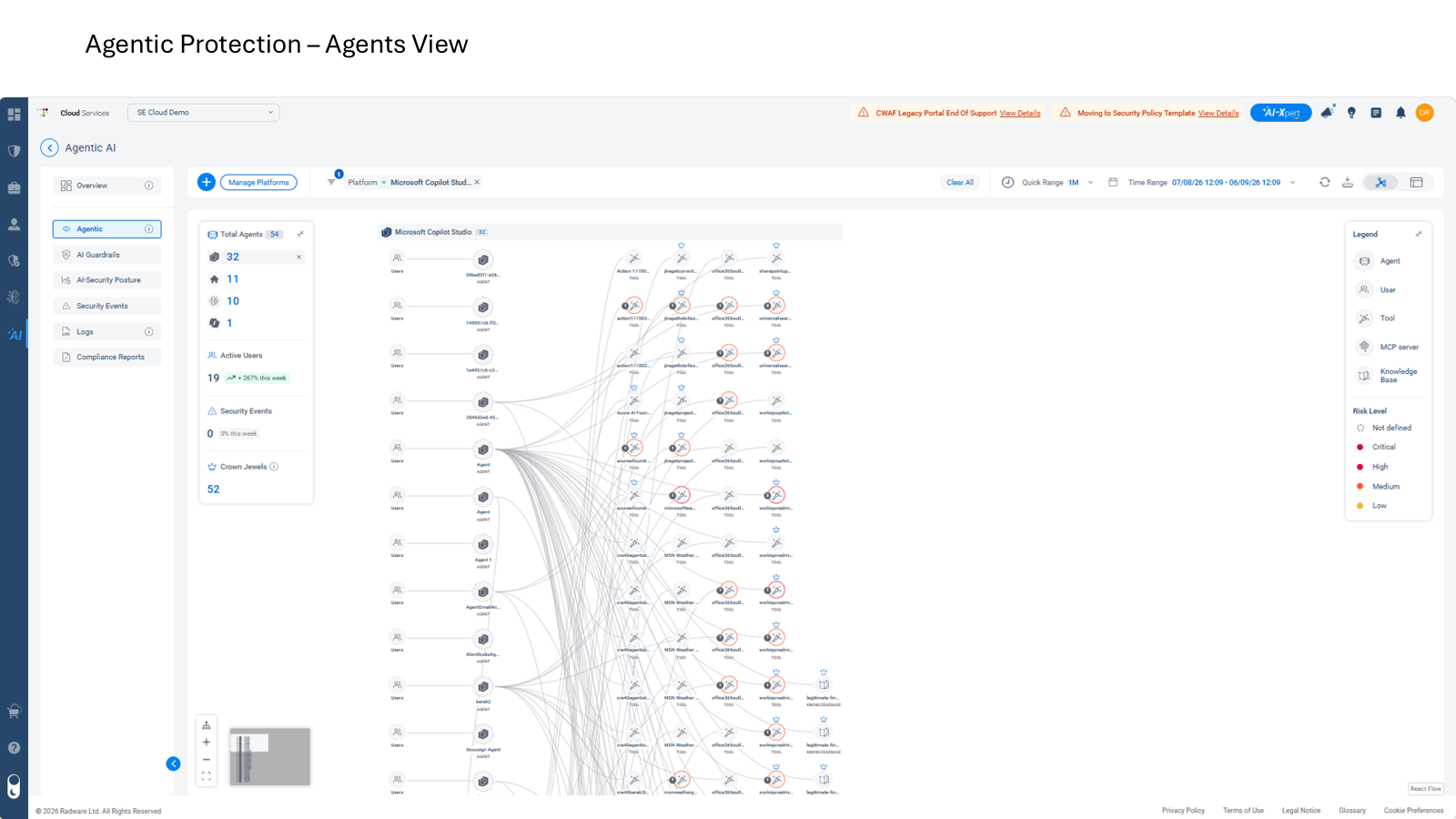
The solution maps agents, the tools they can reach and the interactions between them, applies guardrails to agent actions, and covers SaaS, homegrown and end-user device deployments. Coverage extends to developer-hosted agents running on the client side, including Claude Code agents.
Key features include:
- Agent tools discovery: Continuously discovers all types of agents and the tools they can access across environments, building a picture of what is running and what each agent can reach.
- Agent relationship mapping: Maps agent connections and dependencies so teams can see how activity and data move between agents and tools.
- Agent behavior analytics: Tracks usage trends, anomalies and performance changes across agent activity over time.
- Rich agent metadata: Provides visibility into agent configuration, usage patterns and the tools each agent has available.
- LLM guards: Builds guardrails that control usage, validate prompts and protect against prompt injection, jailbreaks, unsafe outputs and data leaks.
- Agent behavioral protection: Maintains runtime monitoring of agent actions and intents, detecting and mitigating malicious activity including indirect prompt injection, jailbreaking and supply chain attacks.
- MCP tool control: Allows or blocks specified tools per agent, monitors tool calls and blocks actions that diverge from the agent's assigned goal.
- Real-time security posture: Identifies and scores risks across agents and tools, completing and elaborating on the attack story as events unfold.
- Full execution risk graph mapping: Captures agent workflows across all AI environments, with an interactive connection map for tracking risk throughout the agent lifecycle.
- Posture management reports: Generates audit-ready reporting to demonstrate compliance with global standard requirements.
Limitations (as reported by users on Gartner Peer Insights, covering the broader Radware cloud application protection platform):
- Configuration depth: Some advanced configuration options can feel complex at first, particularly when fine-tuning policies for applications.
- Analytics navigation: Certain deeper analytics require switching between different views, which adds steps to day-to-day workflows.
- Support availability: Some users have found support capacity stretched when raising cases at busy periods.
Source: Radware Demo
2. Palo Alto Networks Prisma AIRS

Best for: Enterprises consolidating AI security on one Palo Alto platform
Strengths: Agent discovery, red teaming, runtime enforcement, AI gateway control
Things to consider: Costly, and full value depends on wider Palo Alto adoption
Prisma AIRS is Palo Alto Networks' platform for discovering, assessing and protecting AI agents, applications, models and data from a single console. It gives visibility into every AI agent, app and model in an environment and shows how they connect to each other.
The platform continuously tests AI apps and agents, controls permissions and monitors overall security posture in real time. At runtime it secures AI interactions and enforces AI-specific controls before threats reach downstream systems.
Key features include:
- AI Gateway: Acts as the AI control plane for the enterprise, used to discover, govern and secure every AI activity from one place.
- Agent Security: Verifies every agent identity and enforces real-time security controls to stop unauthorized agent actions as deployments scale from pilot to production.
- AI Runtime Security: Monitors AI behavior and applies safeguards during live interactions to prevent manipulation, data exposure and unsafe actions.
- AI Red Teaming: Simulates real-world attacks against AI agents and applications to find and close gaps before they are exploited at runtime.
- AI Model Security: Scans third-party models for issues including model tampering, malicious scripts and deserialization attacks before they are adopted.
- AI Posture Management: Provides visibility and control over AI data used for training or inference, the integrity of AI agents and apps, and access to deployed models.
- Shadow AI discovery: Identifies AI agents, applications and models across the environment, including deployments the security team has not sanctioned.
- Multi-agent testing and reporting: Recent releases add multi-turn attack support, red teaming for multi-agent systems, agentic target profiling, threat snippets in violation reporting and an API violations view.
Limitations (as reported by users on Gartner Peer Insights):
- Ecosystem dependency: Reviewers describe the platform as expensive and note that full value depends on committing to the wider Palo Alto Networks ecosystem.
- Licensing complexity: Licensing structure is described as a barrier for smaller organizations.
- Policy configuration: Setting up granular policies is reported as cumbersome, with a learning curve for administrators.
- Feature maturity: Some capabilities are described as early stage, and certain alerts and reports need extra tuning to fit a specific environment.
- Pace on niche threats: Reviewers note that a large vendor can be slower than specialist startups to ship protections for newly emerging AI attack techniques.
3. Zenity

Best for: Securing SaaS, cloud and endpoint AI agents from one platform
Strengths: Agent inventory, exploitability testing, runtime action enforcement
Things to consider: Performance and navigation reported as areas needing improvement
Zenity is an AI agent security and governance platform built around the agent's decision rather than its prompts alone. It reasons about what an agent can reach, whose authority it acts under and what it is actually trying to do, and is structured in three layers: surface, enforce and protect.
Coverage spans agentic SaaS such as Salesforce Agentforce and Copilot Studio, homegrown agents on platforms including AWS Bedrock and Google Vertex AI, and personal or coding agents running locally on endpoints.
Key features include:
- AI Observability: Builds a live inventory of agents across SaaS, custom and endpoint deployments and tracks the data each one touches.
- AI Security Posture Management (AISPM): Evaluates agent configuration and IAM permissions against policy before an agent reaches production.
- AI Exposure Management: Validates which of an agent's attack paths are actually exploitable rather than theoretical, scores each one and ships a fix ready to apply in Runtime Boundaries.
- Runtime Boundaries: Evaluates every action an agent takes in real time and lets it through, blocks it, or shuts the agent down.
- Agentic Identity: Correlates enforcement with the agent's actual credentials so a deactivated or over-scoped role is caught before it is exploited.
- AIDR: Monitors agent execution step by step, mapped to OWASP and MITRE ATLAS, and blocks unsafe actions as they occur.
- MCP Security: Extends coverage to agent interactions that run through Model Context Protocol connections.
- Decision chain reconstruction: Rebuilds the full decision chain when something gets through, with Guardian Agents learning from each investigation to sharpen subsequent rules.
Limitations (based on publicly available sources):
- Performance at scale: Public product summaries point to speed, efficiency and handling of large datasets as areas needing improvement.
- Navigation: Interface navigation is cited as an area users would like refined.
- Customization and integration: Customization options and integration capabilities are described as limited compared with broader security platforms.
- Documentation: Product documentation is noted as an area that could be more complete.
4. Noma Security

Best for: Centralized discovery and control of autonomous AI agents
Strengths: Deep agent discovery, blast radius mapping, runtime guardrails
Things to consider: SaaS-based architecture may not suit strict data residency rules
Noma Security provides centralized security, visibility and control for managing autonomous AI agents across an enterprise. It targets the situation where agents multiply with little oversight, operate autonomously, connect to other agents, and trigger tools whose effects cascade through the organization.
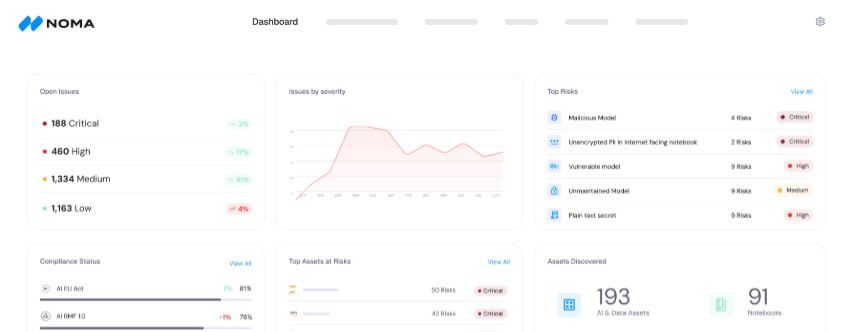
The platform brings discovery, posture management and runtime protection into one place and presents them through the Noma Agentic Risk Map, which visualizes and controls what the company calls the agent blast radius.
Key features include:
- Deep discovery and contextual insight: Automatically discovers every agent in the environment and builds a full profile covering toolsets, functionality, data access permissions, MCP server connections and operations.
- Blast radius visualization: Analyzes each agent's connections, tools, identities and knowledge sources to uncover cascading risk scenarios and intercept dangerous combinations before deployment.
- Proactive agent risk management: Monitors and detects over-permissive and potentially destructive agent capabilities, and enforces enterprise policies that prevent unauthorized actions and data exposure.
- Runtime protection: Applies real-time guardrails to models and agents in production, detecting and blocking malicious prompts, rogue outputs and unauthorized agent actions.
- Agentic access control: Combines policy-based approval, runtime enforcement and continuous monitoring of what agents are permitted to access.
- Red teaming: Runs offensive testing against AI systems as a built-in part of the platform rather than a separate tool.
- MCP server security: Extends threat detection across agents and the MCP servers they rely on.
- AI governance and compliance: Adds real-time monitoring with built-in compliance controls alongside the security functions.
Limitations (based on publicly available sources):
- Cloud-dependent architecture: Gateway integrations require outbound connectivity to Noma's cloud service, which creates friction for organizations with strict data sovereignty or residency obligations.
- Positioning around governance: Independent assessments position the platform around agent governance and discovery rather than low-latency inline prompt filtering.
- Limited independent validation: Customer counts and growth figures are vendor-reported and have not been independently audited.
- Pricing transparency: Pricing is usage-based and provided on request, with no published rates.
Source: Noma
AI Governance and Audit Platforms
5. IBM watsonx.governance

Best for: Enterprises needing audit-ready AI governance across many vendors
Strengths: Governance graph, control enforcement, 200+ regulatory frameworks
Things to consider: Complex setup, high cost, weaker fit outside IBM ecosystem
IBM watsonx.governance is a platform-agnostic AI governance layer that combines AI-native governance with enterprise governance, risk and compliance across hybrid, multi-vendor environments. It governs AI regardless of whether it was built on IBM, open source, OpenAI, AWS, Meta or another platform.
The product connects AI assets, risks and policies to operational, third-party, business continuity and IT risks rather than treating AI risk in isolation. Policies are translated into controls, enforced through AI control planes, and backed by continuous audit-ready reporting.
Key features include:
- Governance Graph: Maintains a living, connected map of the AI estate linking assets to policies, enterprise AI risks and regulatory requirements, so teams can trace what AI is in use, for what purpose, under what controls and whether those controls are working.
- Agent observability: Tracks agent accuracy, hallucinations and context relevance, with telemetry and reasoning trace capture for full auditability of agent behavior.
- Continuous agent assessment: Runs automated tests and versioned benchmarks against agent behavior to check safety, reliability and reproducibility across updates.
- Decision assurance in production: Treats agents as governed assets with continuous in-the-loop evaluation, policy enforcement and automated block, route or fallback actions, including dynamic routing when contextual quality is low.
- Closed-loop control: Feeds breaches, risk signals and corrective actions back continuously so governance intent is measured against operational reality.
- Compliance automation: Maps obligations directly to AI systems across more than 200 regulatory frameworks and automates applicability, evidence collection and audit-ready reporting.
- Third-party AI risk oversight: Uses integrated risk data partnerships to assess vendor dependencies, third-party risk and incident exposure.
- Business value tracking: Ties AI use cases to business objectives and tracks defined KPIs through dashboards and workflows.
Limitations (as reported by users on G2):
- Setup difficulty: Initial configuration, workflow definition and role mapping are described as complex and configuration heavy, in some cases running as a multi-week implementation project.
- Learning curve: Reviewers report a steep learning curve, especially for teams not already familiar with IBM's ecosystem or with governance tooling generally.
- Cost: Pricing is repeatedly described as high, which reviewers say limits accessibility for smaller and mid-sized organizations.
- Non-IBM integrations: Connecting to tools outside the IBM ecosystem is reported as less smooth, with requests for better out-of-the-box connectors.
- Interface density: The feature-rich interface is described as cluttered, with reviewers asking for simplified role-specific dashboards.
6. Credo AI

Best for: Governance teams registering and gating agents before deployment
Strengths: Agent registry, dependency graphs, policy packs, trace evaluation
Things to consider: Some enforcement integrations are planned rather than available
Credo AI is a unified governance platform for discovering, assessing, governing, monitoring and reporting on every AI agent, model and application across an enterprise. It is built as modules that work independently and can be added as AI adoption grows.
For agentic AI the platform runs in three phases: discover and register agents, assess and gate them with approval workflows before deployment, then monitor and respond once they are running in production.
Key features include:
- Agent Registry: Maintains a centralized inventory of agents with agent cards covering purpose, tools, data sources and guardrails, alongside platform and MCP server governance.
- Dependency graph mapping: Maps relationships across agents, sub-agents, models, tools and data to show how a multi-agent network is actually connected.
- Shadow AI discovery: Detects and classifies ungoverned AI across the enterprise through auto-discovery across cloud environments.
- Agentic risk assessment: Provides an agentic risk assessment library with mapped controls, policy inheritance and aggregate risk scoring, plus automated red teaming and drift detection.
- Governance workflows with approval gates: Applies configurable sign-offs and approval gates that an agent must pass before moving to production.
- Runtime governance: Ingests agent traces and continuously evaluates them to detect policy violations, drift and unsafe behavior, with human-in-the-loop escalation for high-risk actions.
- Policy packs and audit trails: Ships pre-built packs for the EU AI Act, NIST AI RMF, ISO 42001 and SOC 2, with automated evidence generation and audit trails.
- Governance Knowledge Graph and GAIA: Connects regulations, business context and AI system configurations, with governance agents that retrieve evidence, assess risk, generate governance plans and remediate incidents.
Limitations (based on publicly available sources):
- Enforcement roadmap: Enforcement integration with CI/CD pipelines, CASBs and API gateways is listed as planned rather than currently available.
- Early-stage agent capability: The Agent Governor capability is labelled as a research preview.
- Governance rather than inline defense: The platform evaluates traces and enforces policy through workflows, and is not positioned as an inline security control against live attacks.
- Pricing transparency: Pricing is enterprise-only and quoted on request, which buyer guides cite as a source of procurement friction.
7. OneTrust AI Governance

Best for: Teams extending existing privacy and GRC programs to AI agents
Strengths: Central AI inventory, risk workflows, runtime guardrails, MCP policy
Things to consider: Configuration heavy, with cost and usability concerns reported
OneTrust AI Governance translates AI risk into enforceable controls, aligning enterprise governance with technical reality. It centralizes AI risk, ownership and compliance in a single program center and sits alongside OneTrust's privacy, third-party and tech risk modules.
The product covers three areas: cataloguing AI systems and assessing their risk, monitoring posture across platforms, and programmatically enforcing controls across AI workflows including agents and MCP environments.
Key features include:
- Central AI inventory: Tracks models, datasets, agents and vendors in one inventory with assigned ownership, lifecycle status and component dependencies.
- Risk identification and tiering: Standardizes risk identification using EU AI Act, NIST and ISO 42001 templates and automates risk tiering by use case, system or component.
- Compliance workflows and reporting: Handles configurable intake and approval workflows, attestation and signoff tracking, and automated evidence and audit outputs.
- Continuous monitoring: Captures drift, quality, safety and performance signals in real time and ingests telemetry across AI platforms for continuous model and agent observation.
- Contextual risk decisioning: Correlates runtime signals with regulatory obligations, aligns monitoring to intended purpose and prioritizes risk using data sensitivity.
- Policy violation detection: Detects and logs AI policy violations in real time and identifies PII and sensitive attributes as they appear.
- Runtime guardrails: Filters prompts and outputs, blocks or allows actions by policy, and constrains unsafe production behavior.
- Agent and MCP governance: Registers agents with a defined purpose, enforces permissions and allowed actions, and applies MCP policy enforcement with audit logs.
- Data and pipeline policies: Applies sensitive data masking and redaction, requires evaluations before promotion to production, and triggers re-reviews when a model, agent, dataset or usage pattern changes materially.
Limitations (as reported by users on Gartner Peer Insights):
- Post-implementation effort: Reviewers describe a significant amount of work left to the customer after implementation is complete.
- Total cost of ownership: Cost of ownership is raised as a concern, particularly by smaller organizations.
- Usability: The end user experience and interface are described as not especially smooth or user friendly.
- Organizational maturity required: Realizing full value depends on configuration and internal governance maturity, and some workflows feel complex for non-technical stakeholders without training.
8. Holistic AI

Best for: Organizations pairing AI audit evidence with runtime intervention
Strengths: Shadow AI discovery, agentic red teaming, agent graph, kill switches
Things to consider: Discovery connectors are read-only; enforcement needs SDK work
Holistic AI is an end-to-end AI governance platform organized around three modules: identify, protect and enforce. It discovers AI systems across cloud, code and vendors, tests them for risk and bias, and turns governance policy into enforceable workflows with audit evidence.
Every capability in the platform is driven by Guardian Agents, which operate in two modes. Sentinel Agents observe and alert without interrupting operations, while Operative Agents intervene inline once risk crosses a defined threshold.
Key features include:
- Shadow AI discovery and inventory: Scans cloud platforms, code repositories and SaaS tools to surface ungoverned AI, then maintains one live registry of models, agents, datasets and endpoints with ownership tracking and artifact lineage.
- Agent Graph: Maps and tests agents, tools, tasks and data flows end to end, with agent workflow tracing and an agent observability graph for multi-agent systems.
- Agentic red teaming: Tests for jailbreaks, prompt injection, toxicity, hallucination and counterfactual bias across agentic and LLM systems.
- Sentinel Agents: Continuously monitor what AI systems output in production, catching prompt injection, jailbreaks, data leakage, hallucination and toxicity without interrupting workflows.
- Operative Agents: Govern what AI systems can do inline, controlling tool calling access, access permissions, spend and agent identity, and activating kill switches or deployment blocks.
- Automated testing and drift monitoring: Covers bias, robustness, efficacy, privacy and transparency, with system activity logs, model drift detection and performance degradation alerts.
- Framework assessments: Maps controls to the EU AI Act, NIST AI RMF, ISO 42001, NYC Local Law 144 and custom frameworks.
- Audit and evidence: Produces full audit trails, version history and on-demand regulatory reports, with configurable sign-offs, controls and remediation tracking.
Limitations (based on publicly available sources):
- Read-only discovery connectors: Discovery integrations are read-only with no agents to install, so inline enforcement depends on separate instrumentation through the Guardian SDK.
- Recent runtime capabilities: Runtime agentic monitoring and the Guardian Agent tiers are recent additions relative to the platform's longer-standing audit and assessment work.
- Roots in bias auditing: Independent buyer guides note the assessment library is strongest for organizations whose main AI risk concentration is demographic outcomes.
- Declining category mindshare: Third-party engagement data shows the platform's share of AI governance research interest falling year over year.
As autonomous AI agents become more common in enterprise workflows, organizations need security controls that extend beyond model evaluation and governance. Effective agentic AI security combines continuous discovery, relationship mapping, runtime monitoring, policy enforcement, and audit-ready traceability to ensure agents operate within approved boundaries. Solutions that provide visibility into agent behavior, detect unsafe or unauthorized actions in real time, and generate comprehensive evidence for investigations and compliance help organizations adopt agentic AI with greater confidence while reducing operational and security risks.