Summary: Enterprise AI agent security platforms discover, govern, and protect autonomous AI agents. Best for runtime agent defense: Radware; broad AI lifecycle security: Palo Alto Prisma AIRS; agent-layer governance: Zenity; agent identity: Okta.
What are Enterprise AI Agent Security Platforms?
Enterprise AI agent security platforms protect systems that reason, decide, and act. They secure the connection between Large Language Models (LLMs) and the tools they access. These platforms stop threats like prompt injection, data leaks, and unauthorized tool access.
Why agent security is crucial:
- Agents can take real actions, not just generate text: They can execute workflows, access enterprise systems, and perform actions that directly affect business operations.
- Shadow AI agents are difficult to govern: Unauthorized agents often operate outside IT oversight, creating visibility, security, and compliance gaps.
- Traditional security tools lack agent context: Conventional security solutions cannot understand agent intent, tool usage, or autonomous decision-making, leaving agent-specific risks undetected.
Unlike simple chat assistants, enterprise AI agents connect directly to enterprise data and external systems. Without proper security, an agent could accidentally delete files, expose private information, or run malicious commands.
This is part of a series of articles about AI security.
In this article:
The table below summarizes the key differences between the platforms covered in this guide. We explore each of them in more detail in the sections that follow.
| Category |
Solution |
Best For |
Key Strengths |
Things to Consider |
| Agent Runtime Protection and Posture Management |
Radware Agentic AI Protection |
Defending AI agents at runtime with behavioral analysis |
Intent-based runtime protection, discovery, and posture management |
Recently launched; capabilities still expanding |
| Agent Runtime Protection and Posture Management |
Palo Alto Networks Prisma AIRS |
Teams standardizing AI security on the Palo Alto ecosystem |
Broad AI lifecycle coverage across discovery, runtime, and red teaming |
Full value tied to the Palo Alto ecosystem; setup learning curve |
| Agent Runtime Protection and Posture Management |
Zenity |
Governing agent sprawl across SaaS, cloud, and endpoints |
Agent-layer discovery, posture management, and runtime detection |
Newer platform; documentation and large-scale performance noted as gaps |
| Agent Runtime Protection and Posture Management |
Noma Security |
Securing AI agents from discovery through runtime |
Discovery, posture, red teaming, and runtime in one platform |
Sales-gated pricing; limited independent public reviews |
| Agent Runtime Protection and Posture Management |
Check Point AI Agent Security |
Discovering and governing agents alongside a broader AI security platform |
Unified posture and runtime protection built on ThreatCloud AI, Lakera, and Cyata technology |
Early access release; full value ties into the wider Check Point ecosystem |
| Agent Runtime Protection and Posture Management |
CrowdStrike Falcon AIDR |
Extending endpoint-centric security to AI agent discovery and runtime |
Endpoint-level AI visibility unified with the existing Falcon sensor and SOC workflows |
Newly launched; strongest value for organizations already running Falcon |
| AI Agent Identity and Access Security |
Okta (Okta for AI Agents) |
Bringing AI agents into an existing identity program |
Treats agents as first-class identities with least-privilege access |
Per-feature pricing adds up; setup and tuning need expertise |
| AI Agent Identity and Access Security |
Microsoft Entra Agent ID |
Managing AI agents within Microsoft Entra and 365 |
Extends familiar Entra identity, access, and governance to agents |
Needs higher Entra or 365 licensing; complex for smaller teams |
| AI Agent Identity and Access Security |
SailPoint Agent Identity Security |
Governing agents alongside human and machine identities |
Unified governance, ownership, and access reviews |
Enterprise cost and implementation effort; technical setup |
| AI Agent Identity and Access Security |
Oasis Security (Agentic Access Management) |
Governing agentic access at the identity layer |
Intent-aware, time-bound access with full chain-of-custody |
Very new agentic product; focused on access, not content defense |
| AI Agent Identity and Access Security |
Zscaler |
Extending Zero Trust access controls to AI agent connections and identities |
MCP/A2A traffic brokering with an Agent Registry and a data-identity access graph |
Newly launched; full value tied to existing Zscaler Zero Trust deployment |
Agents Can Take Real Actions, Not Just Generate Text
Unlike traditional AI models that are limited to producing text outputs or making recommendations, AI agents are designed to interact directly with enterprise systems and data. They can execute workflows, trigger transactions, update records, and even access sensitive resources on behalf of users or other applications. This operational autonomy elevates the importance of robust security controls, as a compromised or misconfigured agent could have significant and immediate consequences for business operations.
The ability of agents to take real actions also increases the potential for abuse, whether intentional or accidental. For example, an agent with broad access privileges could delete critical files, transfer funds, or expose confidential information if not properly governed. As organizations deploy more agents to automate tasks, the risk of cascading failures or security incidents grows, highlighting the need for security platforms that can enforce granular policies and monitor agent behavior in real time.
Shadow AI Agents Are Difficult to Govern
Shadow AI agents (those created or deployed without formal IT oversight) are a growing concern in large organizations. These agents often emerge from business units experimenting with new automation tools or integrating external AI services, bypassing established security and governance protocols. Because shadow agents operate outside of official channels, they can introduce hidden vulnerabilities and compliance risks that go undetected until an incident occurs.
Governing shadow AI agents is challenging because they may use unsanctioned APIs, access sensitive data, or operate with elevated privileges. Without a centralized platform to discover and inventory all agents, security teams struggle to assess risk, enforce policies, or respond to incidents. Enterprise AI agent security platforms address this gap by continuously scanning for new or unauthorized agents, providing visibility and control across the entire organization, and helping to bring shadow deployments back under governance.
Related content: Learn more about agentic AI security and how to defend autonomous agents.
Traditional Security Tools Lack Agent Context
Traditional security tools are designed around protecting human users, endpoints, and static applications. They typically lack the context to understand the unique behaviors, privileges, and operational patterns of autonomous AI agents. As a result, these tools may fail to detect anomalous agent activity, misclassify legitimate actions as threats, or overlook policy violations specific to agent workflows.
Moreover, legacy security solutions often cannot distinguish between actions taken by a human and those initiated by an AI agent. This lack of context makes it difficult to enforce agent-specific access controls, monitor for misuse, or generate accurate audit logs. Enterprise AI agent security platforms fill this gap by providing detailed visibility into agent identities, activities, and integrations, enabling organizations to apply targeted controls and respond to agent-centric risks more effectively.
Agent Discovery and Inventory
Agent discovery and inventory is foundational for any AI agent security platform. This capability involves continuously scanning enterprise environments to identify all active AI agents, regardless of where or how they are deployed. By maintaining an up-to-date inventory, organizations can gain visibility into the types, locations, and functions of agents in use, including those that may have been deployed outside of formal IT processes.
An effective discovery process also helps to uncover shadow agents and unsanctioned deployments, which often operate without adequate oversight. With a complete inventory, security teams can assess the risk posed by each agent, monitor their activities, and ensure they are subject to appropriate governance policies. This visibility is essential for proactive risk management and rapid incident response.
What matters in an enterprise environment:
- Automatically discover AI agents across cloud services, SaaS platforms, developer environments, and endpoints.
- Maintain a continuously updated inventory with ownership, purpose, framework, and deployment details.
- Detect shadow AI agents and unauthorized deployments without requiring manual registration.
- Classify agents by business criticality, data sensitivity, and access privileges.
- Track which models, tools, APIs, and data sources each agent can access.
- Support agent lifecycle management, including onboarding, ownership changes, and retirement.
- Generate audit-ready inventories for security, compliance, and governance teams.
Agent Identity and Access Control
Managing agent identity and access is critical to ensuring that AI agents only perform authorized actions and interact with approved resources. Enterprise AI agent security platforms provide centralized identity management, allowing organizations to assign unique identities to each agent and control their permissions based on role, function, or business need. This helps prevent privilege escalation and limits the potential impact of compromised agents.
Granular access controls also enable organizations to enforce least-privilege principles, ensuring that agents have only the minimum permissions necessary to perform their tasks. By integrating with existing identity providers and access management systems, these platforms can extend consistent security policies across both human users and AI agents, reducing the risk of unauthorized activity and data exposure.
What matters in an enterprise environment:
- Assign every AI agent a unique identity rather than using shared service accounts.
- Enforce least-privilege access with granular permissions for tools, APIs, and data sources.
- Integrate with enterprise identity providers such as Microsoft Entra, Okta, and Ping Identity.
- Support short-lived credentials, token rotation, and secure secret management.
- Require approval workflows for privileged or high-risk agent actions.
- Separate identities for development, testing, and production agents.
- Record complete audit logs showing which agent performed every action and under whose authority.
Tool and API Governance
Tool and API governance focuses on regulating the external systems, APIs, and tools that AI agents can interact with. Enterprise AI agent security platforms allow organizations to define and enforce policies specifying which tools and endpoints agents are permitted to access. This ensures that agents operate within predefined boundaries and do not introduce vulnerabilities by interacting with untrusted or insecure services.
By monitoring and controlling agent interactions with external APIs, organizations can prevent data leakage, unauthorized transactions, and compliance violations. Governance policies can be tailored to specific agents or workflows, enabling flexible yet secure integration with a wide range of enterprise systems. This capability is essential for maintaining control over complex, interconnected agent ecosystems.
What matters in an enterprise environment:
- Allow agents to access only approved tools and APIs through allowlists.
- Restrict high-risk actions such as deleting data, changing configurations, or executing code.
- Validate tool inputs and outputs to reduce prompt injection and indirect prompt attacks.
- Apply context-aware policies based on user identity, agent role, data sensitivity, or business workflow.
- Monitor API usage for abnormal behavior, excessive requests, or unexpected destinations.
- Require human approval before executing sensitive or irreversible operations.
- Maintain version-aware policies as APIs and agent capabilities evolve.
Data Loss Prevention for Agents
Data loss prevention (DLP) for AI agents is designed to protect sensitive information from being exposed, mishandled, or exfiltrated by autonomous agents. Enterprise AI agent security platforms implement DLP policies that monitor agent activities, detect attempts to access or transmit confidential data, and block unauthorized actions in real time. This is especially important as agents may process or generate large volumes of business-critical information.
DLP capabilities can be tailored to specific data types, regulatory requirements, or operational contexts, ensuring that agents comply with data protection standards. By providing detailed logging and alerting, these platforms help organizations investigate incidents, demonstrate compliance, and continuously improve their security posture. Effective DLP for agents is essential for safeguarding intellectual property, customer data, and other sensitive assets.
What matters in an enterprise environment:
- Detect and block attempts to expose regulated or confidential data through prompts or tool outputs.
- Apply data classification policies consistently across structured and unstructured content.
- Prevent agents from sending sensitive information to unauthorized external services or models.
- Redact or mask sensitive values before they are included in prompts or responses.
- Enforce regional data residency and regulatory requirements where applicable.
- Log all policy violations and data access events for investigation and compliance reporting.
- Support organization-specific DLP policies in addition to built-in compliance templates.
Risk Scoring and Posture Management
Risk scoring and posture management enable organizations to assess the security risk associated with each AI agent and the overall agent ecosystem. Enterprise AI agent security platforms use contextual data such as agent behavior, access patterns, and integration points to calculate risk scores and highlight areas of concern. These insights help security teams prioritize remediation efforts and allocate resources effectively.
Posture management tools provide ongoing visibility into the state of agent security, including compliance with policies, configuration drift, and emerging threats. By continuously evaluating risk and posture, organizations can adapt their controls, mitigate vulnerabilities, and ensure that agent-driven automation aligns with their broader security objectives. This proactive approach reduces the likelihood of security incidents and supports continuous improvement.
What matters in an enterprise environment:
- Continuously score agents based on permissions, connected systems, data access, and observed behavior.
- Highlight excessive privileges, insecure configurations, and unused high-risk permissions.
- Prioritize remediation based on business impact and exploitability.
- Monitor posture changes as agents, models, tools, and integrations are updated.
- Map findings to security frameworks and internal governance requirements.
- Provide dashboards for security teams, platform owners, and business stakeholders.
- Trigger alerts when agent risk exceeds defined organizational thresholds.
Integration with Enterprise Security Stack
Seamless integration with the existing enterprise security stack is a critical requirement for AI agent security platforms. These platforms must work alongside tools such as SIEM, SOAR, identity management, and endpoint protection systems to provide a unified security posture. Integration ensures that agent activity is captured in central logs, incidents are correlated across sources, and response workflows are streamlined.
By leveraging existing security investments, organizations can extend their controls to cover AI agents without introducing operational silos or gaps in coverage. Integration also enables automated response to agent-related incidents, supports compliance reporting, and facilitates cross-team collaboration. A well-integrated security platform enhances visibility, accelerates response, and enables enterprises to scale AI adoption with confidence.
What matters in an enterprise environment:
- Integrate with SIEM platforms to centralize logs and correlate agent activity with other security events.
- Connect with SOAR platforms to automate investigation and response workflows.
- Exchange identity and policy information with IAM and privileged access management solutions.
- Export telemetry using standard formats and APIs to avoid vendor lock-in.
- Support integration with cloud security, endpoint security, and data protection platforms.
- Enable real-time alerting through existing security operations workflows.
- Provide APIs and webhooks for custom integrations and enterprise automation.
How we selected these platforms: We shortlisted enterprise AI agent security platforms based on agent discovery and visibility, identity and access control, tool and API governance, runtime threat protection, and AI security posture management.
Agent Runtime Protection and Posture Management
1. Radware Agentic AI Protection
Best for: Defending AI agents at runtime with behavioral analysis
Strengths: Intent-based runtime protection, discovery, and posture management
Things to consider: Recently launched; capabilities still expanding
Radware Agentic AI Protection is a purpose-built solution for securing autonomous AI agents across enterprise environments. It monitors and blocks agent-targeted manipulation and attacks in real time, using behavioral analysis that identifies an agent's intent rather than relying only on static guardrails.
The solution covers the agent lifecycle across SaaS, homegrown, and developer-hosted environments, and maps the agents, tools, and interactions in use. It aligns with the OWASP Top 10 for Agentic AI and the AI Vulnerability Scoring System (AIVSS), and supports both inline and out-of-band enforcement.
Key features include:
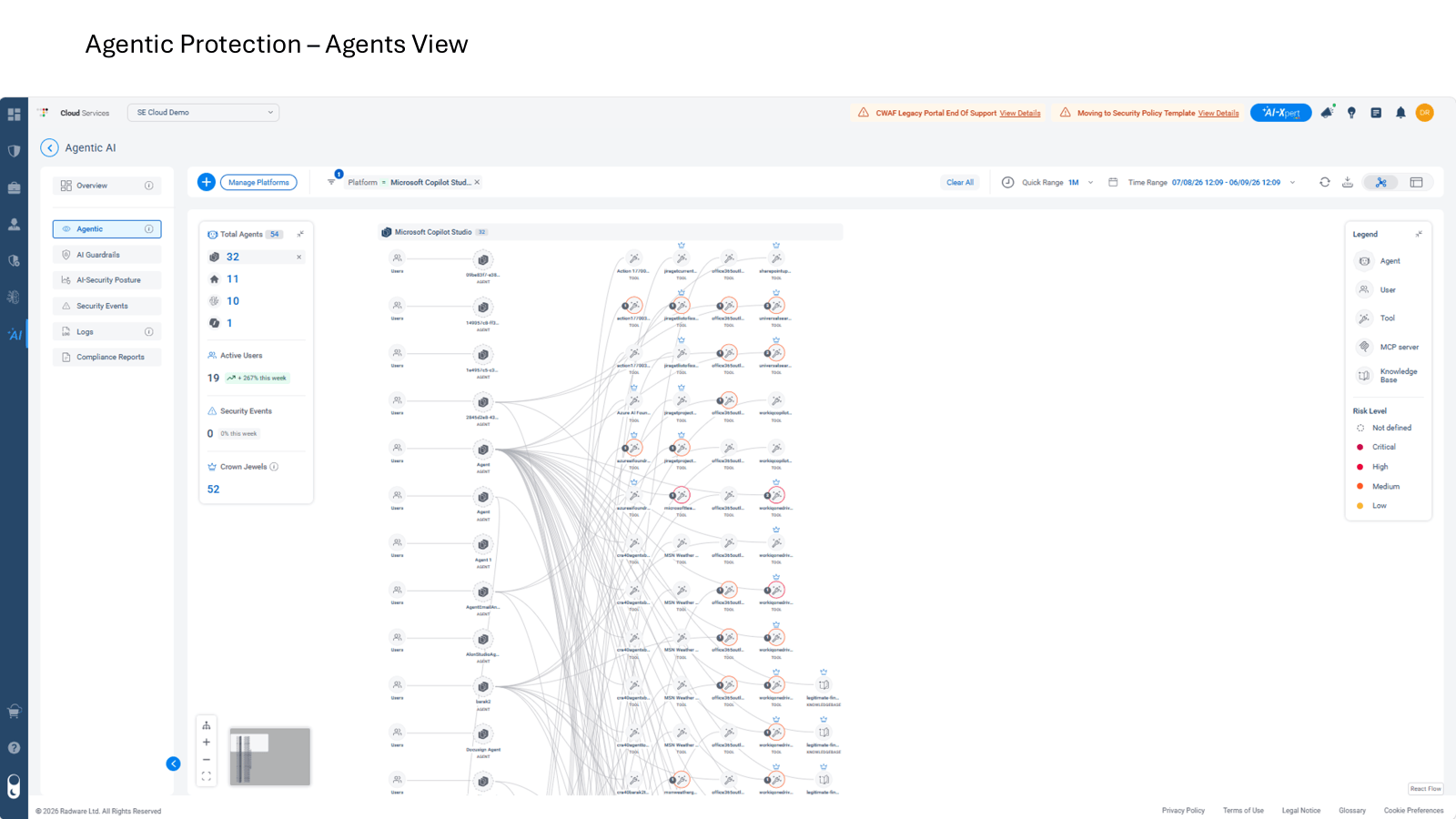
- Agent and tool discovery: Continuously identifies agents and the tools they can access across SaaS, homegrown, and developer environments, and builds rich metadata on agent configuration and usage.
- Intent-based behavioral protection: Applies runtime behavioral analysis to detect and mitigate malicious or abnormal agent activity, including multi-step and cross-agent behaviors.
- LLM firewall and guardrails: Validates prompts and enforces guardrails against indirect prompt injection, jailbreaking, and unsafe outputs, and blocks goal-divergent actions.
- MCP tool control: Allows or blocks specific tools per agent, governing which external systems and Model Context Protocol connections an agent can use.
- Continuous AI security posture management: Scores risk across agents and tools and maps agent workflows in a full execution risk graph and an interactive connection map.
- Developer-hosted agent protection: Monitors, detects, and secures client-side coding agents, including Claude Code agents, on developer endpoints.
- Compliance reporting: Generates audit-ready reports aligned to standards such as ISO 42001, the EU AI Act, and the NIST AI Risk Management Framework.
Limitations (based on publicly available sources):
- Recently introduced: The agentic offering launched in early 2026, so its track record and third-party review coverage are still limited compared with longer-established categories.
- Complementary identity controls: The product centers on behavioral runtime defense and posture management, so organizations that need deep non-human identity governance may pair it with a dedicated identity platform.
- Enterprise engagement: Pricing and onboarding run through a sales process rather than public self-service sign-up.
Source: Radware Agentic AI Security Team
2. Palo Alto Networks Prisma AIRS

Best for: Teams standardizing AI security on the Palo Alto ecosystem
Strengths: Broad AI lifecycle coverage across discovery, runtime, and red teaming
Things to consider: Full value tied to the Palo Alto ecosystem; setup learning curve
Prisma AIRS is Palo Alto Networks' platform for securing AI applications, models, data, and agents from development through deployment. It approaches AI security in three stages: discover shadow AI and every agent, app, and model; assess risk by testing agents and controlling permissions; and protect against runtime threats. For agents specifically, it verifies agent identity and enforces real-time controls to stop unauthorized actions as deployments scale.
The platform brings together AI Runtime Security, AI Model Security, AI Red Teaming, and AI posture management under one control plane, with the Portkey AI Gateway integration adding centralized policy enforcement across applications, models, and agents.
Key features include:
- AI agent security: Verifies each agent's identity and enforces real-time controls to stop unauthorized actions, extending protection to agent-specific threats such as tool misuse and memory manipulation.
- AI runtime security: Monitors live AI interactions and enforces safeguards against prompt injection, data exposure, malicious code, and unsafe actions.
- AI red teaming: Simulates real-world attacks against agents and applications, with support for multi-turn attacks and multi-agent systems, to surface vulnerabilities before deployment.
- AI model security: Scans third-party and open-source models for risks such as model tampering, malicious scripts, and deserialization attacks.
- AI posture management: Discovers shadow AI and provides visibility and control over AI data, agent and app integrity, and access to deployed models.
- Centralized control plane: Consolidates visibility, assessment, identity verification, and runtime enforcement, with the Portkey AI Gateway providing policy enforcement across the AI estate.
Limitations (as reported by users on Gartner Peer Insights):
- Ecosystem dependence and cost: Reviewers note the platform delivers its full value when an organization is committed to the wider Palo Alto Networks ecosystem, and that licensing can be complex and costly for smaller firms.
- Configuration effort: Setting up granular policies is described as cumbersome, with a learning curve for administrators.
- Maturing features: Some capabilities are seen as early-stage, and certain alerts and reports need extra tuning to fit a specific environment.
3. Zenity

Best for: Governing agent sprawl across SaaS, cloud, and endpoints
Strengths: Agent-layer discovery, posture management, and runtime detection
Things to consider: Newer platform; documentation and large-scale performance noted as gaps
Zenity is a security and governance platform built specifically for AI agents across SaaS, cloud, and endpoint environments. Rather than inspecting prompts alone, it analyzes an agent's full execution path, including tool calls, memory access, and data flows, to judge intent and catch actions that prompt-based filters miss. The platform spans build-time configuration and runtime execution through three capabilities: Observe, Govern, and Defend.
It discovers and inventories agents with ownership and dependency mapping, including shadow deployments across low-code copilot builders and SaaS agent platforms. Its Correlation Agent connects posture gaps, runtime anomalies, and identity relationships into incidents that explain what an agent did and why.
Key features include:
- Agent discovery and inventory: Automatically finds agents across SaaS, cloud, and endpoints, mapping ownership, permissions, dependencies, and runtime behavior, including shadow AI.
- AI security posture management: Reviews agent configurations, permissions, memory, and tool integrations before deployment and enforces secure-by-design guardrails aligned to the OWASP LLM Top 10 and MITRE ATLAS.
- AI detection and response: Monitors agent execution paths at runtime, detecting direct and indirect prompt injection, memory manipulation, and unauthorized tool calls, and blocks execution before impact.
- Intent correlation: The Correlation Agent interprets behavior across signals to produce incidents that show what happened, why, and what was affected.
- Sensitive data controls: Flags when agents access or expose data such as PII, PHI, or hardcoded secrets in prompts, responses, or actions.
- Cross-environment coverage: Secures SaaS-managed agents such as Copilot Studio and Salesforce Agentforce, home-grown agents on AWS Bedrock and Google Vertex AI, and device-based agents.
Limitations (based on publicly available sources):
- Documentation and customization: Publicly available summaries point to limited customization and integration options and documentation that could be more complete.
- Performance at scale: The same sources note room for improvement in speed and in handling large datasets.
- Emerging track record: As a recent entrant in agent security, independent long-term review coverage is still limited.
4. Noma Security

Best for: Securing AI agents from discovery through runtime
Strengths: Discovery, posture, red teaming, and runtime in one platform
Things to consider: Sales-gated pricing; limited independent public reviews
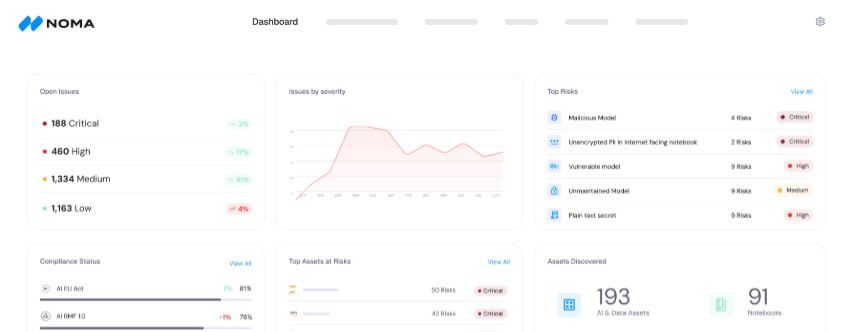
Noma Security provides centralized security, visibility, and control for autonomous AI agents across the enterprise. It automatically discovers each agent along with its toolsets, functionality, data access permissions, and MCP server connections, then visualizes each agent's blast radius, the set of connections, tools, identities, and knowledge sources that could be affected if the agent is compromised.
The platform combines discovery, posture management, red teaming, and runtime protection, and its Agentic Risk Map maps cascading risk scenarios so risky combinations can be intercepted before deployment. At runtime it enforces guardrails and blocks malicious prompts, rogue outputs, and unauthorized actions.
Key features include:
- Deep agent discovery: Identifies every agent and builds a contextual profile covering toolsets, functionality, data access, MCP server connections, and operations.
- Agentic Risk Map: Visualizes each agent's connections, tools, identities, and knowledge sources to surface cascading risk and blast radius.
- Posture and risk management: Detects over-permissive or potentially destructive agent capabilities and enforces policies to prevent unauthorized actions and data exposure.
- Runtime protection: Applies real-time guardrails to detect and block malicious prompts, rogue outputs, and unauthorized agent actions in production.
- Red teaming: Runs automated adversarial testing for prompt injection, jailbreaks, and other AI-specific attacks across the AI lifecycle.
- Broad integration: Connects with more than 80 data, AI, and MLOps platforms, including Microsoft Copilot Studio, Salesforce Agentforce, and ServiceNow, with on-prem and SaaS deployment options.
Limitations (based on publicly available sources):
- Sales-gated pricing: Noma does not publish pricing; cost is quoted per deployment through a sales process and enterprise procurement cycle.
- Limited public reviews: As a company that emerged from stealth relatively recently, it has few independent user reviews on major platforms.
- Support and language scope: Publicly listed details indicate primarily online support and English-language coverage.
Source: Noma Security
5. Check Point AI Agent Security
Best for: Discovering and governing agents alongside a broader AI security platform
Strengths: Unified posture and runtime protection built on ThreatCloud AI, Lakera, and Cyata technology
Things to consider: Early access release; full value ties into the wider Check Point ecosystem
Check Point AI Agent Security secures the AI agents organizations build and deploy, discovering agents across the platforms where they run, assessing risk from each agent's configuration (posture), and protecting behavior at runtime through AI Guardrails. It sits within Check Point's broader AI Defense Plane, which also covers workforce AI safety and continuous AI red teaming, drawing on ThreatCloud AI and technology from the company's recent Lakera and Cyata acquisitions.
Key features include:
- Agent and MCP discovery: Maps agents across the platforms where they run, along with connected MCP servers, tools, models, authentication, and level of autonomy.
- Per-agent risk assessment: Assesses posture (the structural state of an agent) to produce a per-agent risk rating with contributing factors and a risk-types view across all agents.
- AI Guardrails runtime suite: Applies Prompt Defense, Content Moderation, Data Leakage Prevention, Malicious Links, and Agent Behavior Defense across user prompts, model outputs, tool calls, tool responses, and tool descriptions via the Guard API.
- Low-latency enforcement: Delivers sub-50ms response times across 100+ languages to block prompt injection, unauthorized tool calls, unsafe file access, and runaway agent behavior.
- Standalone or unified deployment: AI Guardrails can be embedded directly into an organization's own AI applications, or run as the runtime layer within the full AI Agent Security product.
- Platform integration: Sits within Check Point's broader AI Defense Plane, correlating agent risk with workforce AI usage and AI application security under one control plane.
Limitations (based on publicly available sources):
- Early access release: AI Agent Security is explicitly labeled early access, so capabilities and documentation are still expanding.
- Ecosystem context: Full posture and runtime correlation benefits from adoption of the wider AI Defense Plane and Check Point's existing security stack.
- Enterprise engagement: Pricing and onboarding run through a sales process rather than public self-service sign-up.
6. CrowdStrike Falcon AIDR
Best for: Extending endpoint-centric security to AI agent discovery and runtime detection
Strengths: Endpoint-level AI visibility unified with the existing Falcon sensor and SOC workflows
Things to consider: Newly launched; strongest value for organizations already running Falcon
CrowdStrike Falcon AI Detection and Response (AIDR) extends the Falcon platform to secure AI agents, applications, and workforce AI usage at runtime. The same lightweight Falcon sensor that captures endpoint threats also captures the commands, scripts, file activity, and network connections generated by AI agents running on a device, letting teams trace suspicious agent behavior back to its originating process. CrowdStrike tracks more than 180 prompt injection techniques and reports detecting over 1,800 distinct AI applications across customer endpoints, and it is extending AIDR's runtime guardrails to low-code and developer-built agents in platforms such as Microsoft Copilot Studio.
Key features include:
- EDR AI runtime protection: Captures the commands, scripts, file activity, and network connections of AI agents at the point of execution using the existing Falcon sensor.
- Shadow AI and agent discovery: Identifies AI applications, agents, LLM runtimes, MCP servers, and development tools running across endpoints, SaaS, browser, and cloud environments.
- Prompt injection and jailbreak detection: Detects and prevents direct and indirect prompt injection, jailbreaks, and model manipulation attempts in real time, with comprehensive runtime logs for audit trails.
- Copilot Studio agent coverage: Extends runtime guardrails to agents built in Microsoft Copilot Studio, monitoring prompts, data interactions, and behavior for both developer-built and low-code agents.
- Cross-surface AI governance: Provides visibility into Shadow SaaS usage and agent activity, permissions, and data access across platforms including Salesforce Agentforce, ChatGPT Enterprise, and OpenAI Enterprise GPT.
- Unified Falcon platform: Delivers AI agent security natively within the single lightweight-agent Falcon architecture rather than as a separate, stitched-together tool.
Limitations (based on publicly available sources):
- Recently introduced: Falcon AIDR's agent-specific capabilities were announced in late 2025 and expanded through early 2026, so long-term track record and independent reviews are still limited.
- Falcon ecosystem dependency: The endpoint-centric approach delivers its fullest value for organizations already running the Falcon sensor across their fleet.
- Coverage still expanding: Agent runtime coverage for platforms beyond Microsoft Copilot Studio and a handful of named SaaS agent builders continues to roll out.
AI Agent Identity and Access Security
7. Okta (Okta for AI Agents)

Best for: Bringing AI agents into an existing identity program
Strengths: Treats agents as first-class identities with least-privilege access
Things to consider: Per-feature pricing adds up; setup and tuning need expertise
Okta for AI Agents extends Okta's identity platform to treat AI agents as first-class identities within Universal Directory. It is organized around three questions: where the agents are, what they can connect to, and what they can do. The product discovers known and shadow agents, registers them with a clear human owner, and provides temporary, short-lived credentials in place of long-lived tokens.
It controls the connections agents rely on, from MCP servers to APIs and other agents, enforces least-privilege access policies, and governs the full agent lifecycle with automated workflows, a full audit trail, and a kill switch to revoke access when an agent behaves unexpectedly. The approach is vendor-neutral and built on open standards such as Cross App Access.
Key features include:
- Agent discovery: Continuously finds known and shadow agents, including through OAuth consent grants, and shows what they can access and where they introduce risk.
- Identity registration: Registers agents and MCP servers in a centralized directory with an assigned human owner as a single source of truth.
- Least-privilege access: Issues short-lived credentials instead of long-lived tokens and enforces context-aware authorization policies to limit what a compromised agent can do.
- Lifecycle governance: Applies automated governance workflows and a kill switch to revoke access for rogue agents, with a full audit trail.
- Credential vaulting: Vaults and rotates secrets and API keys to help prevent exposure and lateral movement.
- Standards-based interoperability: Uses open protocols such as Cross App Access to govern agent connections consistently across platforms without vendor lock-in.
Limitations (as reported by users on G2):
- Pricing complexity: Users report that per-user, per-feature pricing escalates as advanced capabilities are added, along with an annual contract minimum. Reviews reflect the broader Okta platform, of which Okta for AI Agents is a newer component.
- Setup and learning curve: First-time administrators describe initial configuration as complex, requiring familiarity with identity protocols such as SAML, SCIM, and OAuth.
- Troubleshooting visibility: Reviewers note that debugging authentication or policy issues is not always intuitive, with limited native troubleshooting visibility.
8. Microsoft Entra Agent ID

Best for: Managing AI agents within Microsoft Entra and 365
Strengths: Extends familiar Entra identity, access, and governance to agents
Things to consider: Needs higher Entra or 365 licensing; complex for smaller teams
Microsoft Entra Agent ID extends Microsoft Entra's identity and access management to AI agents, giving each agent a built-in identity for authentication, policy enforcement, and governance. It is aimed at controlling agent sprawl by assigning identities at scale and applying the same controls used for employees, such as Conditional Access, identity governance, identity protection, and network controls.
Agents created in Microsoft Copilot Studio and Azure AI Foundry appear automatically in a unified directory in the Entra admin center, where administrators can assign sponsors, govern lifecycle, and enforce access policies. The capabilities are delivered as part of Microsoft Agent 365 and require corresponding Entra or Microsoft 365 licensing.
Key features include:
- Agent identities at scale: Assigns each agent a built-in identity using reusable blueprints, enabling authentication and consistent policy enforcement across large agent fleets.
- Conditional Access for agents: Applies adaptive access policies that can block agents showing anomalous activity or attempting to reach risky resources.
- Identity governance: Automates agent lifecycle from creation to expiration, with assigned sponsors, time-bound access assignments, and auditable reviews.
- Identity protection: Detects and flags unusual or unauthorized agent activity, traces agents with compromised tokens, and supports remediation.
- Unified registry and visibility: Provides a central directory of agent identities with metadata, logs, and visual mapping of agent activity across Copilot Studio, Azure AI Foundry, and other sources.
- Network controls: Logs agent network activity, applies web categorization to APIs and MCP servers, and can block malicious destinations.
Limitations (as reported by users on G2):
- Licensing and cost: Reviewers note that fuller capabilities require higher-tier Entra or Microsoft 365 licensing, which raises cost. Reviews reflect the broader Microsoft Entra platform, of which Agent ID is a newer capability.
- Complexity for smaller teams: Users indicate that setup and administration benefit from skilled administrators, making it complex for smaller organizations.
- Administrative overhead and limits: Reviewers cite ongoing maintenance such as credential rotation, configuration constraints such as policy limits, and a UI that can feel convoluted.
9. SailPoint Agent Identity Security
Best for: Governing agents alongside human and machine identities
Strengths: Unified governance, ownership, and access reviews
Things to consider: Enterprise cost and implementation effort; technical setup
SailPoint Agent Identity Security brings AI agents, their users, and the tools they access into one governed view, as part of SailPoint Identity Security Cloud. It aggregates agents from clouds and agent platforms such as AWS, Azure, Google Cloud Platform, Salesforce, and Microsoft Copilot Studio, registering each with a unique identity enriched with business and access context.
The product assigns clear human ownership to each agent, with succession planning as roles change, and lets teams review agent access and revoke inappropriate or excessive permissions. Because it sits within Identity Security Cloud, agents are governed alongside human, non-employee, and machine identities under consistent policy, and it also governs the service accounts that agents use.
Key features include:
- Agent aggregation: Connects to AWS, Azure, GCP, Salesforce, and Copilot Studio to onboard agents automatically, each with a unique identity and full business and access context.
- Ownership assignment: Designates one or more human owners per agent, with succession planning to keep accountability intact as roles change.
- Access review and revocation: Reviews agent access against business needs and policy, and identifies and revokes inappropriate or excessive permissions.
- Indirect access visibility: Detects when human identities gain new entitlements or data access through agents, covering direct and indirect access paths.
- Tool and service account governance: Governs the service accounts each agent uses, from creation to retirement.
- Unified identity governance: Manages human, non-employee, machine, and agent identities in one platform with consistent policy, certifications, and lifecycle control, and offers an MCP Server for Identity Security Cloud.
Limitations (as reported by users on G2):
- Implementation effort: Reviewers describe deployment as complex and time-consuming, which can be a barrier for smaller organizations. Reviews reflect the broader SailPoint Identity Security Cloud platform that Agent Identity Security is built on.
- Cost: Users note that licensing and professional services costs are high and can escalate.
- Technical skill and support: Reviewers cite a technical configuration model often driven through APIs, a UI that can feel click-centric, and support responsiveness that varies by region.
10. Oasis Security (Agentic Access Management)

Best for: Governing agentic access at the identity layer
Strengths: Intent-aware, time-bound access with full chain-of-custody
Things to consider: Very new agentic product; focused on access, not content defense
Oasis Security is a non-human identity platform whose Agentic Access Management (AAM) product governs how AI agents access enterprise resources. It sits between agents and the systems they touch, turning each agent request into a short-lived, least-privilege session with only the permissions required for the specific intent, then removing that access afterward.
AAM analyzes an agent's intent, applies policy to allow or block actions before they reach data, and issues ephemeral per-session identities to eliminate standing privileges and long-lived secrets. Every action is linked to a chain of custody spanning prompt, intent, policy, session, identity, and result, and the sessions are visible within the broader Oasis non-human identity platform.
Key features include:
- Intent analysis and planning: Interprets what an agent is trying to do, breaks it into an action plan, and determines the exact access required.
- Session-level provisioning: Issues ephemeral, per-session identities so agents hold no standing privileges, long-lived tokens, or hardcoded secrets.
- Policy-based enforcement: Validates access decisions against defined policies and blocks risky actions before they reach data, escalating to human review when privilege boundaries are crossed.
- Identity-to-prompt mapping: Binds each prompt to a unique identity for traceability and cross-environment access under unified policies.
- Context-aware privilege escalation: Applies PAM-style, time-bound elevation triggered only when business context and risk require it.
- Audit and visibility: Captures each session's intent, policy, identity, activity, and expiration, and surfaces ephemeral identities and their activity within the Oasis non-human identity platform.
Limitations (based on publicly available sources):
- Early-stage agentic product: Agentic Access Management launched in late 2025, so its track record is short relative to established identity tools.
- Access-layer focus: The platform governs identity and access rather than inspecting prompt content or agent outputs, so it is typically paired with runtime content controls.
- Enterprise orientation: Public sources indicate the strongest fit is large environments with thousands of non-human identities, which can make it heavier than smaller teams need.
11. Zscaler

Best for: Extending Zero Trust access controls to AI agent connections and identities
Strengths: MCP/A2A traffic brokering with an Agent Registry and a data-identity access graph
Things to consider: Newly launched; full value tied to existing Zscaler Zero Trust deployment
Zscaler extends its Zero Trust Exchange platform to secure how AI agents connect to systems, access data, and run on devices, positioning it as a zero trust platform for agentic AI. Rather than letting an agent inherit broad access simply because a user launched it, Zscaler gives each agent its own identity, scoped permissions, and continuous monitoring.
It brokers agent communications through the same inspection and enforcement fabric that already secures users and applications. The platform combines a new AI Broker, an AI Access Graph built on its Symmetry Systems acquisition, and Endpoint AI Security for AI activity on employee devices.
Key features include:
- AI Broker for agent communications: Secures Model Context Protocol (MCP) and Agent-to-Agent (A2A) traffic, the primary standards for how agents connect to data and to each other.
- Agent Registry: An integrated registry shows what each agent is allowed to access, enabling fine-grained access control across enterprise AI agents.
- AI Access Graph: Maps how identities, applications, and data sources connect across the enterprise, powered by Zscaler's Symmetry Systems acquisition, to track data lineage in real time.
- Endpoint AI Security: Finds and stops AI-related threats on employee devices, including risks hidden in browsers, plugins, extensions, and local AI tools.
- Least-privilege enforcement: Applies zero trust principles to reduce unnecessary agent access and risk, hiding internal applications from direct exposure rather than granting broad network access.
- Zero Trust Exchange integration: Runs on the same architecture that already processes hundreds of billions of daily transactions, letting agents onboard into an existing zero trust fabric instead of a separate AI security stack.
Limitations (based on publicly available sources):
- Newly launched: The AI Broker, AI Access Graph, and Endpoint AI Security were announced in mid-2026, so independent long-term reviews are limited.
- Zero Trust Exchange dependency: Full value assumes an organization is already standardized on, or willing to adopt, Zscaler's Zero Trust Exchange platform.
- Access-layer focus: The platform centers on brokering and governing agent connections and identity, which organizations may pair with dedicated runtime content inspection for prompts and outputs.
Conclusion
As AI agents become central to enterprise automation, robust security is no longer optional but a business necessity. By implementing specialized discovery, identity management, and runtime governance, organizations can safely leverage autonomous systems. Prioritizing these layers of protection ensures that innovation drives growth without introducing unmanageable risks.