Summary: DDoS mitigation providers detect and absorb attacks that flood networks and apps. Best for: Radware (behavioral multi-layer defense), Cloudflare (massive scale), Akamai Prolexic (dedicated capacity), and Imperva (SLA-backed mitigation).
Why Are DDoS Mitigation Providers Needed?
DDoS mitigation providers are vendors or service companies that offer solutions to defend against distributed denial-of-service (DDoS) attacks. Major DDoS mitigation providers include Radware, Cloudflare, and Akamai.
DDoS attacks can overwhelm web applications, APIs, or entire networks with malicious traffic, aiming to disrupt normal operations and deny service to legitimate users. DDoS mitigation providers deploy infrastructure, technology, and expertise to identify, absorb, and neutralize harmful traffic before it affects customer systems, ensuring business continuity.
For organizations without dedicated in-house resources or expertise, partnering with a DDoS mitigation provider can be crucial. These providers typically operate large, globally distributed networks capable of handling high volumes of attack traffic. Their services may be delivered through cloud-based platforms, on-premise appliances, or hybrid approaches.
This is part of a series of articles about DDoS solutions.
In this article:
The table below summarizes the key differences between the providers covered in this article. We explore each of them in more detail in the sections that follow.
| Category |
Solution |
Best For |
Key Strengths |
Things to Consider |
| Hybrid & On-Premises |
Radware DDoS Protection |
Behavioral multi-layer defense across any environment |
30 Tbps capacity, 25 scrubbing centers, behavioral AI, 24/7 ERT |
Complex setup, premium pricing |
| Hybrid & On-Premises |
F5 DDoS Attack Protection Services |
L3-L7 protection across cloud, on-prem, containers |
Multi-terabit scrubbing, flexible deployment, BIG-IP options |
Premium cost, dated GUI |
| Hybrid & On-Premises |
NETSCOUT Arbor DDoS Protection |
Service providers and large networks |
800 Tbps visibility, ATLAS intel, AED on-prem, Arbor Cloud 15+ Tbps |
Complex, needs skilled team |
| Cloud & Edge-Based |
Cloudflare DDoS Protection |
Always-on edge protection at massive scale |
500 Tbps capacity, edge mitigation, L3/4/7 |
Advanced features gated to higher tiers |
| Cloud & Edge-Based |
Akamai Prolexic |
High-capacity DDoS across environments |
20+ Tbps dedicated, 32 scrubbing centers, zero-second SLA |
Interface UX, manual intervention |
| Cloud & Edge-Based |
Imperva DDoS Protection |
Websites, networks and IPs, SLA-backed |
3-sec L3/4 SLA, 13 Tbps, automated L7, sub-50ms latency |
Setup expertise, SIEM logging |
DDoS mitigation providers deliver services that focus on detecting, analyzing, and suppressing DDoS threats as they emerge. Their core mission is to separate legitimate user traffic from malicious data streams, ensuring that attacks do not disrupt normal operations. This often involves traffic monitoring, behavioral analysis, and threat intelligence input to distinguish and block attack vectors such as volumetric floods, protocol attacks, and application-level assaults.
Beyond attack filtering, these providers support incident response teams, deliver reporting, and conduct post-attack analysis to strengthen future security posture. Some services include real-time dashboards for visibility, customizable mitigation policies, and proactive alerts. By quickly identifying DDoS activity and deploying countermeasures, these services help organizations restore normal operations with minimal downtime.
Learn more in our detailed guide to anti-DDoS software.
Mitigation Capacity
Mitigation capacity refers to the maximum volume of attack traffic a provider can absorb before their defenses are overwhelmed. A leading DDoS mitigation provider should offer high-capacity scrubbing centers distributed globally, enabling them to withstand multi-terabit-per-second attacks. The provider’s ability to dynamically scale resources based on attack severity ensures protection for both small and large organizations, regardless of the nature or intensity of the assault.
Detection Speed and Response Time
Detection speed and response time are critical parameters for any DDoS mitigation provider. Rapid identification of malicious traffic enables swift action to minimize downtime and service interruptions. Top vendors utilize real-time monitoring, automated detection algorithms, and pre-configured response mechanisms that initiate mitigation within seconds of an attack being detected. The faster the detection and response, the less impact the organization will experience from the attack.
Coverage Across Layers
DDoS attacks can target multiple layers of the OSI model, from volumetric assaults at the network layer (Layer 3/4) to application-level attacks at Layer 7. A mitigation provider must deliver layered coverage, defending against threats at both the infrastructure and application levels. Network-layer protection typically requires high-capacity filtering, while application-layer protection demands analytics to uncover subtler, protocol-based or behavioral threats.
Traffic Routing and Latency Impact
Traffic routing is a core function of DDoS mitigation, as attack traffic is diverted to scrubbing centers where filtering occurs. The quality and configuration of diversion (via DNS changes, BGP rerouting, or inline solutions) influence both the effectiveness of mitigation and user experience. Misconfigured or inefficient routing may introduce delays or create additional points of failure, impacting legitimate traffic flow. Latency impact is an important consideration, since excessive delays can degrade the end-user experience as much as a successful attack.
Integration with Existing Infrastructure
Smooth integration with existing infrastructure simplifies deployment and maximizes the effectiveness of DDoS protection. A top-tier provider should offer APIs, deployment templates, and flexible architecture to support diverse environments, including cloud, on-premise, and hybrid systems. Compatibility with current networking hardware, security tools, and traffic management solutions enables organizations to implement protection with minimal disruption or re-architecture.
False Positive Control
Effective DDoS mitigation blocks hostile traffic while allowing legitimate users through. Excessive false positives, where valid requests are mistaken for attack traffic, can disrupt business, damage reputation, and necessitate manual intervention. Leading providers excel at accurate traffic classification, using algorithms, machine learning, and continuously updated threat intelligence to reduce false positives.
Learn more in our detailed guide to DDoS mitigation services.
How we selected these tools: We shortlisted DDoS mitigation providers based on mitigation capacity, multi-layer (L3/4/7) attack coverage, detection and response speed, deployment flexibility across cloud, on-premises and hybrid environments, and the strength of their threat intelligence.
Hybrid and On-Premises DDoS Mitigation Providers
1. Radware DDoS Protection

Best for: Behavioral, multi-layer DDoS defense across any environment
Strengths: 30 Tbps capacity, behavioral zero-day detection, 24/7 ERT
Things to consider: Complex initial setup and premium pricing
Radware DDoS Protection is a multi-layer solution that protects networks, applications, and data centers using automated, behavioral-based technology. Its cloud service is backed by a network of 25 scrubbing centers worldwide with 30 Tbps of mitigation capacity, connected in full mesh mode using Anycast-based routing so traffic is cleaned close to its source. Patented behavioral-based algorithms automatically detect and block advanced threats in real time, including burst attacks, DNS attacks, Web DDoS, IoT botnets, encrypted attacks, and Ransom DDoS, supported by real-time threat intelligence.
The solution can be deployed as cloud DDoS protection (on-demand or always-on), as a physical or virtual appliance (DefensePro X), or as a hybrid model tailored to a customer’s architecture and threat profile. It is delivered as a fully managed security service, with Radware’s Emergency Response Team providing real-time support, and includes an SLA covering detection, mitigation, and uptime.
Key features include:
- Global scrubbing network: A network of 25 scrubbing centers worldwide provides 30 Tbps of mitigation capacity. The centers are fully meshed and use Anycast-based routing, so attack traffic is analyzed and cleaned at the nearest location to minimize latency.
- Behavioral zero-day detection: Patented behavioral-based algorithms learn legitimate traffic patterns to detect and block new and previously unknown attacks automatically in real time, including burst, DNS, Web DDoS, IoT botnet, and ransom DDoS attacks.
- Multi-layered protection: Protection spans network and application layers and is reinforced by real-time threat intelligence and Threat Intelligence Subscriptions that supply updates on new threats and real-world attack data.
- DNS DDoS protection: Behavioral-based detection combined with automatic real-time signatures identifies and blocks advanced DNS DDoS attacks without manual signature creation.
- Cloud Web DDoS protection: A dedicated capability addresses the scale and dynamic nature of Web DDoS Tsunami attacks (encrypted, application-layer floods) while allowing legitimate traffic through.
- Flexible deployment: Available as cloud services (on-demand and always-on), physical or virtual appliances through DefensePro X, or hybrid combinations to suit different environments.
- Emergency Response Team: A managed service backed by an Emergency Response Team of 120 security experts provides best practices, alerts, and hands-on support before, during, and after an attack.
Limitations (as reported by users on G2):
- Initial setup: Some users report that the initial configuration and implementation can be complex and may require additional vendor support to complete.
- Documentation: Reviewers note that documentation could be more thorough to better support self-service setup and onboarding.
- Cost structure: The pricing model is seen by some users as relatively high, particularly because it is user-based.
2. F5 Networks DDoS Attack Protection Services

Best for: L3-L7 DDoS protection across cloud, on-prem and containers
Strengths: Flexible deployment, multi-terabit scrubbing, BIG-IP options
Things to consider: Premium cost and a dated management interface
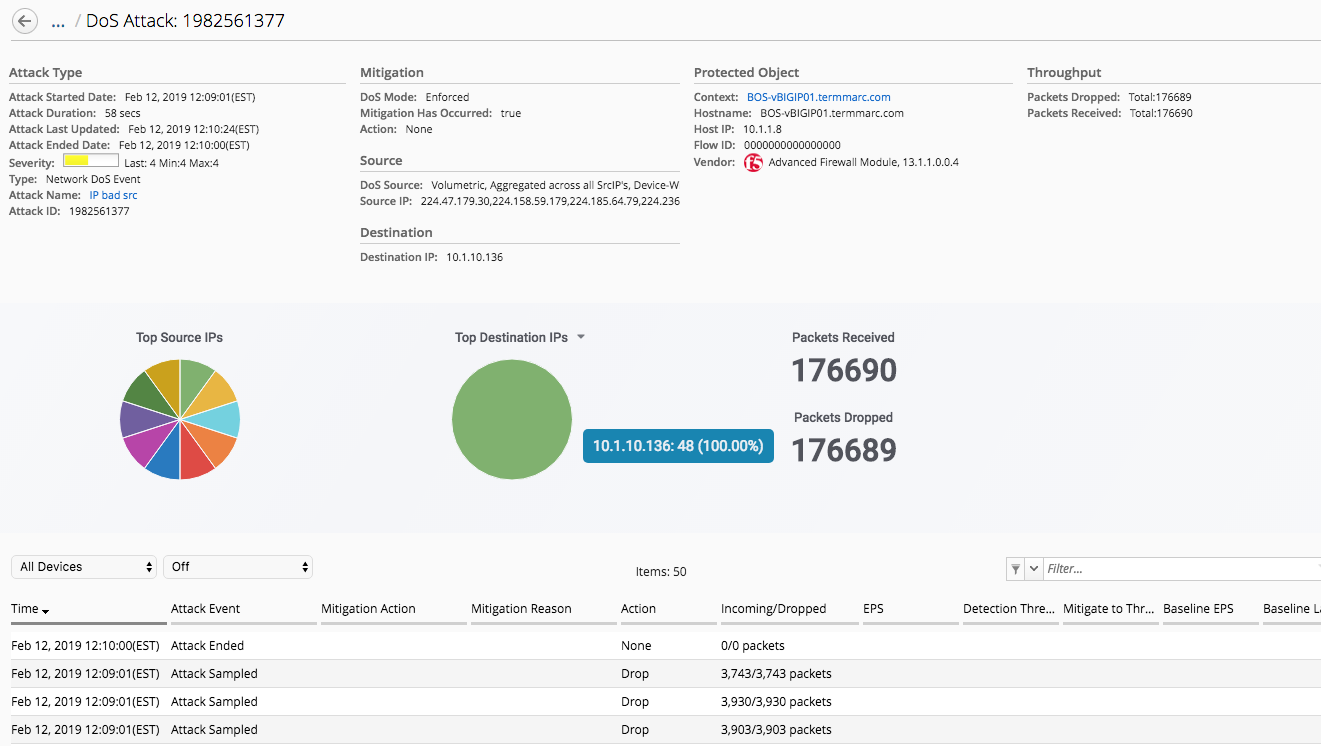
F5 Networks provides DDoS attack protection services across Layers 3, 4, and 7, detecting and mitigating large-scale volumetric network attacks and application-targeted attacks in real time. Network-level protection covers signature-based attacks such as TCP, SYN, and teardrop floods and is backed by a multi-terabit global scrubbing network, while application-level protection addresses HTTP and DNS floods, reflection and amplification, and slowloris attacks.
The portfolio includes F5 Distributed Cloud DDoS Mitigation, a managed SaaS service; BIG-IP Advanced Firewall Manager; BIG-IP DDoS Hybrid Defender; and F5 DoS for NGINX. It can be deployed as a managed service, on-premises hardware, software or virtual appliance, lightweight software, or in containers, giving organizations several options to match their environment.
Key features include:
- Layered L3-L7 defense: Protection spans volumetric Layer 3-4 attacks and application Layer 7 attacks, mitigating network-level threats such as TCP, SYN, and teardrop floods as well as HTTP and DNS floods, reflection and amplification, and slowloris attacks.
- Distributed Cloud DDoS Mitigation: A managed, cloud-delivered service inspects, detects, and scrubs traffic before it reaches infrastructure and applications, offered as Always Available (standby) or Always On (continuous routing) subscriptions.
- Multiple deployment models: The service is available as a managed service, hardware appliance, software or virtual appliance, lightweight software, or containerized form factor for NGINX-based deployments.
- BIG-IP Advanced Firewall Manager: A high-performance, full-proxy network security solution that combines a network firewall, DDoS protection, DNS security, and an application Intrusion Prevention System.
- BIG-IP DDoS Hybrid Defender: Delivers network and application-layer DDoS protection with support for inline, out-of-band, and hybrid deployments.
- Multi-terabit scrubbing network: A global scrubbing network provides multi-terabit capacity for volumetric and signature-based network attacks, with centralized visibility and reporting before, during, and after an attack.
Limitations (as reported by users on G2):
- Cost: As a premium solution, reviewers note that it carries a high cost.
- False positives: Some users report that legitimate traffic can occasionally be blocked, and that more preparation is needed before implementation.
- Interface: The management GUI is described by some reviewers as dated and less intuitive than expected.
Source: F5
3. NETSCOUT Arbor DDoS Protection

Best for: Service providers and large networks needing DDoS at scale
Strengths: 800 Tbps visibility, ATLAS intelligence, on-prem and cloud
Things to consider: Complexity and skilled staff needed to operate
NETSCOUT Arbor provides DDoS detection and defense built around network visibility, automated detection, and intelligently orchestrated mitigation. The vendor reports visibility into 800 Tbps of traffic across more than 550 customers, which informs its ATLAS and ASERT global threat intelligence. Its Adaptive DDoS Protection applies AI and machine learning to counter dynamic, multi-vector attacks.
The product line includes Arbor Edge Defense (AED), an inline on-premises appliance; Arbor Sightline for network-wide detection at scale; Sightline with Sentinel for automated response; the Arbor Threat Mitigation System (TMS) for surgical traffic removal; and Arbor Cloud, a managed cloud service with 16 global scrubbing centers and more than 15 Tbps of mitigation capacity. Deployment is available as a mix of managed services, in-cloud, on-premise, and virtualized solutions.
Key features include:
- Arbor Edge Defense: An inline security appliance deployed at the network perimeter, between the internet router and firewall, that provides stateless, on-premises DDoS protection powered by AI and machine learning to address dynamic multi-vector attacks.
- Arbor Sightline: A network visibility and DDoS detection platform that monitors and identifies networking and security issues at any network scale, supporting capacity planning and AI and machine learning-driven insights for service providers and large enterprise networks.
- Arbor Threat Mitigation System: Filters out malicious traffic while allowing legitimate traffic to pass through, removing DDoS attack traffic surgically and at scale without disrupting network services.
- Arbor Cloud: A cloud-based, fully managed DDoS protection service consisting of 16 global scrubbing centers with more than 15 Tbps of attack mitigation capacity for large-scale volumetric attacks.
- ATLAS and ASERT threat intelligence: All Arbor solutions are backed by global visibility into DDoS attack activity through ATLAS and the ASERT research team, providing continuous threat intelligence and recommended mitigation practices.
- Sightline with Sentinel: Adds automated DDoS protection on top of Sightline to simplify incident response against smarter, faster-moving attacks.
Limitations (as reported by users on G2):
- Cost and complexity: The platform can be costly and complex, requiring skilled teams for deployment, tuning, and day-to-day management, which can be impractical for smaller organizations.
- Manual configuration: Users report that the solution requires significant manual effort to fine-tune, with configurations needing regular review to stay current.
- Documentation: Documentation for users and administrators is cited as an area for improvement.
- Hardware lifecycle: Some users note that certain appliances were moved to end-of-life with limited notice, affecting return on investment.
Cloud and Edge-Based DDoS Protection Services
4. Cloudflare DDoS Protection

Best for: Always-on, edge-based DDoS protection at massive scale
Strengths: 500 Tbps capacity, edge mitigation, fast onboarding
Things to consider: Advanced features and analytics gated to higher tiers
Cloudflare DDoS Protection is a globally distributed service that absorbs large-scale attacks using 500 Tbps of network capacity, which the vendor states is 23 times larger than the biggest DDoS attack ever recorded. Attack traffic is mitigated at the edge, at the data center nearest its source, to keep services online without slowing performance. Protection spans OSI Layers 3, 4, and 7 and runs on the same infrastructure that powers a significant share of internet traffic.
The service covers websites and web applications, TCP/UDP applications through Cloudflare Spectrum, and networks and data centers through Magic Transit. Onboarding is designed to be straightforward, and support is available 24/7 by email and phone, including an Under Attack hotline for immediate assistance.
Key features include:
- 500 Tbps network capacity: The global network provides 500 Tbps of capacity, which Cloudflare states is 23 times larger than the largest DDoS attack on record, allowing it to absorb large attacks without impacting performance.
- Edge-based mitigation: Attack traffic is filtered at the data center closest to its source, reducing latency while keeping websites, applications, and networks online.
- Layered protection across L3, 4, and 7: Coverage extends across the network and application layers to protect websites and applications, TCP/UDP services, and infrastructure.
- Cloudflare Spectrum: A Layer 4 reverse proxy that extends DDoS protection to applications built on any protocol, including custom protocols, for any box, container, or virtual machine.
- Magic Transit: Protects networks, data centers, and infrastructure against Layer 3 and 4 DDoS attacks using Cloudflare’s global network.
- Onboarding and 24/7 support: Turning on protection is designed to be straightforward, with 24/7 email and phone support and an Under Attack hotline for immediate help during an incident.
Limitations (as reported by users on G2):
- Learning curve: Managing firewall rules and WAF configurations can have a steep learning curve for those less familiar with networking, and fine-tuning can be time-consuming.
- Tiered features: Some advanced and bot management features are only available on Enterprise plans, and the jump in cost to reach premium features can be significant for smaller organizations.
- Configuration and false positives: Some advanced security features require careful configuration to avoid false positives or unintended blocking of legitimate traffic.
- Analytics and retention: Deeper analytics and longer log retention are often tied to higher-tier plans, which can affect budgeting and monitoring.
5. Akamai Prolexic

Best for: High-capacity DDoS defense across cloud, on-prem and hybrid
Strengths: 20+ Tbps dedicated, 32 scrubbing centers, zero-second SLA
Things to consider: Interface usability and manual steps during attacks
Akamai Prolexic provides DDoS defense and a network cloud firewall available in-cloud, on-premises (powered by Corero), or as a hybrid. It offers more than 20 Tbps of dedicated DDoS defense capacity across 32 anycast global scrubbing centers, supported by more than 1 Pbps of overall Akamai network capacity. Anycast routing mitigates attacks closest to their source while applying the platform’s collective capacity to the largest attacks across IPv4 and IPv6 traffic.
Prolexic is backed by a zero-second mitigation SLA, a 100% platform availability SLA, and a 24/7/365 security operations command center with more than 225 frontline responders across six global locations. It is available always-on or on-demand, and includes the Prolexic Network Cloud Firewall and connectivity over Akamai Direct Connect.
Key features include:
- Dedicated scrubbing capacity: More than 20 Tbps of dedicated DDoS defense capacity is distributed across 32 anycast scrubbing centers, supported by more than 1 Pbps of Akamai network capacity, with anycast routing to mitigate close to the source.
- Zero-second mitigation SLA: Proactive mitigation controls are designed to stop more than 98% of attacks instantly, backed by a zero-second mitigation SLA and a 100% platform availability SLA.
- Flexible deployment: Protection is available in-cloud, on-premises (powered by Corero), or as a hybrid, in always-on or on-demand modes, with Routed GRE and IP Protect options for different network configurations.
- Prolexic Network Cloud Firewall: A firewall that sits at the edge of the network, outside other firewalls, letting teams define geo- and IP-based access control lists and rules, with API-driven integration to respond quickly to zero-day threats.
- Prolexic over Akamai Direct Connect: A private, high-capacity connection between a customer origin and Akamai that delivers large traffic packets via GRE tunnels up to 1,500 bytes, supports 10G and 100G ports, and offers up to 99.99% connectivity uptime.
- 24/7/365 SOCC: A security operations command center with more than 225 frontline responders across six global locations provides pre-, during-, and post-mitigation review, custom runbooks, and operational readiness drills.
Limitations (as reported by users on G2):
- User interface: Reviewers note that the user interface and overall user experience are areas that could be improved.
- Manual intervention: Managing attacks can require hands-on intervention, which some users associate with a steeper learning curve.
- Mitigation completeness: A few users reported that, even after tuning, certain attacks were not fully mitigated.
- Proactive features: Some users feel the solution offers fewer proactive security features compared with competing options.
6. Imperva DDoS Protection

Best for: Websites, networks and IPs needing SLA-backed mitigation
Strengths: 3-second L3/4 SLA, 13 Tbps scrubbing, automated L7 defense
Things to consider: Setup expertise and SIEM logging configuration
Imperva DDoS Protection, now part of Thales, defends against volumetric, protocol-based, and Layer 7 attacks across Layers 3, 4, and 7. It offers a guaranteed mitigation SLA of three seconds or less for Layer 3 and 4 attacks, typically within one second, backed by 13 Tbps of global scrubbing capacity. Its network is designed so that 95% of the world experiences sub-50 millisecond latency through Anycast routing and real-time capacity management, and it is ISP-agnostic.
Protection is offered in three options: Website Protection, which routes HTTP/S traffic through a secure proxy alongside the cloud WAF; Networks Protection, which uses GRE tunnels, Cross Connects, and virtual Cross Connects such as Equinix Fabric Cloud Exchange; and Individual IP Protection for non-HTTP assets via IP anycast. The platform is fully automated with self-onboarding and supports always-on or on-demand modes.
Key features include:
- Multi-layer coverage: Protection spans Layer 3 and 4 attacks such as UDP floods, SYN floods, and DNS amplification, as well as Layer 7 attacks such as HTTP GET/POST floods and slowloris.
- Three-second mitigation SLA: A guaranteed SLA of three seconds or less for Layer 3 and 4 attacks, typically within one second, is backed by 13 Tbps of multi-terabit scrubbing capacity and high-capacity packet processing.
- Three protection options: Website Protection works with the cloud WAF via a DNS change, Networks Protection uses GRE tunnels and Cross Connects including Equinix Fabric Cloud Exchange, and Individual IP Protection covers non-HTTP assets through IP anycast.
- Automated, self-service operation: A self-service portal allows configuration and adjustment of settings, and fully automated mitigation neutralizes threats without manual intervention in both always-on and on-demand modes.
- Adaptive Layer 7 defense: Machine learning analyzes traffic patterns and sets thresholds for Layer 7 attacks, and the vendor reports that only 0.01% of visitors encounter a CAPTCHA challenge, limiting disruption to legitimate users.
- Low-latency global network: Anycast routing and real-time capacity management dynamically optimize traffic so that 95% of the world experiences sub-50 millisecond latency, and the service integrates with SIEM systems and sends alerts by email, SMS, and mobile app.
Limitations (as reported by users on G2):
- Setup: Reviewers note that setup can take time and requires technical expertise, including a working knowledge of DNS and network workflow.
- SIEM logging: Some users find audit logging to SIEM challenging to configure and have raised concerns about the security of logged data.
- Integration: Integration with a local manager is described as unclear or not possible by some users.
- Zero-day handling: Some users would prefer automatic signature updates for newly published zero-days rather than suggestions for manual remediation.
Related content: Read our guide to DDoS mitigation tools.
Conclusion
DDoS mitigation providers play a critical role in protecting digital infrastructure from increasingly sophisticated and high-volume attacks. By offering scalable, real-time defense mechanisms across multiple network layers, these providers ensure service availability and performance even during large-scale disruptions. Key capabilities such as rapid detection, behavioral traffic analysis, automated response, and global scrubbing infrastructure enable organizations to maintain business continuity without internal operational strain.