Summary: LLM pipeline security vendors protect prompts, data, agents, and APIs in AI applications. Radware is best for prompt and agent protection, F5 for private AI guardrails, Prisma AIRS for unified AI platforms, and Check Point for AI agent governance.
What are LLM Pipeline Security Vendors?
LLM pipeline security vendors provide tools that protect the systems, data, and workflows used to build and operate large language model (LLM) applications. Their solutions address security risks across the LLM pipeline, including data ingestion, model integration, prompt processing, retrieval-augmented generation (RAG), and output generation. These tools help organizations identify vulnerabilities, prevent unauthorized access, and monitor interactions between LLMs and external systems.
A key focus of LLM pipeline security is protecting applications against threats such as prompt injection, data leakage, insecure tool execution, and model supply chain attacks. For example, attackers can embed malicious instructions in documents retrieved by a RAG system, causing an LLM to disclose sensitive information or perform unintended actions. Security vendors address these risks through input validation, content filtering, access controls, runtime monitoring, and automated security testing.
Key evaluation criteria:
The solutions in this guide are compared against six capabilities:
- Real-time prompt injection and jailbreak prevention: Detecting and blocking direct and indirect attempts to manipulate model behavior.
- Inline LLM firewall and traffic inspection: Inspecting prompts and responses in the traffic path before they reach their destination.
- Sensitive data detection and leakage prevention: Finding and blocking PII, credentials, and confidential data in inputs and outputs.
- AI agent behavior monitoring and control: Visibility into agent actions and enforcement of what agents are allowed to do.
- MCP server and tool security: Discovering MCP servers and tools and controlling how agents use them.
- LLM API discovery and runtime protection: Finding LLM-related APIs and protecting them against abuse at runtime.
Solutions compared in this guide
- Application and API Security Platforms with LLM Protection
- Radware Agentic AI Security
- Akamai Firewall for AI
- Cloudflare AI Security for Apps
- Enterprise Security Platforms with AI Runtime Suites
- Palo Alto Networks Prisma AIRS
- Cisco AI Defense
- CrowdStrike Falcon Guardian
- AI Guardrail and Runtime Protection Platforms
- F5 AI Guardrails
- Check Point AI Agent Security
- HiddenLayer AI Security Platform
- AI Agent Security and Governance Platforms
- Zenity
- Noma Security
- Lasso
This is part of a series of articles about WAF.
In this article:
Prompt Injection and Jailbreak Attacks
Prompt injection attacks occur when attackers insert malicious instructions into content processed by an LLM. These instructions can appear in user messages, retrieved documents, web pages, or tool responses. The goal is to make the model ignore application instructions, disclose restricted information, or perform unauthorized actions.
Jailbreak attacks use specially crafted prompts to bypass a model's safety restrictions. Unlike indirect prompt injection, which exploits untrusted external content, jailbreak attempts often target the model directly through user input. Defenses include separating trusted instructions from external data, validating tool calls, and enforcing permissions outside the model.
Sensitive Data Leakage and Exfiltration
LLM applications often process confidential documents, personal information, credentials, and internal business data. Sensitive data leakage occurs when this information appears in model responses, application logs, external API requests, or unauthorized retrieval results.
Attackers may use prompt injection or repeated queries to extract information that should remain restricted. Security controls include data masking, retrieval-level access permissions, output inspection, and restrictions on external data transfers. Organizations should also minimize sensitive information included in prompts and retained in logs.
Training Data and Retrieval-Augmented Generation (RAG) Poisoning
Data poisoning occurs when attackers introduce malicious or misleading content into datasets used for model training, fine-tuning, or retrieval. Poisoned training data can influence model behavior, while compromised RAG documents can cause an application to generate incorrect answers or follow malicious instructions.
RAG pipelines are particularly vulnerable when they ingest content from external websites, shared repositories, or user-uploaded files. Attackers can modify documents to influence retrieval results or insert instructions that the model may treat as authoritative. Mitigation techniques include source verification, document access controls, ingestion scanning, and monitoring changes to indexed content.
Model Extraction and Model Theft
Model extraction attacks attempt to reproduce a target model's behavior by collecting its responses to carefully selected queries. Attackers can use these responses to train a substitute model that approximates the original system's capabilities. Model theft can also involve unauthorized access to model weights, configuration files, or deployment artifacts.
These attacks can expose proprietary intellectual property and enable attackers to study model behavior outside the protected environment. Organizations can reduce the risk through API authentication, query rate limits, unusual usage detection, and strict access controls for model files and infrastructure.
Insecure LLM API Endpoints
LLM applications commonly communicate with hosted models, vector databases, and external services through APIs. Weak authentication, exposed API keys, insufficient authorization, and insecure request handling can allow attackers to access models or application data without permission.
Attackers may exploit these weaknesses to submit unauthorized requests, retrieve sensitive information, modify application configurations, or consume paid inference resources. Recommended controls include strong authentication, scoped API credentials, request validation, network restrictions, and centralized API monitoring.
Excessive Agency and Unauthorized Tool Execution
Excessive agency occurs when an LLM application has more permissions or operational capabilities than necessary. Agent-based systems may be able to execute code, query databases, send messages, modify files, or interact with external services. If these capabilities are insufficiently restricted, attackers can manipulate the model into performing harmful actions.
For example, a prompt injection embedded in a retrieved document could instruct an agent to send confidential data to an external endpoint. Security controls should enforce least-privilege permissions, validate tool parameters, restrict high-risk operations, and require explicit approval for sensitive actions. Authorization decisions should be enforced by application code rather than relying on the model's judgment.
Denial-of-Service and Resource Exhaustion Attacks
Denial-of-service attacks against LLM pipelines aim to degrade application availability or increase operating costs. Attackers can submit large prompts, trigger repeated inference requests, or exploit agent workflows that generate excessive model calls and tool executions.
LLM applications are especially exposed to resource exhaustion because inference consumes significant computational resources. Complex requests and uncontrolled agent loops can increase token usage, latency, and infrastructure costs. Defenses include request rate limiting, token budgets, execution timeouts, concurrency limits, and monitoring for abnormal consumption patterns.
LLM pipeline security solutions differ in their deployment methods, protection scope, and approach to detecting AI-specific threats. Some extend existing application and API security platforms, while others provide dedicated AI runtime controls, agent governance, or model security testing. Organizations may combine multiple categories to protect different stages of the LLM lifecycle.
Application and API Security Platforms with LLM Protection
Application and API security platforms extend traditional web application and API protection capabilities to LLM-powered applications. These solutions typically inspect traffic between users, applications, and model endpoints to identify malicious prompts, sensitive data exposure, API abuse, and other AI-specific threats. They may integrate LLM security controls with existing web application firewalls (WAFs), API gateways, and application security policies.
A key advantage is the ability to protect LLM applications through established security infrastructure. Organizations can apply consistent traffic inspection, access controls, rate limiting, and threat monitoring across conventional applications and AI services. This category includes solutions such as Radware Agentic AI Security, Akamai Firewall for AI, and Cloudflare AI Security for Apps.
Related content: Read our article about WAF architecture.
Enterprise Security Platforms with AI Runtime Suites
Enterprise security platforms offer AI protection capabilities as part of broader cybersecurity portfolios. These solutions may combine AI application discovery, runtime threat detection, prompt injection protection, sensitive data controls, and security monitoring with existing network, cloud, endpoint, and security operations technologies.
These platforms are particularly relevant to organizations deploying LLM applications across multiple business units and environments. Centralized policy management and integration with existing security operations workflows can help teams investigate AI-related incidents alongside other enterprise threats. Examples include Palo Alto Networks Prisma AIRS, Cisco AI Defense, and CrowdStrike Falcon Guardian, although their individual capabilities and deployment approaches differ.
AI Guardrail and Runtime Protection Platforms
AI guardrail and runtime protection platforms focus on inspecting and controlling interactions with language models. They analyze prompts, model responses, and, where supported, intermediate application interactions to detect prompt injection, jailbreak attempts, harmful content, sensitive data leakage, and violations of application-specific policies. Some also offer adversarial testing and model security assessments.
These solutions are useful when organizations require configurable security controls tailored to specific AI applications. They can enforce content policies, restrict sensitive information in model outputs, and provide visibility into suspicious interactions. Depending on the product, protection may be deployed through APIs, SDKs, proxies, or integrations with AI development frameworks. Examples include F5 AI Guardrails, Check Point AI Agent Security, and HiddenLayer AI Security Platform.
AI Agent Security and Governance Platforms
AI agent security and governance platforms address risks introduced by autonomous and semi-autonomous systems that interact with external tools, enterprise applications, and sensitive data. Unlike solutions primarily focused on inspecting model inputs and outputs, these platforms emphasize visibility into agent identities, permissions, tool usage, and actions performed across connected systems.
Capabilities may include discovering deployed agents, monitoring agent behavior, identifying excessive permissions, enforcing action-level security policies, and detecting suspicious interactions with external tools or MCP servers. These controls are particularly important when agents can modify business records, execute code, or transfer information between applications. Vendors in this category include Zenity, Noma Security, and Lasso, with differing levels of emphasis on agent discovery, runtime enforcement, and AI security governance.
Use the criteria below to test how each vendor handles the threats that matter most in your LLM pipeline.
Real-time prompt injection and jailbreak prevention
Prompt injection can arrive through user messages or through untrusted content such as retrieved documents, web pages, and tool responses. A vendor’s detection engine determines whether these attacks are stopped before the model acts on them. Accuracy matters in both directions: missed attacks expose the application, while excessive false positives block legitimate users.
Evaluation criteria:
- Does it detect both direct and indirect prompt injection, including instructions hidden in retrieved content?
- What are the measured detection and false-positive rates on your own traffic samples?
- Does it support the languages your users write in?
- How often is the attack library or detection model updated?
Inline LLM firewall and traffic inspection
Where a solution sits in the traffic path determines what it can see and how quickly it can act. Inline deployment through a reverse proxy, edge network, gateway, or SDK lets the solution block malicious prompts before they consume model resources. The deployment method also affects latency, model compatibility, and how much application change is required.
Evaluation criteria:
- Which deployment options are available: edge, reverse proxy, gateway, API, or SDK?
- Does it inspect both prompts and responses, including streaming responses?
- What latency does it add per request?
- Does it work across multiple model providers and self-hosted models?
Related content: Read our article about LLM firewalls.
Sensitive data detection and leakage prevention
LLM applications handle PII, financial data, credentials, and internal documents, any of which can leak through prompts, responses, or tool calls. Data protection controls should detect sensitive content in both directions and block, mask, or redact it according to policy. Coverage for custom data types is often what separates generic filters from usable enterprise controls.
Evaluation criteria:
- Does it inspect both inputs and outputs for sensitive data?
- Can you define custom data patterns beyond standard PII categories?
- Does it support masking or redaction, or only blocking?
- Does it integrate with existing DLP tools and compliance frameworks?
AI agent behavior monitoring and control
Agents can call tools, query databases, and modify resources, so a compromised agent can cause real damage. Security solutions should record what agents do and enforce permissions outside the model itself. Audit trails are needed to investigate incidents and demonstrate compliance.
Evaluation criteria:
- Does it discover agents across SaaS, homegrown, and developer-hosted environments?
- Can it block specific agent actions or tool calls at runtime?
- Does it detect anomalous agent behavior or goal-divergent actions?
- Does it provide detailed, exportable audit logs of agent activity?
MCP server and tool security
MCP connects agents to external tools and data sources, which introduces risks from malicious servers, manipulated tool descriptions, and over-permissioned tools. Vendors vary widely in how deeply they inspect MCP traffic. Look for controls that operate at the level of individual tools, not just whole servers.
Evaluation criteria:
- Does it discover MCP servers and tools in use, including unapproved ones?
- Can it allow or block individual tools per agent?
- Does it inspect tool requests and responses for injected instructions?
- Does it detect changes to server configurations or tool definitions?
LLM API discovery and runtime protection
LLM applications depend on APIs to reach models, embedding services, and vector databases, and many of these endpoints are undocumented. Discovery identifies shadow AI endpoints, while runtime protection stops abuse, credential misuse, and resource exhaustion. These capabilities often come from a vendor’s broader API security offering.
Evaluation criteria:
- Does it automatically discover LLM-powered endpoints and shadow AI services?
- Does it protect against API abuse, unbounded consumption, and DDoS?
- Does it provide posture management based on live traffic?
- Does it integrate with existing API security tools?
The table below summarizes how each vendor measures up against the six criteria. Each solution is explored in detail in the next section.
| Category |
Solution |
How It Meets the Criteria |
| Application and API Security Platforms with LLM Protection |
Radware Agentic AI Security |
Covers all six criteria through an inline LLM Firewall, Agentic AI Protection, MCP Server Protection, and the API Security Service, managed within Radware’s cloud security platform. |
| Application and API Security Platforms with LLM Protection |
Akamai Firewall for AI |
Strong edge-based prompt and response inspection with data leakage filtering; agent, MCP, and API discovery controls are not described on the product page. |
| Application and API Security Platforms with LLM Protection |
Cloudflare AI Security for Apps |
Inline prompt injection and PII detection within the Cloudflare WAF, plus free LLM endpoint discovery; no agent or MCP controls. |
| Enterprise Security Platforms with AI Runtime Suites |
Palo Alto Networks Prisma AIRS |
Broad platform covering runtime security, AI gateway, agent security, and posture management, with network and API intercept modes. |
| Enterprise Security Platforms with AI Runtime Suites |
Cisco AI Defense |
Network-level runtime guardrails tuned by model validation, plus AI asset inventory; MCP-specific controls are not detailed. |
| Enterprise Security Platforms with AI Runtime Suites |
CrowdStrike Falcon Guardian |
Focused on workforce and endpoint agents, linking prompts to endpoint actions; inline AI gateway capability is listed as coming soon. |
| AI Guardrail and Runtime Protection Platforms |
F5 AI Guardrails |
Runtime guardrails for prompts, data, and agent tool calls with private and air-gapped deployment; no LLM API discovery on the page. |
| AI Guardrail and Runtime Protection Platforms |
Check Point AI Agent Security |
Agent and MCP discovery with runtime guardrails across prompts and tool calls, delivered mainly through the Guard API. |
| AI Guardrail and Runtime Protection Platforms |
HiddenLayer AI Security Platform |
Agentless runtime security, AI discovery, model scanning, and agentic and MCP security, with limited detail on inline inspection. |
| AI Agent Security and Governance Platforms |
Zenity |
Agent-centric observability, posture, MCP security, and intent-based detection across SaaS, cloud, and endpoints; not an inline prompt firewall. |
| AI Agent Security and Governance Platforms |
Noma Security |
Session-aware agent runtime controls, MCP and skill approval, and AI asset discovery; prompt-level filtering is not detailed. |
| AI Agent Security and Governance Platforms |
Lasso |
Discovery, posture, red teaming, and inline runtime enforcement at proxy, API, or AI gateway layers. |
How we selected these solutions: We shortlisted LLM pipeline security vendors based on their ability to block prompt injection at runtime, inspect LLM traffic, prevent sensitive data leakage, monitor and control AI agents, secure MCP servers and tools, and discover and protect LLM-powered APIs.
Application and API Security Platforms with LLM Protection
1. Radware Agentic AI Protection
Best for: Securing LLM apps, AI agents, and MCP servers on one platform
Strengths: Inline prompt firewall plus agent, MCP, and API runtime protection
Things to consider: LLM Firewall is an add-on to Cloud Application Protection Services
Radware Agentic AI Protection is a set of products that protect each layer of an LLM pipeline: Radware LLM Firewall for prompts, Agentic AI Protection for AI agents, MCP Server Protection for the MCP servers agents connect to, Agent Trust Management to enable trusted AI agent traffic with intent-aware trust assessment and granular permissions, and the API Security Service for the APIs that expose AI features. The products run within Radware’s cloud security platform, alongside its WAF, bot management, and DDoS protection engines.
LLM Firewall inspects prompts inline before they reach the origin server and blocks prompt injection, resource abuse, and other OWASP Top 10 risks for LLMs. Agentic AI Protection maps agents and tools, analyzes agent intent, and blocks agent-targeted manipulation at runtime. MCP Server Protection identifies MCP servers and defends them against MCP-specific application attacks and protocol-aware DDoS.
Key features include:
- Inline, pre-origin prompt protection: LLM Firewall catches user prompts before they reach the server, so malicious prompts are blocked early and never consume LLM tokens, compute, or network resources.
- Model-agnostic onboarding: Protection works across LLM types with minimal integration work, and master-configuration templates cover multiple LLM models, prompts, and applications.
- Real-time PII blocking and output controls: LLM Firewall detects and blocks PII before it reaches the LLM and stops toxic, biased, or off-brand responses, with policies that enforce responsible AI use.
- Agent discovery and relationship mapping: Agentic AI Protection continuously discovers agents and tools, maps their connections and dependencies, and provides metadata on configuration, usage, and tools.
- Agent behavioral protection: The platform monitors agent actions and intent at runtime, applies LLM guards against prompt injection, jailbreaks, and unsafe outputs, and detects indirect prompt injection and supply chain attacks. An independent test report rated its indirect prompt injection blocking at up to 95.7%.
- Real-time agent identification and trust assessment: Agent Trust Management identifies AI agents in real time, captures their declared intent, and continuously correlates identity, intent, and behavior to detect suspicious activity and intent deviations.
- Granular agent permissions and governance: Agent Trust Management applies trust-based permissions to sensitive actions such as login, account creation, and checkout, allowing legitimate agent interactions while restricting risky activity without relying on blanket allow-or-block decisions.
- MCP tool control and server protection: Administrators can allow or block MCP tools per agent. MCP Server Protection maps MCP servers, tools, prompts, and resources, monitors client-server requests, and detects command injection, SSRF, and authentication abuse.
- Developer-hosted agent coverage: Agentic AI Protection monitors and secures agents running on developer endpoints, including Claude Code agents, in addition to SaaS and homegrown agents.
- Posture management and reporting: A full execution risk graph captures agent workflows across environments, scores risks across agents and tools, and generates audit-ready posture reports.
- API discovery and runtime protection: The API Security Service discovers third-party, outdated, shadow, and deprecated APIs from live traffic and protects them against embedded attacks, business logic attacks, API bots, and HTTPS floods.
- Flexible deployment: MCP Server Protection runs as a cloud service within Cloud Application Protection Services or as a cloud-augmented service for on-premises Alteon and DefensePro platforms.
| Criterion |
Solution Fit |
Key Considerations |
| Real-time prompt injection and jailbreak prevention |
LLM Firewall blocks prompt injection and jailbreaks at the prompt level; agent LLM guards cover indirect injection. |
Prompt and agent protections are delivered as separate products that are configured together. |
| Inline LLM firewall and traffic inspection |
Inline, pre-origin inspection that blocks prompts before they reach servers, with LLM activity dashboards. |
Offered as an add-on to Cloud Application Protection Services tiers. |
| Sensitive data detection and leakage prevention |
Real-time PII detection and blocking before prompts reach the LLM, plus output controls for toxic or off-brand content. |
Data protection details focus on PII in prompts; check custom data category needs during evaluation. |
| AI agent behavior monitoring and control |
Agent discovery, relationship mapping, behavior analytics, intent-based runtime protection, and developer endpoint coverage. |
Agentic AI Protection launched in 2026, so integrations continue to expand. |
| MCP server and tool security |
Per-agent MCP tool control plus MCP Server Protection with MCP-aware firewall and MCP DDoS protection. |
Server-side protection applies to MCP servers the organization operates. |
| LLM API discovery and runtime protection |
API Security Service discovers shadow and deprecated APIs and provides runtime protection and posture management. |
API discovery is delivered through the API Security Service rather than the LLM Firewall itself. |
2. Akamai Firewall for AI

Best for: Edge-based protection for customer-facing LLM apps and chatbots
Strengths: Inspects prompts and responses inline at the Akamai edge
Things to consider: No agent, MCP, or tool controls described on the product page
Akamai Firewall for AI is an LLM firewall that protects generative AI applications from prompt injection, harmful output, and sensitive data exposure. It runs on the Akamai edge, where it inspects incoming prompts and outgoing AI responses before they reach the AI application or the user.
The firewall analyzes inputs to detect and block prompt injection, jailbreaks, and policy violations, and filters outputs to prevent data leaks, toxicity, prohibited topics, and compliance violations. It is model-agnostic and protects AI models hosted on-premises, in the cloud, or in hybrid environments. Akamai also offers deployment through a REST API for teams that do not route traffic through the edge.
Key features include:
- Prompt injection and jailbreak blocking: Analyzes and filters input queries in real time to detect malicious prompts, jailbreak attempts, and adversarial queries before they reach the model.
- Output filtering and content moderation: Reviews generative AI responses and blocks toxic, biased, misleading, or offensive content, as well as responses that violate compliance policies.
- Sensitive data protection: Inspects AI-generated responses for unauthorized disclosure of PII and intellectual property, using policy-based controls to support AI governance requirements.
- Model extraction and scraping defense: Detects unauthorized queries and data scraping attempts aimed at extracting model knowledge or proprietary training data.
- Edge and API deployment: Runs at the Akamai edge to block attacks before they reach LLM inference, or integrates through a REST API.
- Adaptive security rules: Refines protections over time against evolving attack techniques and aligns with frameworks such as the OWASP Top 10 for LLM Applications and AI TRiSM.
| Criterion |
Solution Fit |
Key Considerations |
| Real-time prompt injection and jailbreak prevention |
Detects and blocks prompt injection, jailbreaks, and adversarial inputs in real time. |
Indirect injection through tools or retrieved content is not specifically described. |
| Inline LLM firewall and traffic inspection |
Inline inspection of prompts and responses at the Akamai edge, or via REST API. |
Edge deployment assumes traffic is routed through Akamai. |
| Sensitive data detection and leakage prevention |
Filters outputs for data leaks, PII, and intellectual property disclosure with policy-based controls. |
Product page focuses on output-side leakage; confirm prompt-side PII handling. |
| AI agent behavior monitoring and control |
Not addressed on the product page. |
Agent discovery and runtime control require another solution. |
| MCP server and tool security |
Not addressed on the product page. |
No MCP server or tool call controls are described. |
| LLM API discovery and runtime protection |
Protects LLM inference at the edge; discovery is not described on the Firewall for AI page. |
Akamai announced API LLM Discovery as part of its separate API Security product. |
3. Cloudflare AI Security for Apps
Best for: Teams already using Cloudflare WAF for internet-facing AI apps
Strengths: Free LLM endpoint discovery and WAF rule-based mitigation
Things to consider: Detection fields are a paid add-on and require the Cloudflare WAF
Cloudflare AI Security for Apps, formerly Firewall for AI, detects and mitigates threats against LLM-powered applications, including prompt injection, PII exposure, and toxic topics. It sits in front of LLM-powered applications as part of Cloudflare’s reverse proxy, whether the application uses a third-party model or a self-hosted one.
The product automatically identifies LLM-powered endpoints across a customer’s web properties, regardless of hosting location or model. Detection results become fields that teams use in the familiar WAF rule builder to log, block, or challenge requests. Out of the box, it supports the request formats used by OpenAI, Anthropic, Google Gemini, Mistral, Cohere, xAI, DeepSeek, and others.
Key features include:
- Automatic LLM endpoint discovery: Identifies LLM-powered endpoints across internet-facing properties, and this capability is free on all Cloudflare plans, including Free, Pro, and Business.
- Prompt injection detection: Scores each prompt for the likelihood of injection attempts, such as instructions to ignore system prompts or reveal them.
- PII detection in prompts: Detects personally identifiable information such as phone numbers, email addresses, social security numbers, and credit card numbers in incoming prompts.
- Custom topics detection: Lets teams define topic categories and receive a relevance score for each prompt, which can drive logging or blocking.
- WAF rule builder mitigation: Uses Cloudflare WAF custom rules and rate limiting rules to act on detection results, including protection against unbounded consumption.
- Default-secure parsing: When a request does not match a known model format, the product runs detection on the entire request body.
- Posture integration with Wiz: Mutual customers can view discovered LLM endpoints within a broader security posture view.
| Criterion |
Solution Fit |
Key Considerations |
| Real-time prompt injection and jailbreak prevention |
Prompt injection scoring on every request containing an LLM prompt. |
Detection currently handles requests with a JSON content type only. |
| Inline LLM firewall and traffic inspection |
Inline as part of Cloudflare’s reverse proxy, with WAF rules for enforcement. |
The Cloudflare WAF must be enabled on the zone for detection fields to work. |
| Sensitive data detection and leakage prevention |
Detects PII in incoming prompts and supports blocking requests for PII. |
PII detection documentation centers on prompts; output-side redaction is not detailed. |
| AI agent behavior monitoring and control |
Not addressed on the product page. |
No agent discovery or runtime action control. |
| MCP server and tool security |
Not addressed on the product page. |
MCP traffic protection would rely on general WAF rules. |
| LLM API discovery and runtime protection |
Free automatic discovery of LLM-powered endpoints, plus WAF-based protection. |
AI detection fields are a paid add-on on Enterprise plans. |
Enterprise Security Platforms with AI Runtime Suites
4. Palo Alto Networks Prisma AIRS

Best for: Palo Alto Networks customers securing AI apps, agents, and models
Strengths: Gateway, runtime, red teaming, posture, and model scanning in one
Things to consider: Network intercept sizing and US-region log storage requirements
Palo Alto Networks Prisma AIRS is an AI security platform that discovers AI apps and agents, assesses AI risk continuously, protects AI interactions in real time, and governs AI agents. It is organized into modules for AI gateway, AI runtime security, AI red teaming, AI posture management, AI supply chain security, agent identity security, and agentic endpoint security.
Its runtime protection uses the Precision AI engine to monitor AI traffic and detect prompt injection, sensitive data exposure, malicious URLs, and toxic content. Prisma AIRS offers two deployment modes, Network Intercept and API Intercept, to secure AI applications, models, data, and agents.
Key features include:
- AI Gateway: Acts as an AI control plane that discovers, governs, and secures AI activity across the enterprise.
- AI Runtime Security: Monitors AI behavior and enforces real-time safeguards against manipulation, data exposure, and unsafe actions during live interactions.
- AI agent security: Protects autonomous agents against risks such as memory manipulation and tool misuse during interactions with tools and workflows.
- AI Supply Chain Security: Scans third-party AI models for model tampering, malicious scripts, and deserialization attacks before adoption.
- AI Red Teaming: Simulates real-world attacks against AI agents and applications to identify weaknesses before runtime.
- AI Posture Management: Provides visibility into AI training and inference data, the integrity of AI agents and apps, and access to deployed models.
- Agent identity and endpoint controls: Agent Identity Security applies identity controls to AI agents, and Agentic Endpoint Security governs autonomous agents at the endpoint.
| Criterion |
Solution Fit |
Key Considerations |
| Real-time prompt injection and jailbreak prevention |
Precision AI engine detects prompt injection and malicious prompts in AI traffic. |
Detection depth varies by deployment mode; validate both intercept modes. |
| Inline LLM firewall and traffic inspection |
Network Intercept mode inspects AI traffic inline; API Intercept is available for application-level integration. |
Network intercept needs at least 4 vCPUs and licensing caps transactions per vCPU per day. |
| Sensitive data detection and leakage prevention |
Detects sensitive data exposure in AI traffic, alongside malicious URL and toxic content detection. |
Network intercept logs are stored, and AI traffic is inspected, in the US region. |
| AI agent behavior monitoring and control |
Dedicated agent security against memory manipulation and tool misuse, plus agent identity and endpoint controls. |
Agent capabilities span several modules, each licensed under a credit-based model. |
| MCP server and tool security |
Tool misuse protection for agents; MCP-specific controls are not detailed on the platform page. |
Confirm MCP server discovery and protection scope during evaluation. |
| LLM API discovery and runtime protection |
Discovers AI apps and agents, with AI Gateway governing AI activity. |
Full coverage typically assumes adoption of the broader Palo Alto Networks platform. |
5. Cisco AI Defense
Best for: Cisco customers enforcing AI guardrails at the network layer
Strengths: Guardrails tuned per model using algorithmic red teaming results
Things to consider: MCP and agent tool controls are not detailed on the product pages
Cisco AI Defense protects organizations that use third-party AI applications and those that build their own. For AI development, it detects AI assets, assesses models for vulnerabilities through algorithmic red teaming, and deploys guardrails to protect AI applications in real time.
AI Runtime Protection enforces guardrails embedded in the network, without agents or libraries in the application. Guardrails are configured automatically to the vulnerabilities of each model, as identified through AI Model and Application Validation, and draw on threat intelligence from Cisco’s AI research team and Talos.
Key features include:
- AI Runtime Protection: Inspects every input and blocks prompt injection, prompt extraction, denial of service, and command execution before payloads reach the model.
- Output scanning: Scans model responses for sensitive information, hallucinations, and harmful content, including data from fine-tuning or RAG sources, and blocks responses that fall outside policy.
- AI Model and Application Validation: Uses algorithmic red teaming to identify safety and security vulnerabilities across models at scale.
- Customizable guardrails: Offers hundreds of out-of-the-box protections that can be tailored to each model and to organizational standards for language and sensitive data.
- AI Cloud Visibility: Automatically inventories AI workloads, models, and connected data sources across distributed cloud environments.
- AI Access: Surfaces third-party AI applications in use and enforces policies that manage employee access and prevent sensitive data loss.
- Standards alignment: Maps detections to NIST, MITRE ATLAS, and the OWASP Top 10 for LLM Applications.
| Criterion |
Solution Fit |
Key Considerations |
| Real-time prompt injection and jailbreak prevention |
Blocks prompt injection, prompt extraction, and off-topic attacks in real time. |
Guardrail tuning depends on running AI Model and Application Validation first. |
| Inline LLM firewall and traffic inspection |
Network-level enforcement without agents or libraries in the application. |
Strongest fit where Cisco network enforcement points are already deployed. |
| Sensitive data detection and leakage prevention |
Stops PII from reaching models and scans outputs for sensitive information. |
Custom definitions of sensitive information require policy configuration. |
| AI agent behavior monitoring and control |
Runtime protection covers AI agents along with chatbots and RAG apps. |
Agent discovery and action-level controls are not detailed on the product pages. |
| MCP server and tool security |
Not addressed on the product pages. |
Command execution detection exists, but MCP-specific controls are not described. |
| LLM API discovery and runtime protection |
AI Cloud Visibility inventories AI models and data sources; runtime guardrails protect production apps. |
Discovery focuses on cloud AI assets rather than API traffic analysis. |
6. CrowdStrike Falcon Guardian
Best for: Falcon customers securing workforce and endpoint AI agents
Strengths: Links agent prompts to endpoint actions for investigation
Things to consider: AI gateway capability is listed as coming soon
CrowdStrike Falcon Guardian is the company’s AI detection and response (AIDR) solution, formerly marketed as Falcon AIDR. It discovers and governs AI use, secures AI agents at runtime, protects sensitive data, and detects and responds to AI threats across endpoints, cloud, and SaaS environments.
Falcon Guardian correlates AI agent activity with endpoint telemetry, so security teams can trace how a user prompt leads to downstream processes and system actions. This context supports investigation of compromised agents and helps determine the blast radius across affected agents and systems.
Key features include:
- Shadow AI and agent discovery: Discovers workforce AI use and endpoint agents, showing which tools are in use, who uses them, and token consumption.
- Prompt attack detection: Inspects AI interactions at runtime to detect direct and indirect prompt injection spanning more than 200 techniques.
- Sensitive data protection: Identifies sensitive data in AI interactions and redacts, encrypts, or blocks it before exposure.
- Agent action tracing: Connects agent activity with endpoint telemetry to trace prompts to the system actions they trigger.
- AI governance controls: Turns AI governance policy into enforceable controls that define how users interact with AI tools and which agents are permitted to run.
- Detection, investigation, and containment: Detects compromised agents, reconstructs what happened, and deploys containment actions to stop threats from spreading.
| Criterion |
Solution Fit |
Key Considerations |
| Real-time prompt injection and jailbreak prevention |
Detects direct and indirect prompt injection across 200+ techniques. |
Published detection efficacy and latency figures come from internal benchmarks. |
| Inline LLM firewall and traffic inspection |
Applies security policies as users, apps, and agents interact with AI services. |
The AI gateway for centralized inline control of AI traffic is listed as coming soon. |
| Sensitive data detection and leakage prevention |
Redacts, encrypts, or blocks sensitive data in AI interactions. |
Data protection is tied to Falcon policy configuration. |
| AI agent behavior monitoring and control |
Agent discovery, action tracing via endpoint telemetry, governance, and containment. |
Deepest visibility applies to agents on endpoints running the Falcon sensor. |
| MCP server and tool security |
Addresses poisoned tools as a runtime threat to agents. |
CrowdStrike documents its MCP proxy for stdio transport workflows. |
| LLM API discovery and runtime protection |
Discovers AI use across endpoints, cloud, and SaaS. |
Focus is on AI usage and agents rather than discovery of LLM-powered APIs. |
AI Guardrail and Runtime Protection Platforms
7. F5 AI Guardrails

Best for: Regulated teams needing guardrails in private or air-gapped setups
Strengths: Natural-language custom guardrails and agent tool-call blocking
Things to consider: Applied as guardrails; API discovery is not covered on this page
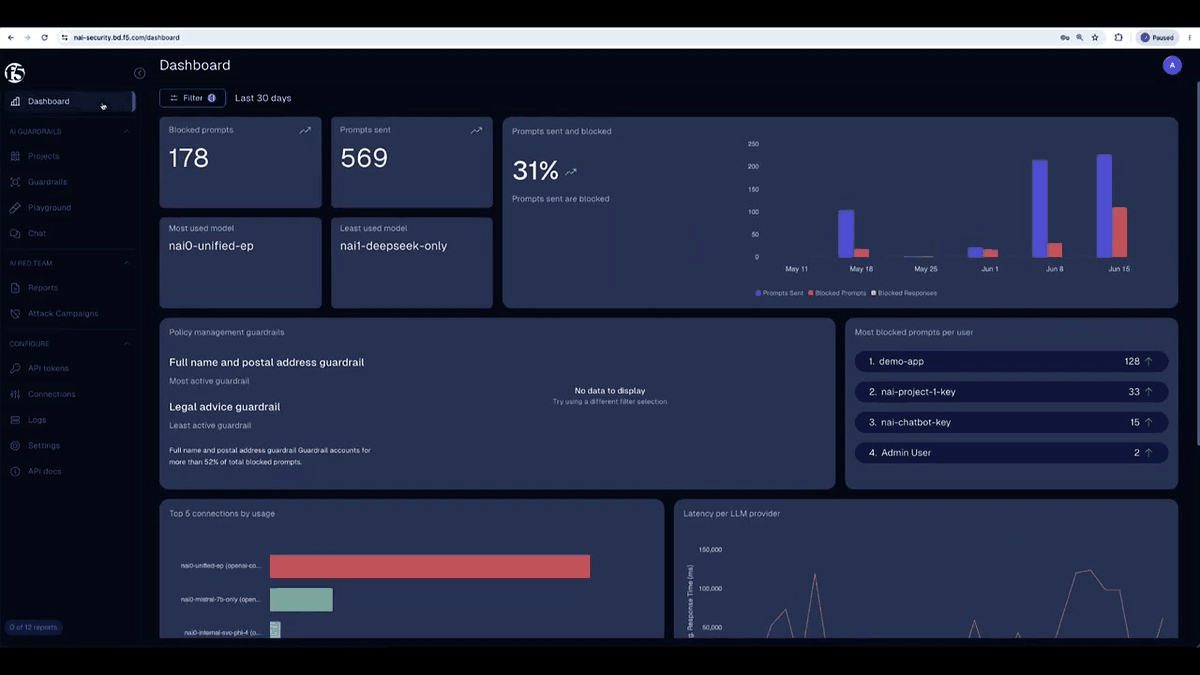
F5 AI Guardrails provides runtime security for deployed AI models and agents, addressing prompt injection, data leakage, harmful outputs, and adversarial attacks. It applies model-agnostic policy enforcement across public and proprietary models and supports deployment in public cloud, private cloud, on-premises, and fully air-gapped environments.
Teams can use expert-built guardrails or create custom guardrails through a natural-language interface, tailored by use case, region, and industry. For agentic systems, the product logs system prompts, instructions, model reasoning, and tool calls, and blocks unauthorized tool calls and agent actions.
Key features include:
- Prompt injection defense: Protects against prompt injection, data exfiltration, and jailbreak attacks using a continuously updated attack library that adds more than 10,000 attack patterns each month.
- Custom guardrail creation: Builds policy-driven guardrails in natural language for specific use cases, regions, and industries.
- Semantic data security: Prevents leakage of standard and custom sensitive data categories during AI interactions, with prebuilt controls for PII, PCI, PHI, and EU AI Act alignment.
- Agent action and tool-call controls: Enforces guardrails on agent actions and tool use to prevent excessive agency and privilege escalation, and audits and blocks unauthorized tool calls.
- Agent visibility: Observes and logs system prompts, instructions, reasoning, and tool calls for single-agent and multi-agent systems.
- Content moderation: Aligns outputs to enterprise definitions of biased, toxic, or harmful content.
- Audit-ready traceability: Explains why each interaction was blocked or allowed and exports metrics and enforcement actions to a dashboard or third-party SIEM.
- Model risk leaderboards: CASI and ARS leaderboards compare the risk profiles of prominent AI models to inform model selection.
| Criterion |
Solution Fit |
Key Considerations |
| Real-time prompt injection and jailbreak prevention |
Runtime detection of prompt injection and jailbreaks, backed by a large monthly-updated attack library. |
Custom guardrails need tuning to balance coverage and false positives. |
| Inline LLM firewall and traffic inspection |
Inspects AI interactions at runtime with model-agnostic enforcement. |
Inline gateway deployment is offered through F5’s separate AI Gateway product. |
| Sensitive data detection and leakage prevention |
Semantic detection of standard and custom data categories, with prebuilt PII, PCI, PHI, and EU AI Act controls. |
Fully private deployments require customer-managed infrastructure. |
| AI agent behavior monitoring and control |
Logs agent reasoning and tool calls and blocks excessive agency and privilege escalation. |
Agent discovery across SaaS platforms is not described on the page. |
| MCP server and tool security |
Audits and blocks unauthorized tool calls for OpenAI, Anthropic, and similarly formatted agents. |
MCP server discovery and server-side protection are not described. |
| LLM API discovery and runtime protection |
Not addressed on the product page. |
F5 offers API security as a separate product. |
Source: F5
8. Check Point AI Agent Security
Best for: Teams embedding runtime guardrails into homegrown agents via API
Strengths: Screens prompts, tool calls, and tool descriptions in 100+ languages
Things to consider: Runtime protection runs through the Guard API, not a network proxy
Check Point AI Agent Security, built on the Lakera acquisition, secures AI agents from discovery to runtime. It discovers agents and MCP-connected tools, assesses each agent’s risk based on its configuration, tools, data access, MCP servers, and autonomy, and enforces access controls and runtime guardrails.
Runtime protection detects and blocks prompt attacks, data leakage, unsafe tool use, and unauthorized agent actions, and it requires no changes to models or prompts. The product observes more than 100 languages and draws on attack data from the Gandalf adversarial game played by more than one million users.
Key features include:
- Agent and MCP discovery: Discovers AI agents and MCP-connected tools across cloud, low-code, and custom environments, including agents that teams did not register.
- Risk assessment: Assesses each agent based on configuration, tools, data access, MCP servers, and level of autonomy.
- Prompt attack protection: Blocks prompt injection, jailbreaks, and adversarial instructions before they reach the model, with sub-50 ms runtime latency.
- Indirect injection defense for connected tools: Blocks indirect injection arriving through MCP-connected tools before agents act on compromised instructions.
- Data and access controls: Detects sensitive data in prompts and responses and enforces access controls on what agents can reach.
- Multilingual coverage: Observes attacks in more than 100 languages in real time.
| Criterion |
Solution Fit |
Key Considerations |
| Real-time prompt injection and jailbreak prevention |
Blocks prompt injection, jailbreaks, and adversarial instructions with sub-50 ms latency. |
Documentation notes the default policy is intentionally strict and may over-flag until tuned. |
| Inline LLM firewall and traffic inspection |
Inspects inputs and outputs on every AI interaction without model or prompt changes. |
Runtime protection integrates through the Guard API; native platform integrations are on the roadmap. |
| Sensitive data detection and leakage prevention |
Detects sensitive data exposure in prompts and responses. |
Data leakage guardrails are configured per project policy. |
| AI agent behavior monitoring and control |
Agent discovery, risk assessment, and runtime blocking of unsafe or unauthorized actions. |
AI Agent Security is documented as an early access release. |
| MCP server and tool security |
Discovers MCP-connected tools and screens tool calls, responses, and descriptions. |
Focus is on agent-side tool use rather than protecting MCP servers you host. |
| LLM API discovery and runtime protection |
Identifies the APIs and systems agents can access. |
Discovery of LLM-powered APIs from traffic is not described. |
9. HiddenLayer AI Security Platform

Best for: Enterprises protecting proprietary models and agentic workflows
Strengths: Agentless runtime security plus model scanning and red teaming
Things to consider: Product page gives limited detail on inline traffic inspection
HiddenLayer AI Security Platform covers the AI lifecycle through four modules: AI Discovery, AI Supply Chain Security, AI Attack Simulation, and AI Runtime Security. The platform is model-agnostic and agentless and requires no training data, so it deploys without exposing model weights, prompts, or customer data.
Runtime capabilities include AI guardrails that enforce policies against prompt injection, data leakage, and unsafe AI behavior, as well as agentic and MCP security for autonomous, tool-using systems. A dedicated Agent Harness Security use case provides runtime visibility, threat detection, and inline enforcement for AI coding agents.
Key features include:
- AI Discovery: Builds a living inventory of AI models and workflows across environments, including shadow AI.
- AI Runtime Security: Detects and responds to AI attacks in production without affecting performance.
- AI guardrails: Enforces policies that prevent prompt injection, data leakage, and unsafe AI behavior in real time.
- Agentic and MCP security: Protects autonomous agents and MCP-based systems from prompt injection, unsafe tool use, and harmful autonomous actions.
- Agent harness security: Provides runtime visibility, threat detection, and inline enforcement for AI coding agents.
- Model scanning and supply chain security: Analyzes models for malware, backdoored weights, vulnerabilities, and unknown components before deployment.
- AI attack simulation: Continuously runs adversarial simulations against AI systems.
- Ecosystem connectors: Integrates with cloud, CI/CD, data platforms, SIEM/SOAR, API gateways, and MLOps tools.
| Criterion |
Solution Fit |
Key Considerations |
| Real-time prompt injection and jailbreak prevention |
AI guardrails prevent prompt injection in real time. |
Jailbreak detection specifics are not detailed on the platform page. |
| Inline LLM firewall and traffic inspection |
Agentless runtime detection; integrates with API gateways. |
Inline enforcement is described mainly for AI coding agents. |
| Sensitive data detection and leakage prevention |
Prevents data leakage and model extraction. |
Data categories and redaction options are not listed on the page. |
| AI agent behavior monitoring and control |
Protects agents from unsafe tool use and harmful autonomous actions. |
Agent behavior analytics depth is not detailed on the page. |
| MCP server and tool security |
Agentic and MCP security use case covers prompt injection and unsafe tool use in MCP systems. |
MCP server discovery and server-side hardening are not described. |
| LLM API discovery and runtime protection |
AI Discovery inventories models and AI workflows, including shadow AI. |
Discovery centers on AI assets rather than API traffic. |
AI Agent Security and Governance Platforms
10. Zenity

Best for: Governing agents across SaaS, cloud, and endpoint platforms
Strengths: Intent-based detection across tool calls, memory, and data use
Things to consider: Agent-centric; not positioned as an inline prompt firewall
Zenity is an AI agent security and governance platform that covers agentic SaaS, personal and coding agents, and cloud and homegrown agents. Its capabilities include AI observability, AI security posture management (AISPM), exposure management, boundaries, agentic identity, MCP security, and AI detection and response (AIDR).
The platform analyzes the full execution path of an agent, including tool calls, memory access, data usage, and control flow, to detect malicious or unintended outcomes even when inputs look harmless. It supports platforms such as Microsoft 365 Copilot, Copilot Studio, Salesforce Agentforce, ServiceNow, ChatGPT Enterprise, Claude Enterprise, Amazon Bedrock, and Google Vertex AI.
Key features include:
- AI observability and inventory: Identifies which agents exist, who owns them, what they can access, and how they behave.
- AISPM and exposure management: Surfaces over-permissioned agents and risky configurations and enforces guardrails before agents reach runtime.
- Boundaries and enforcement: Defines what agents can do, steers them toward appropriate behavior, and stops harmful actions.
- Intent-based detection and response: Correlates configuration, permissions, and runtime behavior to detect threats, mapped to OWASP and MITRE ATLAS.
- MCP security and agentic identity: Includes dedicated capabilities for MCP security and for managing agent identities.
- Multi-environment coverage: Applies consistent governance across SaaS, cloud, and endpoint agents.
| Criterion |
Solution Fit |
Key Considerations |
| Real-time prompt injection and jailbreak prevention |
Detects outcomes of malicious prompts hidden in documents, emails, or web pages through execution path analysis. |
Detects attacks through agent behavior rather than filtering prompts at the edge. |
| Inline LLM firewall and traffic inspection |
Not positioned as an inline LLM firewall. |
Pair with an inline firewall for prompt-level blocking. |
| Sensitive data detection and leakage prevention |
Covers data leakage as a risk type, including over-shared resources and DLP bypass routes. |
Prompt-level PII redaction is not detailed. |
| AI agent behavior monitoring and control |
Observability, posture, boundaries, and intent-based runtime detection across environments. |
Coverage depends on supported agent platforms and integrations. |
| MCP server and tool security |
Dedicated MCP security capability and tool call analysis. |
MCP feature details are not provided on the homepage. |
| LLM API discovery and runtime protection |
Not addressed on the product page. |
Focus is on agents rather than LLM-powered APIs. |
11. Noma Security

Best for: Security teams governing agent behavior and MCP server access
Strengths: Session-aware runtime controls including masking and killswitch
Things to consider: Prompt-level filtering is not detailed on the product page
Noma Security is an agent security and governance platform covering SaaS agents, endpoint AI agents, and cloud agents. Its products include AI-DR for runtime agent behavior, Agent Access Control, AI-SPM for discovering agents, MCP servers, skills, and tools, and AI Red Teaming.
At runtime, Noma weighs each agent action against the full session, who the agent acts for, what data it can reach, and how it normally behaves. It can stop destructive actions, steer the agent, alert a human, mask data, or trigger a killswitch. Its Open Enforcement approach applies policies at the agent control points an organization already runs.
Key features include:
- Agent runtime security (AI-DR): Detects and stops risky agent behavior in real time using session context and behavioral baselines.
- Agent access control: Approves, reviews, or blocks every agent, MCP server, and skill, and scopes actions by user, team, or tool sensitivity.
- AI-SPM and asset discovery: Discovers every agent, MCP server, skill, and tool and surfaces risk.
- MCP security: Secures MCP servers, tools, and connections.
- Agentic identity: Controls what each agent can access and do.
- Open Enforcement: Defines governance once and enforces it at existing agent control points across AI infrastructure.
- AI red teaming and supply chain security: Uses multi-turn attacks to test AI applications and identifies agent supply chain risks and misconfigurations.
| Criterion |
Solution Fit |
Key Considerations |
| Real-time prompt injection and jailbreak prevention |
Detects manipulated agents through runtime behavior; red teaming tests multi-turn attacks. |
Prompt-level injection filtering is not detailed on the product page. |
| Inline LLM firewall and traffic inspection |
Enforces policy through existing agent control points. |
Not positioned as a standalone inline LLM firewall. |
| Sensitive data detection and leakage prevention |
Can mask data during agent sessions. |
Sensitive data categories and detection methods are not listed. |
| AI agent behavior monitoring and control |
Session-aware runtime analysis with stop, steer, alert, mask, and killswitch actions. |
Effectiveness depends on integration with each agent environment. |
| MCP server and tool security |
Discovers and approves or blocks MCP servers, skills, and tools. |
MCP protection focuses on governance and access rather than protocol-level DDoS. |
| LLM API discovery and runtime protection |
AI asset discovery across the organization. |
LLM API traffic discovery is not described. |
12. Lasso

Best for: Teams combining agent discovery, red teaming, and runtime policy
Strengths: Inline enforcement at proxy, API, or AI gateway layer
Things to consider: Prompt-level data leakage controls are not detailed on the homepage
Lasso is an AI security platform that connects discovery, AI risk management, automated red teaming, and runtime protection in a continuous loop. It discovers agents through platform integrations and homegrown applications through CI, and maps models, system prompts, tools, and guardrails into an AI bill of materials.
Runtime enforcement runs inline at the proxy, API, or AI gateway layer. Lasso’s detection and response module uses intent analysis to detect behavioral anomalies and provides full attack context, including which agent was targeted and the impact.
Key features include:
- Discovery and AI-BOM: Inventories every agent and application and maps models, system prompts, tools, and guardrails, updated on every change.
- AI security posture management: Analyzes what agents are exposed to, what actions they can perform, and what sensitive data they can reach, with NIST and OWASP alignment.
- Automated red teaming: Runs a library of more than 3,000 attacks, including multi-turn agentic attacks, context poisoning, and tool chain manipulation, and updates policies through purple teaming.
- Inline runtime enforcement: Enforces policies at the proxy, API, or AI gateway layer with portfolio-wide visibility and built-in remediation guidance.
- AI detection and response: Detects and terminates threats mapped to MITRE and OWASP, with sub-50 ms classification and intent analysis.
- Use-case coverage: Includes dedicated use cases for MCP, prompt injection, AI gateway security, and AI coding assistants.
| Criterion |
Solution Fit |
Key Considerations |
| Real-time prompt injection and jailbreak prevention |
Runtime detection mapped to OWASP, with a prompt injection use case and sub-50 ms classification. |
Detection accuracy figures are self-reported. |
| Inline LLM firewall and traffic inspection |
Inline enforcement at proxy, API, or AI gateway layer. |
Requires routing AI traffic through a supported enforcement point. |
| Sensitive data detection and leakage prevention |
Posture analysis of the sensitive data agents can reach. |
Prompt and response redaction options are not detailed on the homepage. |
| AI agent behavior monitoring and control |
Agent discovery, posture, and intent-based behavioral anomaly detection. |
Agent discovery relies on platform integrations and CI connections. |
| MCP server and tool security |
Dedicated MCP use case; red teaming covers tool chain manipulation. |
MCP-specific runtime controls are not detailed on the homepage. |
| LLM API discovery and runtime protection |
Discovers homegrown AI applications through CI and enforces at the API layer. |
Discovery from live API traffic is not described. |
Selecting the right LLM pipeline security solution requires evaluating your specific architectural needs, deployment models, and primary threat vectors. As AI applications expand to include autonomous agents and extensive integrations, comprehensive coverage from prompt protection to runtime API security is essential. Aligning vendor capabilities with your organization’s governance and technical environment ensures robust defense without compromising operational efficiency.